
The incessant, high-pitched shriek emanating from a high-pressure steam control valve isn’t just an annoyance; it’s a diagnostic signal. This aerodynamic noise calculation for valves goes beyond mere audibility, hinting at destructive forces within your system—from supersonic flow control valve conditions to imminent valve vibration metal fatigue. Meeting OSHA valve noise standards requires more than just hearing protection; it demands a deep understanding of the physics driving this sonic assault.
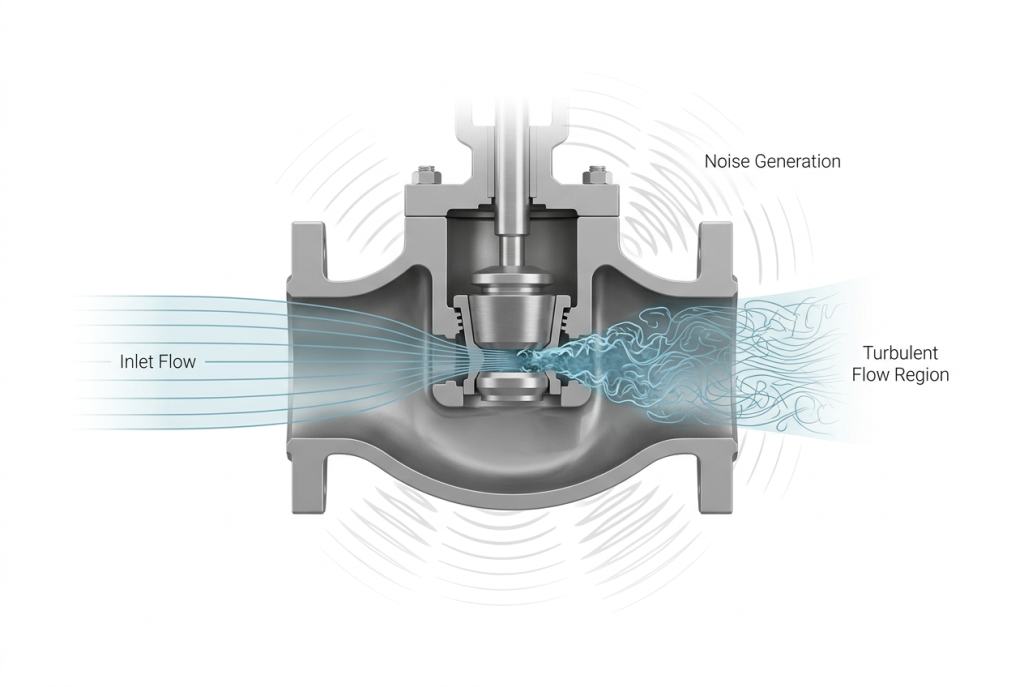
Understanding Aerodynamic Noise Generation in Control Valves
Aerodynamic noise in high-pressure steam control valves stems from two primary phenomena: turbulence generation and supersonic flow. As steam passes through the restricted area of a partially open valve, its velocity increases dramatically. If the pressure drop across the valve is severe enough, the velocity can reach or exceed the speed of sound, creating unstable flow conditions.
The Role of Supersonic Flow and Pressure Recovery
When steam accelerates to supersonic flow within the valve, shock waves form. These shock waves, coupled with intense turbulence generated at high velocities, are efficient producers of sound energy. Downstream of the valve, as the flow expands and decelerates, a phenomenon called pressure recovery can occur, where kinetic energy is converted back into static pressure. If this recovery is too abrupt, it exacerbates noise generation.
Acoustic Power Output (Lp) Rule of Thumb
For a quick estimation, every 10 dB increase in noise level represents a tenfold increase in acoustic power. Thus, a valve emitting 110 dB is 100 times more powerful acoustically than one at 90 dB, underscoring the critical need for decibel reduction strategies.
IEC 60534-8-3: The Standard for Valve Noise Prediction
To accurately predict and mitigate noise, engineers rely on internationally recognized standards. The IEC 60534-8-3 standard provides a detailed methodology for predicting the aerodynamic noise generated by control valves handling compressible fluids, like steam.
Simplified Overview of the IEC Calculation
The standard considers several factors to determine the predicted sound power level (Lw) and then converts it to sound pressure level (Lp) at a specific distance:
- Flow Parameters: Inlet/outlet pressure, temperature, mass flow rate, fluid properties.
- Valve Characteristics: Flow coefficient (Cv), pressure recovery factor (FL), and specific trim geometry.
- Piping Effects: Downstream piping length, thickness, and acoustic characteristics.
- Correction Factors: Account for pipe attenuation, valve size, and sound-absorbing materials.
While the full calculation is complex, the core idea is to quantify the mechanical and aerodynamic energy converted into sound. It’s crucial to use software tools that implement these standards for accurate predictions.
Multi-Stage Trim Technology for Noise Abatement
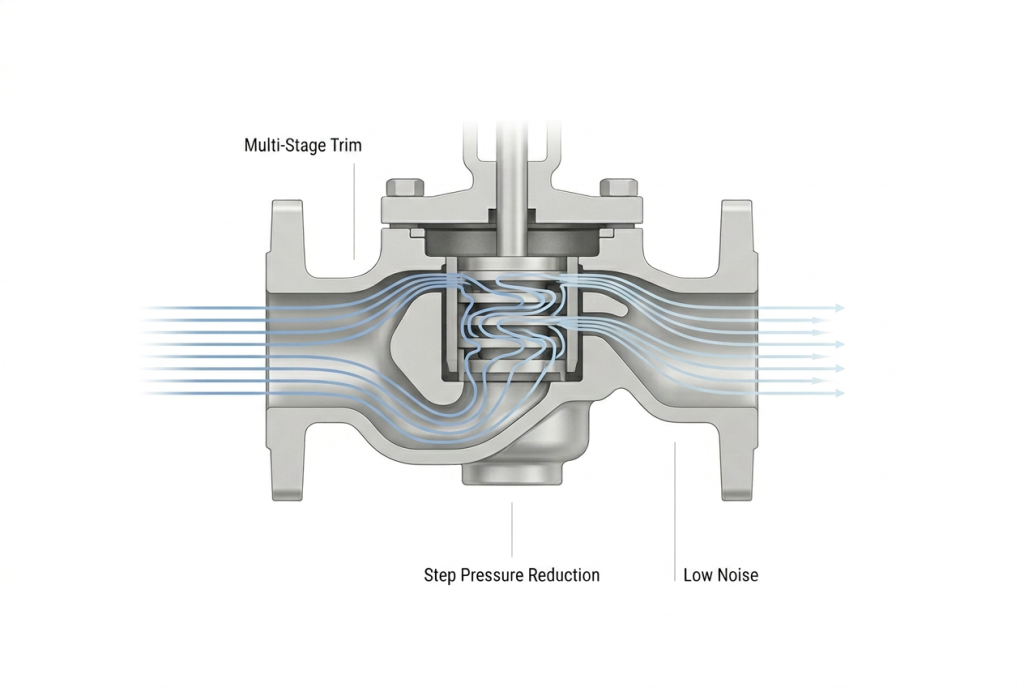
The most effective strategy for control valve noise reduction technology, particularly for high-pressure steam, is the implementation of multi-stage “path-tortuous” trims. These specialized trims are designed to break down a large, single pressure drop into several smaller, manageable steps.
How “Path-Tortuous” Designs Break Up Pressure Drops
Instead of allowing steam to accelerate rapidly to supersonic velocities at a single point, multi-stage trim noise reduction forces the flow through an intricate series of progressively larger restrictions. Each stage provides a controlled pressure reduction, preventing the steam from reaching critical (supersonic) velocity, thereby mitigating the primary source of aerodynamic noise.
| Trim Type | Pressure Drop Reduction | Noise Reduction (dB) | Benefit |
|---|---|---|---|
| Single-Stage | Abrupt | 0-5 dB | Basic throttling |
| Two-Stage | Modéré | 5-15 dB | Improved for moderate dp |
| Multi-Stage (e.g., 5+) | Gradual, path-tortuous | 15-30+ dB | Excellent for severe service, meeting OSHA valve noise standards |
Beyond Audibility: Noise as a Structural Threat
While meeting OSHA valve noise standards protects personnel, the deeper threat of excessive aerodynamic noise is its ability to induce valve vibration metal fatigue. Acoustic energy at specific frequencies can excite the natural frequencies of valve components, leading to destructive oscillation.
When Noise Becomes Vibration Fatigue
If a valve is allowed to operate in a high-noise, high-vibration environment for prolonged periods, the acoustic energy translates into mechanical stress. This can cause:stem failures, trim loosening, packing leaks, actuator damage, and even body cracking. Standard earplugs are designed to protect hearing, but they do nothing to mitigate the physical damage occurring within the valve itself.
The continuous, high-frequency vibration induced by uncontrolled aerodynamic noise accelerates material fatigue, making the valve prone to sudden, unexpected failure—a “silent killer” that undermines system reliability.
Conclusion: Engineering Silence for System Integrity
The proper calculation and mitigation of aerodynamic noise in high-pressure steam control valves is a critical engineering task, extending far beyond simple sound reduction. By understanding the physics of supersonic flow and applying technologies like multi-stage “path-tortuous” trims, engineers can effectively meet OSHA valve noise standards and, more importantly, prevent the insidious onset of valve vibration metal fatigue.
BCST Valve specializes in designing and manufacturing high-pressure control valves with advanced noise abatement capabilities. Our engineering team leverages cutting-edge tools and a deep understanding of IEC 60534-8-3 to provide solutions that ensure safe, reliable, and quiet operation for your most demanding steam applications.
Need a Quiet Solution for Your High-Pressure Steam System?
Contact BCST Valve for expert consultation on control valve noise reduction technology and custom trim designs.


 English
 Arabic
 Russian
 French
 Spanish