
A high-pressure shut-off valve can pass a routine leakage check and still be the wrong choice for hydrogen service. The reason is simple: hydrogen is unforgiving. Its small molecular size, demanding sealing requirements, and compatibility concerns mean that engineers must evaluate how the valve is tested, not just whether the valve closes.
Quick answer: Bubble testing can identify obvious leaks, but it is often too limited for demanding hydrogen applications. Helium leak testing is widely preferred when engineers need higher sensitivity and better confidence that a high-pressure shut-off valve is suitable for severe gas isolation service.
Why leak testing matters more in hydrogen service
In many industrial systems, “tight shutoff” is treated as a general valve feature. In hydrogen service, that mindset is risky. Hydrogen behaves differently from heavier gases, and even very small leakage paths can become serious performance or safety concerns. Engineers are not only buying a valve body, seat, and stem. They are buying confidence that the valve will isolate under real process conditions.
That is why testing method matters. A basic shop-floor check may be acceptable for utility service, but a hydrogen shut-off valve used in a high-pressure system often needs a more sensitive and more meaningful leak verification method. This is especially true when the process involves repeated cycling, demanding shut-off criteria, or critical downstream equipment.
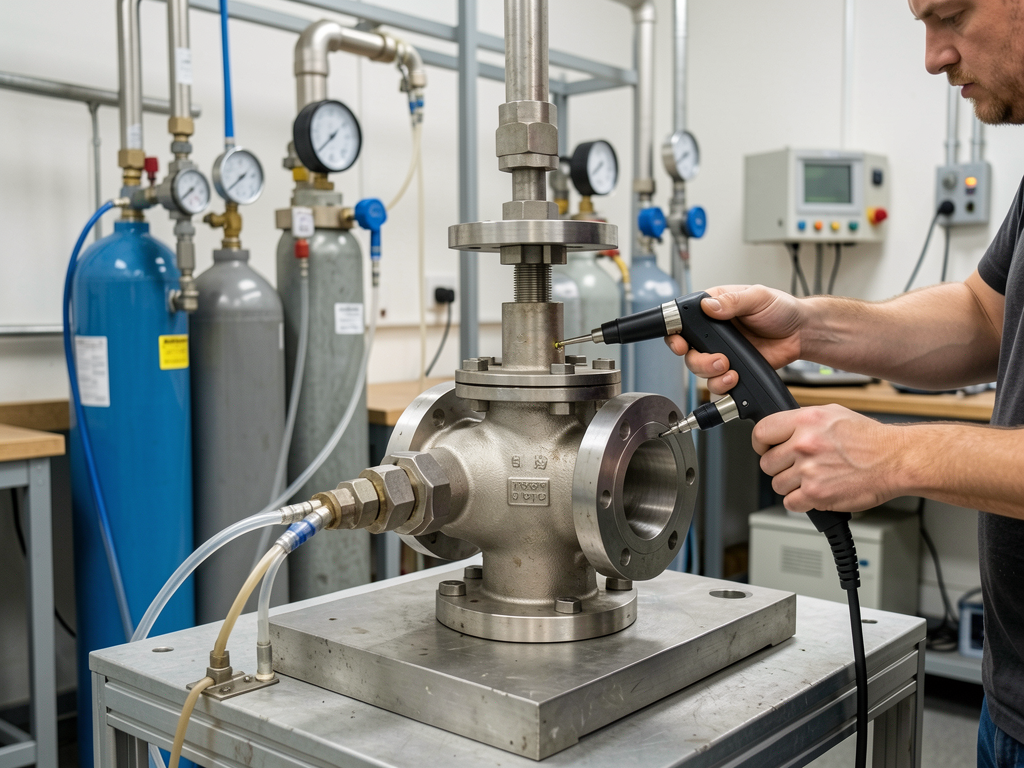
What is bubble testing?
Bubble testing is a simple leakage detection method in which pressurized gas is applied to the valve and escaping gas is observed through bubble formation, typically using a liquid medium. It is practical, familiar, and low-cost. For many general industrial checks, it helps confirm whether a valve has an obvious leak path.
The strength of bubble testing is its simplicity. The weakness is also its simplicity. It is not the best tool when the application demands very high sensitivity, very low allowable leakage, or a gas service where microscopic leakage paths matter.
In other words, bubble testing may tell you that a valve is not grossly leaking. It does not always provide the level of assurance needed for critical hydrogen isolation.
What is helium leak testing?
Helium leak testing uses helium as a tracer gas to detect very small leakage paths with greater sensitivity than visual bubble methods. Helium is widely used because it is inert, stable, and easier to detect accurately in controlled leak testing procedures. In engineering practice, it is often used as a proxy gas when evaluating valves intended for hydrogen service.
The practical value is clear: if an engineer needs stronger evidence that a valve can support low-leakage high-pressure gas isolation, helium testing offers a more rigorous route than a basic visual test. It helps move the discussion away from “it seemed sealed” toward “it met a defined detection threshold under a controlled method.”
Helium leak testing vs. bubble testing: what is the real difference?
| Facteur | Bubble Testing | Helium Leak Testing |
|---|---|---|
| Detection sensitivity | Plus bas | Plus élevé |
| Typical use | General leakage screening | Critical or severe gas verification |
| Visual simplicity | Simple and direct | More controlled and technical |
| Suitability for hydrogen-related evaluation | Limited for critical service | Better aligned with demanding requirements |
| Confidence in very low leakage applications | Plus bas | Plus élevé |
The real difference is not that one method is always “good” and the other is always “bad.” The difference is whether the test method matches the engineering risk. For utility service, bubble testing may be fine. For hydrogen isolation, it may be too blunt an instrument.
Why helium is used as a proxy for hydrogen
Engineers use helium in leak testing because it behaves as a practical tracer gas for finding very small leakage paths while being easier to handle in a controlled testing setup. For severe service shut-off valves, the goal is not merely to prove that the valve closes mechanically. The goal is to determine whether the sealing system can withstand a service condition where even small leakage paths matter.
This becomes more important when the valve is part of a high-value system, such as hydrogen process lines, test skids, energy equipment, or instrumentation packages. In these applications, the cost of a better factory acceptance test is small compared with the cost of field leakage, troubleshooting, downtime, and replacement.
Testing alone is not enough: material selection still matters
A valve can pass a sensitive leakage test and still be a poor long-term choice if the body alloy, trim, or sealing materials do not suit hydrogen duty. In hydrogen service, material selection is not a secondary specification item. It is part of the shut-off reliability equation.
That is why engineers should review body material, nickel content where relevant, seat design, sealing element performance, and service temperature range along with the test report. BCST Valve’s stainless steel valve solutions are relevant here because material choice directly affects service life and severe-gas suitability. Testing confirms present leakage performance. Material selection supports future leakage performance.
What engineers should ask before specifying a hydrogen shut-off valve
- What leakage standard or acceptance criteria applies to this service?
- Was the valve checked only by bubble testing, or was a helium leak test performed?
- Are the body and trim materials suitable for hydrogen service?
- What seat and seal materials are used, and how do they behave under cycling?
- Will the valve also face rapid decompression or thermal shock during operation?
- Does the application require a new installation or a retrofit into an existing skid footprint?
That last two questions matter more than many buyers expect. If the valve also sees sudden pressure changes, you should review our article on the Joule-Thomson effect and rapid gas decompression in shut-off valves. If the job involves replacing an older unit in a packed skid, our guide to retrofit high-pressure shut-off valves in legacy skid explains how to avoid expensive piping rework.
When bubble testing may still be acceptable
Bubble testing still has a role. It can be useful for routine screening, maintenance checks, and less demanding industrial services where the required sensitivity is lower and the consequences of minor leakage are limited. The mistake is not using bubble testing. The mistake is assuming it provides the same engineering confidence as a more sensitive leak testing method in a critical hydrogen application.
For that reason, valve buyers should match the test method to the process risk rather than defaulting to the cheapest verification method available.
FAQ
Is helium leak testing better than bubble testing for hydrogen valves?
For critical hydrogen service, helium leak testing is generally the more appropriate method because it offers higher sensitivity and better confidence in low-leakage applications.
Can a valve pass bubble testing and still be risky in hydrogen service?
Yes. A valve may pass a simple bubble test yet still fall short of the performance confidence needed for severe gas isolation duty.
Does leak testing replace material review?
No. Leak testing and material selection work together. A sensitive test confirms current shut-off performance, while good material selection helps preserve that performance in service.
Need a shut-off valve for hydrogen or severe gas service?
Send BCST Valve your media type, pressure class, connection type, and leakage requirement. We can help review suitable valve options for high-pressure shut-off duty.


 English
 Arabic
 Russian
 French
 Spanish