
Choosing the wrong flue gas damper can compromise plant safety and operational efficiency. This decision impacts energy costs, environmental compliance, and the reliability of your entire process, leading to costly downtime.
To select a flue gas damper, first define all process conditions, including temperature, pressure, and gas composition. Next, determine the required level of isolation, match the damper type to the application, and finally, specify the correct materials of construction and actuator for long-term reliability.

This guide breaks down the selection process into clear, manageable steps. By following this structured approach, you can confidently choose a damper that meets your project’s technical requirements, ensuring both safety and performance while managing life cycle costs effectively. Let’s begin the process of how to select a flue gas damper.
Define the Process Conditions First
Inaccurate process data is a common cause of premature damper failure. Your selection’s success depends on the quality of the initial information you provide, as it forms the basis for all engineering decisions.
Provide the manufacturer with the complete range of operating temperatures, system pressures, and a detailed gas analysis. This ensures the damper is mechanically and chemically compatible with your environment, preventing failures from corrosion, heat, or pressure.
The core of your specification lies in three areas: temperature, pressure, and gas composition. Overlooking even minor details here can have major consequences. For example, a damper rated for normal operating temperatures may warp and fail during a predictable, but unstated, process upset condition where temperatures spike for a short period.
Temperature and Pressure Ranges
You must define the full spectrum of temperatures the damper will experience. This includes normal operating temperature, minimum ambient temperature, and maximum design or excursion temperatures. High temperatures reduce the yield strength of metals and can destroy non-metallic seals. The design must also account for thermal expansion to ensure the damper blade does not bind within the frame as it heats up, which is a common failure mode.
Pressure specifications are equally critical. You must state the system’s normal operating pressure and, more importantly, the maximum differential pressure across the damper when it is in the closed position. The damper frame, blade, and actuator must be designed to withstand this load without excessive deflection that could compromise sealing or cause permanent damage.
Gas Composition and Particulates
The chemical makeup of the flue gas determines the material selection. You must identify all corrosive components, such as sulfur oxides (SOx), chlorides, and moisture content. The combination of these elements, especially with temperature, dictates the rate of corrosion. For instance, the presence of moisture can lead to the formation of sulfuric acid below the acid dew point, which is highly aggressive to many metals.
You must also quantify any solid particulates, like ash or dust, in the gas stream. A high dust load can cause severe erosion on damper components, particularly on blade edges and seals. Particulate can also accumulate in the damper frame or on seals, preventing the damper from closing properly. In such cases, special design features like abrasion-resistant materials or self-cleaning seals may be necessary.
Match Damper Type to Application Needs
Using the wrong type of damper for the job is a frequent mistake. The damper’s design must align with its primary function, whether that is flow control, simple shut-off, or man-safe isolation.
Choose between a louver, butterfly, or guillotine damper based on your primary requirement. Louver dampers are best for modulation, while guillotine dampers provide the tightest isolation. Butterfly dampers offer a balance between the two.
Each damper type has a distinct set of strengths and weaknesses. Understanding this trade-off is essential for a cost-effective and functional solution. A complex, zero-leakage damper is unnecessary for a simple flow-balancing task where a basic louver damper would suffice. Let’s compare the most common designs.
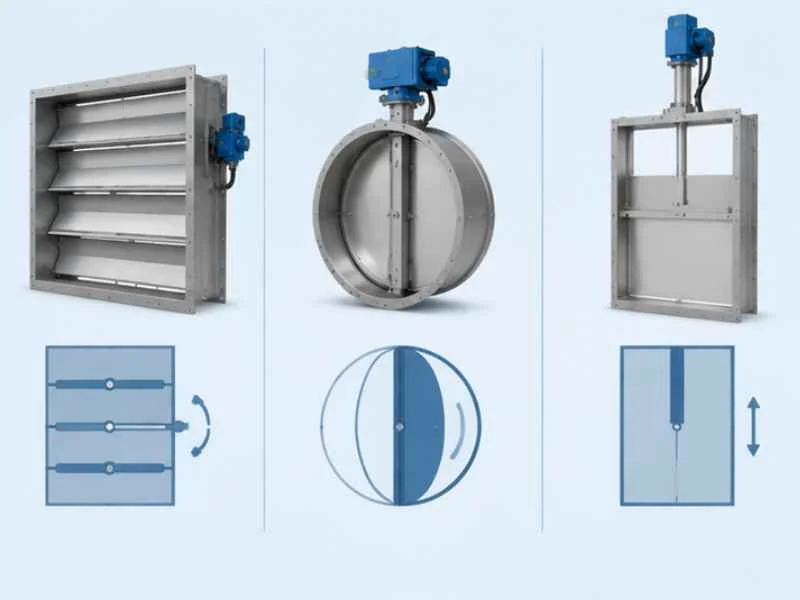
Common Damper Designs
Your choice of damper style will have the biggest impact on performance and cost.
- Louver Dampers: These dampers use one or more blades that rotate to open or close the duct. They are the most common choice for throttling or modulating gas flow. While cost-effective, their multiple leak paths around each blade make achieving a tight seal challenging without special features.
- Butterfly Dampers: A single, circular, or rectangular blade pivots in the center of the duct. They offer good control characteristics and can provide better shut-off than a standard louver damper. They are common in round ducts and are used for both on/off and control applications.
- Guillotine Dampers: Also known as slide gate dampers, these feature a flat plate that slides across the duct to block flow. They are strictly for on/off isolation and cannot be used for modulation. However, they provide the best possible shut-off, making them the standard choice for applications requiring safe maintenance access.
The following table summarizes the key characteristics:
| Damper Type | Fonction principale | Sealing Capability | Suitability for Modulation |
|---|---|---|---|
| Louver | Flow Control (Modulation) | Fair | Excellent |
| Papillon | On/Off or Control | Bon | Bon |
| Guillotine | Isolation (On/Off) | Excellent to Zero-Leak | Not Suitable |
Specify Sealing Performance and Materials
The damper’s useful life and performance depend heavily on its seals and materials. An incorrect material will fail quickly due to heat or corrosion, while an inadequate seal will fail to meet process requirements.
Select the seal type based on the required leakage rate for your application. Then, choose materials of construction that can withstand the maximum temperature and corrosive elements present in the flue gas.
Early in my career, I visited a client’s site where a flue gas damper was failing after only a few months. The issue was severe corrosion on the damper blade. The original specification called for standard stainless steel, but it did not account for the high chloride content in their specific process. It was a valuable lesson in the importance of a complete chemical analysis. The right material choice is not just about temperature; it’s about the entire chemical environment.
Sealing Systems and Leakage Rates
Damper leakage is the amount of gas that passes through when it is fully closed. The acceptable leakage rate varies by application. For flow balancing, a leakage rate of 1-5% might be acceptable. For critical isolation where personnel safety is a concern, the requirement is often zero leakage.
To achieve low leakage, various seal designs are used, from simple metal-on-metal seals to more effective flexible metallic seals that conform to the sealing surface.
For the most demanding applications requiring 100% shut-off, a seal air system is employed. This system uses a fan to pressurize the space around the damper blade seals with clean air. This air pressure is higher than the duct pressure, creating an air barrier that prevents any flue gas from leaking out.
Sélection des matériaux pour la durabilité
Choosing the correct materials is essential for the damper’s structural integrity and lifespan.
- Carbon Steel (e.g., A36): A cost-effective choice for low-temperature (below 400°C) and non-corrosive service.
- Corten Steel: Offers improved atmospheric corrosion resistance over carbon steel at a modest cost increase.
- Stainless Steel (e.g., 304, 316L, 310S): Provides good resistance to corrosion and maintains strength at higher temperatures. Grade 310S is often used for its superior high-temperature strength.
- High-Nickel Alloys (e.g., Inconel, Hastelloy): Reserved for the most severe applications with extreme heat and/or highly aggressive corrosive agents. These are premium materials for critical service.
The final material selection must be made by a qualified engineer who can review the complete process data.
Select the Right Actuator for the Job
A damper is only as good as the actuator that drives it. The actuator must be powerful enough to operate the damper reliably under all conditions without failing.
Choose an actuator that delivers sufficient torque, operates on your available power source, provides the correct control signal, and has the proper fail-safe action to ensure plant safety.
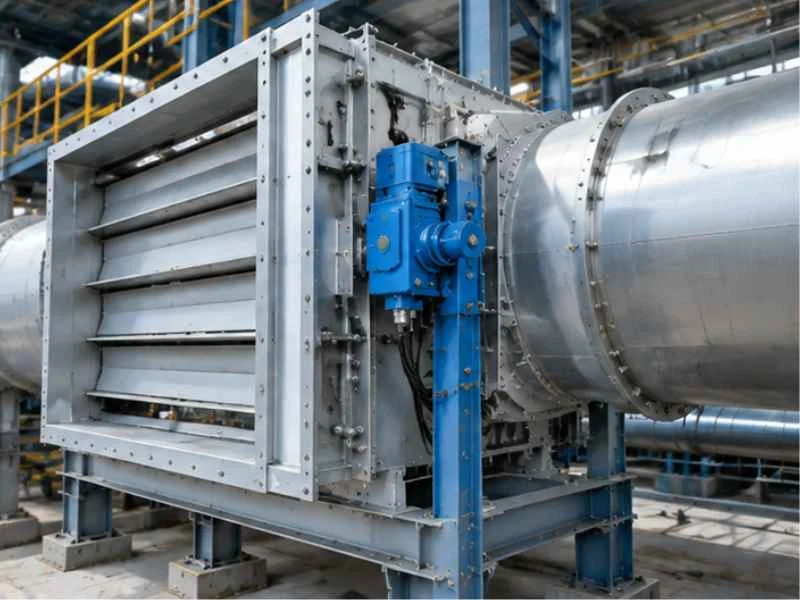
The actuator is the muscle of the damper assembly. Sizing it correctly is not a guessing game; it requires a calculation based on specific forces. The main force an actuator must overcome is the dynamic torque created by the gas flow and pressure acting on the damper blade. Friction in the bearings and seals also adds to the required force. An undersized actuator will fail to close the damper fully, while a grossly oversized one is an unnecessary expense and can even damage the damper’s linkage.
Actuator Power and Control
You must first decide on the power source, which is typically what is available and standard at your plant. Common options are pneumatic (compressed air), electric, and hydraulic.
Next, define the control type. For simple open/close functions, an on/off actuator is sufficient. For flow control, you need a modulating actuator that can position the damper blade anywhere between fully open and fully closed in response to a control signal (e.g., 4-20 mA).
The Critical Fail-Safe Position
Perhaps the most important consideration is the fail-safe action. You must decide what the damper should do in the event of a power failure.
- Fail-Open: The damper opens automatically when power is lost.
- Fail-Close: The damper closes automatically when power is lost.
- Fail-in-Place: The damper remains in its last position when power is lost.
This decision is critical for safety. For example, a damper on an emergency generator exhaust must fail open to prevent back-pressure from damaging the engine. Conversely, a damper supplying fuel gas might need to fail close.
Questions fréquemment posées
Q1: What is the primary function of a Flue Gas Damper?
A: A Flue Gas Damper’s main job is to control or isolate the flow of hot gases in a duct system. This is done either to regulate a process (modulation), like furnace temperature, or to completely block the duct for safe maintenance on downstream equipment like scrubbers or fans.
Q2: How does temperature affect Flue Gas Damper selection?
A: Temperature is a critical factor. It dictates the material selection, as high heat weakens metals and can destroy seals. It also causes thermal expansion, which must be managed in the design to prevent the blade from jamming. You must specify both normal and maximum temperatures for a reliable damper.
Q3: What are common reasons a Flue Gas Damper might leak?
A: Leakage often occurs due to worn or damaged seals, blade warping from high temperatures, or particulate buildup that prevents the damper from closing fully. Using the wrong damper type for an isolation duty, such as a standard louver damper, is also a common cause of poor sealing performance.
Q4: When is a guillotine type Flue Gas Damper the best choice?
A: A guillotine damper is the best choice when you need excellent, near-zero leakage for on/off isolation. It is the industry standard for applications that require a safe environment for personnel to perform maintenance on equipment downstream of the damper. It is not suitable for flow control.
Q5: What is a seal air system for a Flue Gas Damper?
A: A seal air system is a feature used to achieve 100% isolation. It uses a fan to blow clean air into a channel between two sets of seals around the damper blade. This air is at a higher pressure than the duct gas, creating an air barrier that prevents any flue gas from leaking past the closed damper.
Q6: How do I choose the correct actuator for my Flue Gas Damper?
A: To choose the right actuator, you must first calculate the torque needed to move the damper under maximum pressure and flow. Then, specify the power source (electric, pneumatic), the control type (on/off or modulating), and the crucial fail-safe position (fail-open, fail-close, or fail-in-place) based on your process safety requirements.
Dernière réflexion
The key to a successful outcome on how to select a flue gas damper is a methodical process. By thoroughly defining your conditions, matching the damper type to the function, and correctly specifying materials and actuation, you build safety and reliability directly into your plant’s design from the start.
BCST has extensive experience engineering damper solutions for demanding industrial services. If you require assistance in specifying the correct flue gas damper for your project, contact us today for expert guidance.


 English
 Arabic
 Russian
 French
 Spanish