
Automatic Pipeline Filtration
Self-Cleaning Filter Manufacturer
BCST manufactures automatic self-cleaning filters for continuous removal of suspended solids from industrial water and process pipelines. The filter cleans its screen without dismantling the housing, helping plants reduce manual maintenance, minimize wastewater and maintain stable downstream flow.
- Automatic cleaning without removing the filter element
- Continuous or minimally interrupted process flow
- Pressure differential, timer or manual cleaning control
- Filtration ratings and materials selected for the application
- Engineered connections, controls and discharge arrangements
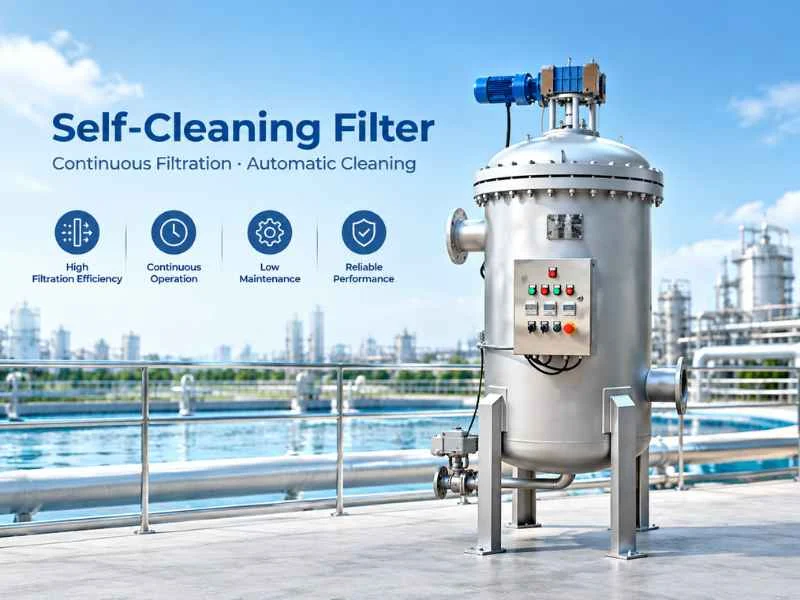
Continuous Filtration
Maintain process flow while accumulated solids are discharged automatically.
Lower Maintenance
Reduce manual screen cleaning and unnecessary pipeline shutdowns.
Flexible Control
Use differential pressure, timed cycles or manual initiation.
Application Engineered
Configure the filter for the fluid, solids load and operating conditions.
Product Range
Self-Cleaning Filter Solutions
Select the cleaning mechanism according to particle characteristics, filtration accuracy, process continuity and available discharge conditions.
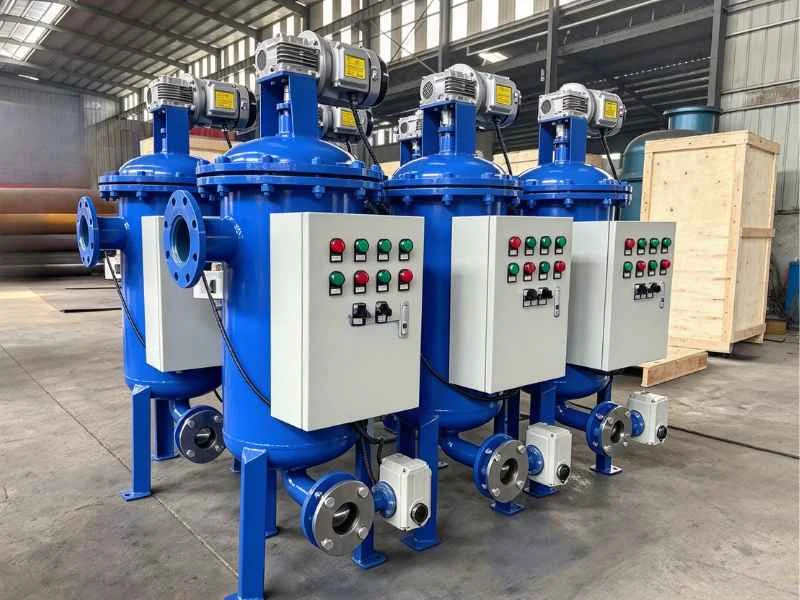
Brush Self-Cleaning Filter
An internal brush removes retained contaminants from the screen and directs them toward the drain outlet.
- Suitable for particles that can be brushed from the screen
- Low cleaning-water consumption
- Automatic or manual operating options
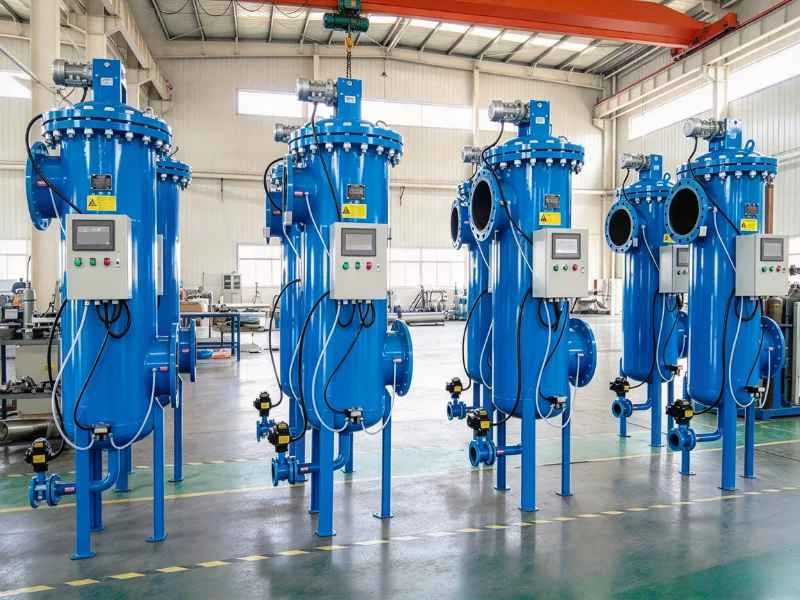
Suction Scanner Filter
Focused suction nozzles travel across the screen surface and remove collected solids while filtration continues.
- Continuous-flow applications
- Efficient screen-surface cleaning
- Suitable for high-capacity water systems
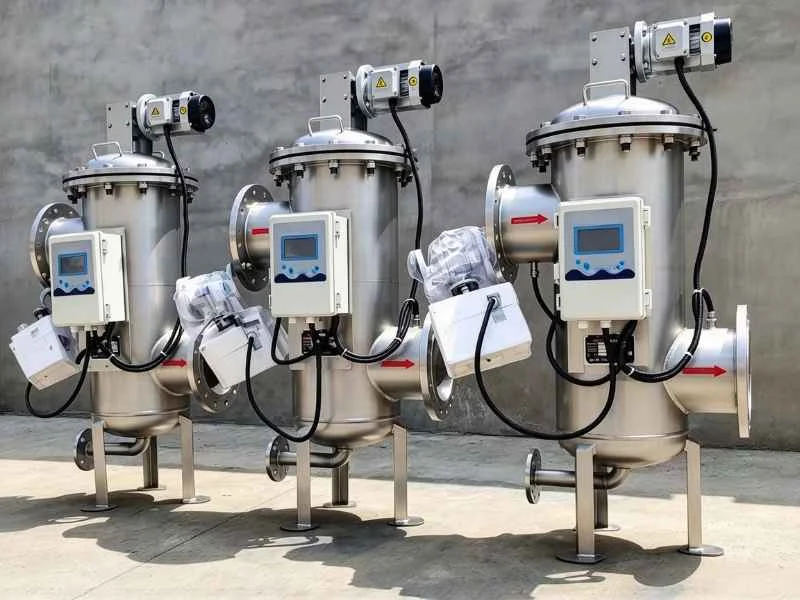
Automatic Backwash Filter
Filtered fluid reverses through the element to dislodge accumulated solids and discharge them through the drain.
- High solids-loading capability
- Automated backwashing cycle
- Multiple element configurations available
Product Comparison
Choose the Appropriate Cleaning Method
| Filter Type | Cleaning Method | Best Suited For | Process Flow | Principaux éléments à prendre en compte |
|---|---|---|---|---|
| Brush self-cleaning filter | Rotating or driven internal brush | Brush-removable particles and moderate solids loads | Normally maintained during cleaning | Particle adhesion and screen compatibility |
| Suction scanner filter | Localized suction across screen surface | Cooling water, irrigation and process-water systems | Continuous filtration | Minimum operating and discharge pressure |
| Automatic backwash filter | Reverse flow through filter element | Higher flow rates and variable solids loads | Continuous or minimally interrupted | Backwash flow and drain capacity |
| Manual brush filter | Hand-operated brush mechanism | Smaller systems with simple maintenance requirements | Application dependent | Operator access and cleaning frequency |
Operating Principle
How a Self-Cleaning Filter Works
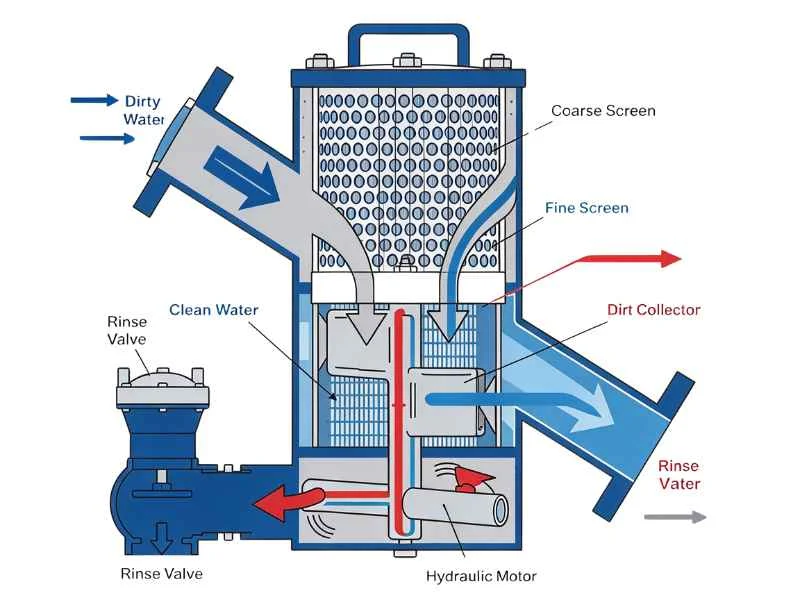
- Filtration: Process fluid enters the housing and passes through the screen, which retains suspended solids.
- Loading: Accumulated contaminants gradually increase the differential pressure across the screen.
- Cleaning signal: A differential-pressure switch, timer or operator initiates the cleaning cycle.
- Screen cleaning: The brush, suction scanner or backwash mechanism removes retained solids.
- Discharge: Separated contaminants leave through the drain or flushing valve.
- Return to monitoring: The controller resets and continues monitoring the next cleaning cycle.
Stable Differential Pressure
Automatic cleaning helps control pressure loss as solids accumulate.
Reduced Manual Handling
Operators do not need to open the housing for every cleaning cycle.
Controlled Solids Discharge
Cleaning waste is directed to the specified drain or recovery system.
Engineering Data
Configurable Technical Options
Final values depend on the selected model, operating conditions and project specification.
| Paramètres | Available Engineering Options | Selection Basis |
|---|---|---|
| Nominal size | Selected to suit required flow and allowable velocity | Flow rate, pipe size and pressure-drop limit |
| Filtration rating | Coarse to fine screen options, model dependent | Smallest harmful particle and downstream equipment |
| Design pressure | Engineered pressure classes | Maximum operating and design pressure |
| Température de fonctionnement | Material- and seal-dependent range | Normal, minimum and maximum fluid temperature |
| Housing material | Carbon steel, stainless steel or project-specified alloy | Fluid compatibility, corrosion allowance and environment |
| Screen material | Stainless steel and engineered alternatives | Corrosion resistance, strength and cleaning method |
| Connexion | Flanged or project-specific connection | Piping standard, pressure class and installation layout |
| Cleaning control | Differential pressure, timer, manual command or combined logic | Solids variability and plant control philosophy |
| Actionnement | Electric, pneumatic or hydraulic options where applicable | Utility availability and hazardous-area requirements |
| Power supply | Matched to the project electrical specification | Site voltage, frequency and enclosure requirements |
Customer Priorities
What Must Be Confirmed Before Selection?
Process Conditions
- Fluid name, composition and viscosity
- Normal, minimum and maximum flow rate
- Operating and design pressure
- Operating and design temperature
- Available pressure for cleaning and discharge
- Allowable clean and dirty pressure drop
Contaminant Conditions
- Required filtration rating
- Particle type, shape and hardness
- Typical and maximum solids concentration
- Sticky, fibrous or deformable contaminants
- Expected variation in solids loading
- Acceptable cleaning-waste volume
Screen & Materials
Materials Selected for the Process
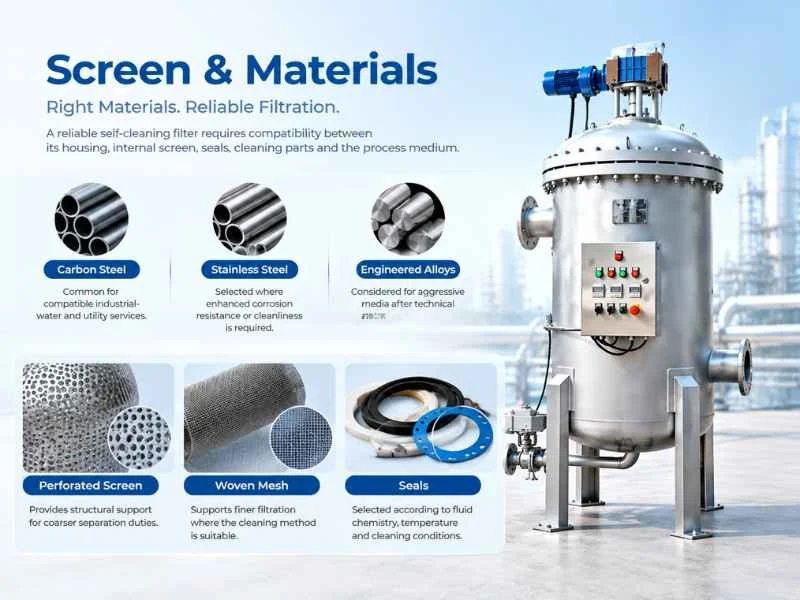
A reliable self-cleaning filter requires compatibility between its housing, internal screen, seals, cleaning parts and the process medium.
- Carbon steel: Common for compatible industrial-water and utility services.
- Acier inoxydable : Selected where enhanced corrosion resistance or cleanliness is required.
- Engineered alloys: Considered for aggressive media after technical review.
- Perforated screen: Provides structural support for coarser separation duties.
- Woven mesh: Supports finer filtration where the cleaning method is suitable.
- Seals: Selected according to fluid chemistry, temperature and cleaning conditions.
Application Matrix
Typical Industrial Applications
| Industry or System | Typical Contaminants | Downstream Equipment Protected | Selection Priority |
|---|---|---|---|
| Cooling-water systems | Rust, scale, sand and biological debris | Heat exchangers, spray nozzles and cooling circuits | Continuous flow and controlled pressure drop |
| Process-water systems | Suspended solids and pipeline debris | Pumps, valves, meters and process equipment | Material compatibility and filtration accuracy |
| Production d'électricité | Scale, corrosion products and suspended matter | Cooling equipment and auxiliary systems | Reliability and automation |
| Exploitation minière et traitement des minerais | Sand, grit and mineral particles | Nozzles, pumps and water circuits | Abrasion resistance and solids capacity |
| Traitement chimique | Process solids and corrosion products | Reactors, exchangers and control equipment | Chemical compatibility and safe drainage |
| Traitement de l'eau | Sediment, organic matter and suspended solids | Membranes, nozzles and downstream treatment units | Screen rating and cleaning efficiency |
| Irrigation and reuse water | Sand, algae and organic debris | Emitters, sprinklers and distribution piping | Low maintenance and economical flushing |
Manufacturer Support
From Process Data to Filter Configuration
1. Process Review
We review the fluid, flow range, solids characteristics, pressure, temperature and operating objectives.
2. Hydraulic Selection
The filter size and screen area are evaluated against velocity and allowable pressure drop.
3. Cleaning Design
The cleaning method, trigger logic, drain arrangement and actuation are configured for the system.
4. Documentation
Required drawings, technical data and inspection documents are prepared for the approved order scope.
Quality Control
Inspection Before Delivery
Inspection and testing are defined by the approved specification, selected model and purchase-order requirements.
- Material and component verification
- Dimensional and visual inspection
- Pressure testing where required
- Screen and internal assembly inspection
- Cleaning-mechanism operational check
- Control-panel and instrument function check
- Coating, marking and packing inspection
- Project documentation review
Installation & Operation
Plan for Reliable Long-Term Performance
Installation
- Follow the marked flow direction
- Provide adequate service clearance
- Support connected piping independently
- Connect the drain to a suitable disposal point
- Install isolation and bypass valves where required
Commissioning
- Flush major construction debris before operation
- Verify the control and actuation sequence
- Confirm differential-pressure settings
- Check drain capacity during a cleaning cycle
- Record clean-filter operating pressure
Maintenance
- Inspect the screen at planned intervals
- Monitor cleaning frequency for process changes
- Check seals, drive parts and drain valves
- Investigate unusual pressure-drop increases
- Keep recommended service parts available
Send Us Your Filtration Data
Provide the medium, flow rate, operating pressure, temperature, particle characteristics, required filtration rating and connection standard. Our engineers will help configure a suitable self-cleaning filter.
Questions fréquemment posées
Self-Cleaning Filter FAQ
Does a self-cleaning filter stop the process during cleaning?
Many designs continue filtering during the cleaning cycle. The actual flow condition and temporary pressure change depend on the filter type and system design.
How is the automatic cleaning cycle initiated?
Cleaning can be triggered by differential pressure, a preset timer, a manual command or combined control logic.
How do I choose the correct filtration rating?
Select a rating fine enough to protect the downstream equipment while remaining practical for the solids load, fluid properties and cleaning mechanism.
Can the filter handle sticky or fibrous contaminants?
Possibly, but these contaminants require careful evaluation. Particle behavior may determine the screen type, cleaning mechanism or need for another filtration technology.
What information is needed for accurate sizing?
Provide the fluid, flow range, pressure, temperature, viscosity, solids concentration, particle size, required filtration rating and allowable pressure drop.
How much cleaning water will the filter use?
Consumption depends on the cleaning method, filter size, discharge duration and solids load. It should be evaluated as part of the complete selection.
Can BCST provide stainless-steel self-cleaning filters?
Yes. Stainless-steel and other material options can be evaluated according to fluid compatibility, operating conditions and project requirements.
Can the filter connect to the plant control system?
Control interfaces, status signals and remote commands can be configured where applicable. Provide the required control philosophy and communication details during quotation.
 English
 Arabic
 Russian
 French
 Spanish