
Debris in your pipelines can damage expensive equipment. This leads to unplanned downtime, costly repairs, and potential safety risks, affecting your entire operation.
The main difference in the Y strainer vs. basket strainer debate is design and capacity. Y-strainers are compact and ideal for low debris loads. Basket strainers have a larger body, hold more debris, and offer lower pressure drop, making them better for liquid applications.

Choosing the correct crépine protects your pumps, meters, and valves from damage. This guide will compare the design, applications, and maintenance of both types. Understanding these differences will help you select the most reliable and cost-effective solution for your system.
Understanding the Y-Strainer’s Design and Applications
Y-strainers are a common sight in many industrial plants. But their compact size has specific limitations you must consider for your application.
A Y-strainer features a body shaped like the letter “Y” with a filter screen element sitting in the lower, angled leg. It is best used in systems with relatively clean fluids to remove occasional small solid particles. Its design allows for both horizontal and vertical installation.
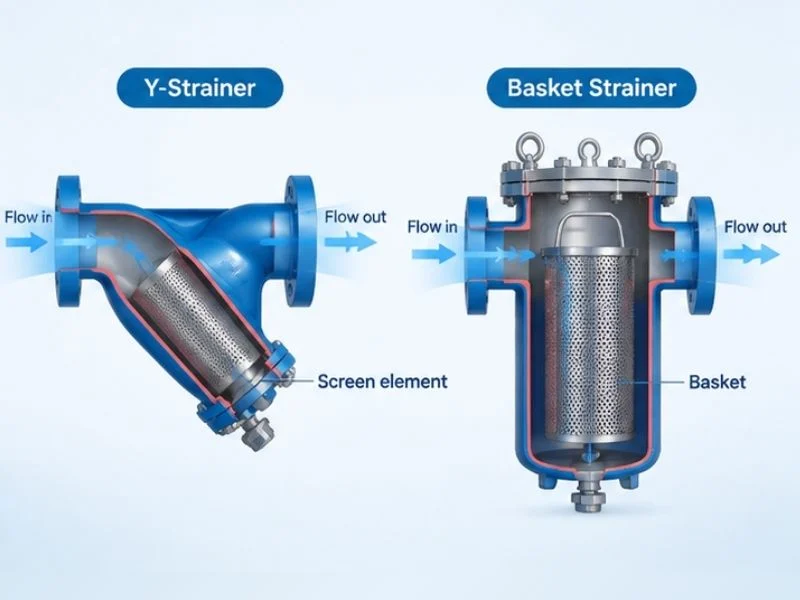
The flow enters the main body and passes through the screen, which traps unwanted debris. The clean fluid then exits the strainer. The “leg” of the Y contains the screen and a blow-off connection. This connection allows for cleaning the screen by opening a valve to flush out the collected particles. However, for a thorough clean, the cap on the leg must be removed to access the screen itself.
Because of their design, Y-strainers have a smaller debris-holding capacity compared to basket strainers. This makes them suitable for applications where the amount of solids is expected to be low. They are frequently used in steam, air, gas, and some liquid services. For example, they are excellent for protecting downstream equipment from occasional pipe scale or weld slag.
A key consideration is pressure drop. The fluid must change direction to pass through the screen, which can result in a higher pressure drop than a basket strainer of the same size. This effect is more pronounced at higher flow rates. When installing a Y-strainer in a horizontal pipeline, the leg should always point downwards. This ensures that the collected debris is not washed back into the flow. In vertical lines, they can only be installed with the flow moving downwards.
Exploring the Basket Strainer’s Features and Uses
When your process requires longer run times and handles more particulate, the limitations of a Y-strainer become apparent. A more robust solution is needed.
A basket strainer has a large-chamber body containing a vertical, removable basket. This design provides a much larger filtration area, allowing it to hold significantly more debris than a Y-strainer. It is ideal for liquid services where continuous flow and low pressure drop are critical.
Basket strainers are designed for installation in horizontal pipelines. The fluid enters the chamber, flows down into and through the basket, and then exits the strainer. The top-down flow ensures that all trapped debris remains inside the basket when it is removed for cleaning. This feature prevents particles from accidentally re-entering the pipeline, a common risk in other designs.
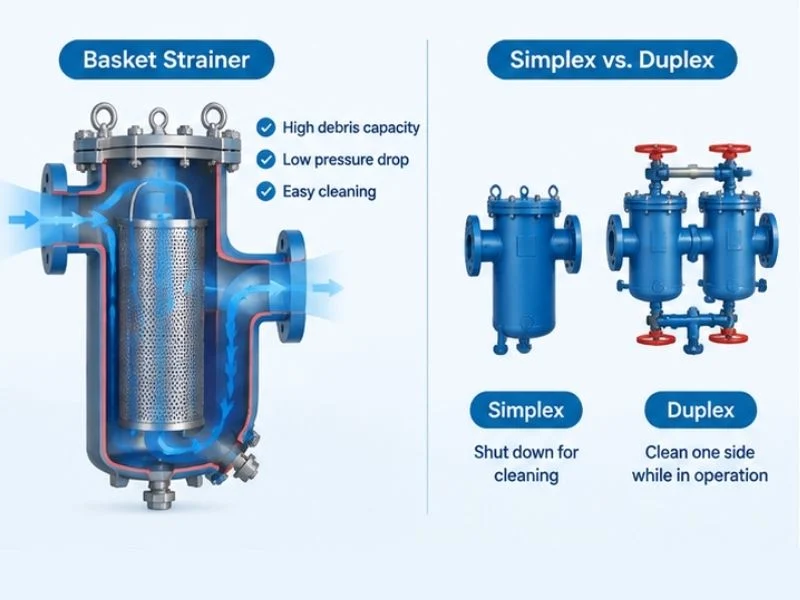
The primary advantage is its high debris-holding capacity. This translates to longer intervals between cleanings, reducing maintenance labor and system downtime. This is crucial for project engineers like Hassan, who prioritize operational reliability and minimizing life-cycle costs. The larger filtration area also results in a significantly lower pressure drop across the strainer, which can improve pump efficiency and save energy.
Simplex vs. Duplex Basket Strainers
Basket strainers come in two main configurations: simplex and duplex. A simplex strainer is a single unit that requires shutting down the line for cleaning. A duplex strainer consists of two strainer chambers connected by diverter valves. This allows you to divert the flow to one chamber while the other is taken offline for basket cleaning, all without interrupting the process. For critical 24/7 operations, like in many chemical and oil and gas plants, a duplex basket strainer is often the standard choice. It eliminates the need for costly shutdowns just to clean a strainer.
Comparing Key Selection Criteria: Y Strainer vs. Filtre à panier
Your final choice depends on a clear understanding of how each strainer performs under your specific operating conditions. A direct comparison helps simplify this decision.
The most important factors in the Y strainer vs. basket strainer decision are debris capacity, pressure drop, installation needs, and cleaning access. Basket strainers lead in capacity and low pressure drop, while Y-strainers offer compactness and more flexible installation orientations.
Let’s break down these differences in a more structured way. Thinking through these points will ensure you don’t just choose a strainer, but the right strainer. A poor choice can lead to frequent maintenance, process bottlenecks, or even inadequate protection for vital downstream equipment. The table below provides a clear, at-a-glance comparison to guide your selection.
| Fonctionnalité | Y-Strainer | Filtre à panier |
|---|---|---|
| Debris Capacity | Low | Haut |
| Chute de pression | Plus élevé | Plus bas |
| Installation Orientation | Horizontal or Vertical (flow down) | Horizontal Only |
| Footprint | Compact | Plus grand |
| Meilleur pour | Gases, Steam, Clean Liquids | Liquids, High Debris Loads |
| Continuous Operation | No (requires shutdown for cleaning) | Yes (with Duplex model) |
As the table shows, if your application involves liquids with a significant amount of solids, a basket strainer is almost always the better choice. Its ability to hold more debris means less frequent cleanings. For a project engineer focused on uptime and reliability, this is a major benefit. The lower pressure drop also contributes to better system efficiency over the long term. A Y-strainer is a perfectly good, cost-effective choice for protecting equipment in clean gas or steam lines where particles are an occasional nuisance rather than a constant presence.
Considering Maintenance and Long-Term Costs
The initial purchase price is only one part of the equation. Maintenance requirements and operational impact determine the true cost of ownership over the equipment’s life.
Y-strainer maintenance can be frequent in systems with more debris than expected. Basket strainers, especially duplex models, minimize downtime for cleaning, which significantly lowers operational costs in critical or high-debris processes.
To clean a Y-strainer, you typically must isolate and depressurize that section of the pipeline. Then, you can open the blow-off valve or remove the cap to access the screen. This process, while simple, means the line is out of service. If debris loads are higher than anticipated, this downtime can become a frequent operational headache.
Cleaning a simplex basket strainer is similar; it also requires shutting down the flow. However, because it holds more debris, the frequency of this task is lower. The real advantage comes with duplex basket strainers. I remember working with a client whose process involved cooling water drawn from a river. They were using large Y-strainers and had to shut down their main cooling loop twice a week to clean them. By replacing them with duplex basket strainers, they completely eliminated this planned downtime. The maintenance team could switch to the clean strainer and service the dirty one without impacting operations at all. The higher initial investment paid for itself in less than a year through improved uptime and reduced labor.
This is a critical calculation for any project. The upfront cost of a duplex unit might be higher, but the long-term savings in production continuity and maintenance resources often make it the most economical choice for essential liquid applications.
Frequently Asked Questions (FAQ)
Q1: Can a Y-strainer be installed vertically?
A: Yes, but only in pipelines where the flow direction is downwards. This orientation allows gravity to help keep collected debris in the strainer’s leg pocket. Installing it in an upward flow line would cause debris to fall back into the pipe when flow stops, defeating its purpose.
Q2: What is a duplex basket strainer?
A: A duplex basket strainer consists of two identical simplex strainer chambers linked by a diverter valve system. This design allows the process flow to be switched from the dirty strainer to the clean one, permitting cleaning or basket replacement without shutting down the pipeline. It is essential for continuous operations.
Q3: Which strainer generally has a lower pressure drop?
A: A basket strainer generally has a lower pressure drop than a Y-strainer of the same pipe size. This is because its larger body and vertically oriented basket provide a much greater filtration surface area. Fluid can pass through with less restriction, which improves energy efficiency, especially in pumping systems.
Q4: Are strainers the same as filters?
A: While related, they are not the same. Strainers are typically used to remove larger solid particles (measured in mesh size) from a fluid stream, primarily to protect downstream mechanical equipment like pumps and valves. Filters are designed to remove much finer particles (often measured in microns) to achieve a certain level of fluid purity.
Q5: How do I choose the right screen mesh size?
A: The screen mesh size should be selected based on the protection requirements of the most sensitive equipment downstream. Check the equipment manufacturer’s recommendation for the maximum allowable particle size. Choose a mesh that is fine enough to catch harmful debris but not so fine that it clogs too quickly and causes excessive pressure drop.
Q6: What happens if I use the wrong type of strainer for my application?
A: Using the wrong strainer can lead to several problems. A Y-strainer in a high-debris liquid line will clog frequently, causing excessive pressure drop and requiring constant maintenance. Using a basket strainer where a compact Y-strainer would suffice may be an unnecessary expense. The most critical risk is choosing a strainer that fails to protect your equipment, leading to costly damage and downtime.
Dernière réflexion
In the Y strainer vs. basket strainer decision, prioritize your application’s needs. Choose Y-strainers for clean gases or occasional debris. For liquids and high-debris loads where uptime is critical, a basket strainer is the superior choice. BCST provides industrial pipeline filtration for reliable process protection. Contact us to ensure your project gets the reliable protection it deserves.


 English
 Arabic
 Russian
 French
 Spanish