
Protecting your storage tanks from pressure changes is critical for safety. An incorrect valve choice leads to tank damage, product loss, and operational hazards, affecting project integrity.
To select a breather valve, you must first determine the required pressure and vacuum set points. Then, calculate the necessary flow capacity based on pumping and thermal effects. Finally, choose materials and connections compatible with the stored medium and environment.

This guide will walk you through these essential steps in a clear, practical way. Following this process helps you specify a pressure vacuum relief valve (PVRV) that provides reliable, long-term protection for your assets. It also ensures you maintain operational safety and compliance with industry standards.
Determine Correct Set Pressures and Vacuum Settings
Setting the right pressure and vacuum levels is your first critical decision. Incorrect settings can either fail to protect the tank or cause unnecessary venting and product loss.
To find the right set points, check your tank’s design pressure and vacuum limits. The valve should be set to open just below these limits, typically at 80-90% of the tank’s rating, to ensure a safe operating margin.
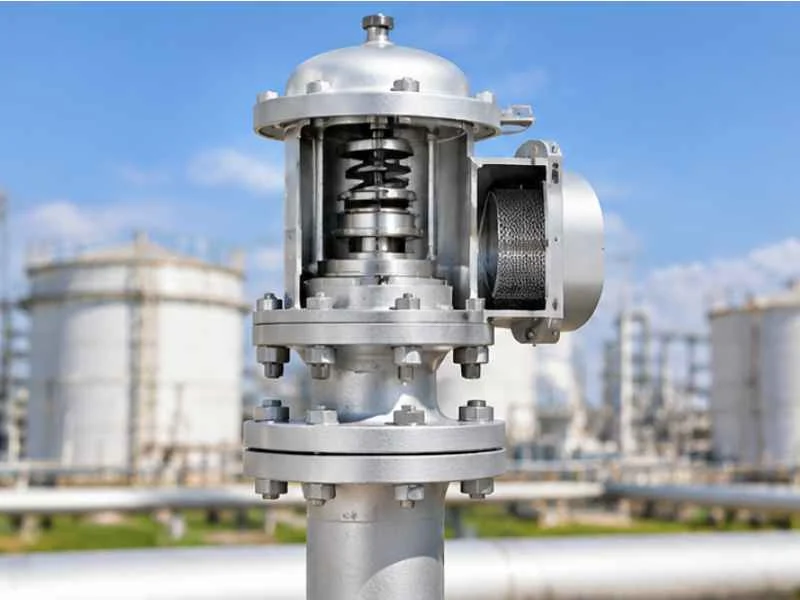
The most important information for this step is on the tank’s nameplate or in its design documentation. Look for the Maximum Allowable Working Pressure (MAWP) and the Maximum Allowable Working Vacuum (MAWV). These values represent the absolute limits your tank can handle without risking structural damage. You must never set the breather valve to open at or above these limits.
For safe operation, you need a buffer between the valve’s set point and the tank’s maximum rating. For example, if a tank’s MAWP is 1.0 psig, a common practice is to set the breather valve’s pressure relief setting at 0.85 psig. Similarly, if the MAWV is -0.5 psig, the vacuum relief setting might be -0.45 psig. This margin prevents the valve from opening during minor, normal pressure fluctuations, which helps reduce product evaporation and fugitive emissions.
Setting the valve too close to the normal operating pressure can cause it to “simmer” or leak constantly. Conversely, setting it too close to the tank’s design limit reduces your safety margin. Always follow the guidelines in standards like API 2000, which provides a framework for determining these settings for atmospheric and low-pressure storage tanks.
Calculate Required Sizing and Flow Capacity
An improperly sized valve is a serious safety risk. An undersized valve cannot vent pressure fast enough, potentially causing tank rupture. An oversized valve is an unnecessary expense.
To correctly size a breather valve, you must calculate the total required flow capacity. This involves adding the flow rate from liquid movement (pumping) and the flow rate from thermal changes (breathing). Use a recognized standard like API 2000 for these critical calculations.
The total venting requirement is a sum of two main components: thermal breathing and liquid movement.
Thermal Inbreathing and Outbreathing
Tanks “breathe” due to changes in ambient temperature. During the day, rising temperatures cause the vapor inside the tank to expand, creating pressure. The breather valve must release this excess vapor, a process called outbreathing. At night, falling temperatures cause the vapor to contract, creating a vacuum. The valve must allow air to enter to equalize this pressure, which is called inbreathing. The required flow rate for thermal effects depends on the tank’s volume, the type of product stored, and the geographical location’s temperature shifts.
Flow from Pumping Operations
The second component is the flow rate caused by filling or emptying the tank. When you pump liquid into a tank, you displace an equal volume of vapor, which must be vented out. The required outbreathing flow rate is directly related to your maximum filling rate. Conversely, when you pump liquid out of the tank, a vacuum is created. The breather valve must allow air to flow in at a rate equal to your maximum emptying rate to prevent the tank from collapsing. You must use the highest possible pumping rates in your calculations to ensure the valve can handle worst-case scenarios.
After calculating the total required inbreathing and outbreathing flow rates (in standard cubic feet per hour or normal cubic meters per hour), you can use manufacturer-provided sizing charts or software to select a specific valve model that meets or exceeds these requirements at your chosen set pressures. This is a crucial part of how to select a breather valve correctly.
Choose Appropriate Materials and End Connections
The valve’s materials must withstand the stored fluid and the external environment. Corrosion or material degradation can cause the valve to stick, leak, or fail entirely over time.
Select body, trim, and seal materials based on the stored product’s corrosivity, operating temperature, and external site conditions. Common choices include aluminum for standard hydrocarbons and stainless steel or specialty alloys for more aggressive chemicals or marine environments.
The valve body is the main housing. Its material must resist corrosion from both the internal fluid and the external atmosphere. For example, an aluminum body is lightweight and cost-effective for storing fuels or solvents in a standard industrial area. However, for a coastal facility exposed to salt spray or for storing corrosive chemicals, a stainless steel (304 or 316) or even a fiberglass-reinforced plastic (FRP) body would be a more reliable choice.
The internal components, or “trim,” such as the pallet, stem, and seats, are in direct contact with the tank vapors. These parts must be fully compatible with the product to prevent sticking or degradation. The sealing materials, like gaskets and diaphragms, are equally important. Common options include:
- Buna-N (Nitrile): Good for petroleum products but has limited temperature and chemical resistance.
- Viton (FKM): Offers excellent resistance to a wide range of chemicals and higher temperatures.
- PTFE (téflon) : Provides superior chemical resistance but is a harder material, which may affect sealing performance at very low pressures.
The table below gives a general overview of common body materials.
| Matériau | Applications typiques | Key Considerations |
|---|---|---|
| Aluminium | Fuels, Solvents, Standard Service | Lightweight, low cost, poor for caustic or acid service. |
| Acier au carbone | General Industrial, Oil & Gas | Strong, cost-effective, requires coating for corrosion. |
| Acier inoxydable | Chemicals, Water, Food & Beverage | Excellent corrosion resistance, higher cost. |
| Hastelloy/Alloys | Highly Corrosive Chemicals | Superior resistance, high cost for specialized service. |
Finally, consider the end connections. Most breather valves are mounted on a flange on the tank roof. Ensure the valve’s flange type, size, and pressure rating (e.g., ANSI 150# or DIN PN10) match the tank’s nozzle perfectly to ensure a secure and leak-free installation.
Frequently Asked Questions (FAQ)
Q1: What is the main function of a Breather Valve?
A Breather Valve, or Pressure Vacuum Relief Valve (PVRV), is a safety device designed to protect atmospheric and low-pressure storage tanks. It automatically opens to relieve excess internal pressure (outbreathing) or vacuum (inbreathing) that occurs during pumping operations or due to thermal changes. This prevents the tank from rupturing or collapsing, protecting assets, personnel, and the environment.
Q2: How do I test my Breather Valve?
Breather Valves should be periodically tested to ensure they open at the correct set points. This is typically done on a certified test bench that can apply precise pressure and vacuum. The test verifies the “crack open” pressure and checks for seat leakage. Following manufacturer recommendations and site-specific maintenance schedules is essential for reliable performance.
Q3: Can a single Breather Valve provide both pressure and vacuum relief?
Yes, most standard Breather Valves are combination units that provide both functions. They have two separate pallets or diaphragms within a single housing. One opens outward to relieve pressure, and the other opens inward to relieve vacuum. This consolidated design simplifies installation and maintenance on the tank nozzle.
Q4: How does temperature affect Breather Valve selection?
Temperature impacts a Breather Valve in two ways. First, ambient temperature swings cause thermal breathing, which must be factored into flow capacity calculations. Second, the operating temperature of the stored product dictates material selection. Seals and gaskets must be rated for the fluid’s temperature range to prevent them from becoming brittle or degrading.
Q5: What is the difference between a Breather Valve and an emergency vent?
A Breather Valve handles normal operational venting from pumping and thermal effects. An emergency vent is a larger device designed to handle much higher flow rates caused by abnormal situations, most commonly an external fire. While both protect the tank, the emergency vent is a last-line-of-defense safety device for catastrophic scenarios, as defined by standards like API 2000.
Q6: Why is my Breather Valve leaking or “chattering”?
A leaking or “chattering” (rapidly opening and closing) Breather Valve often indicates a problem. Leaking can be caused by a damaged seal, debris on the seat, or corrosion. Chattering typically happens when the valve’s set point is too close to the tank’s normal operating pressure, causing it to open and close with minor fluctuations. Both issues require inspection and may point to incorrect sizing or set point selection.
Dernière réflexion
A successful project hinges on getting the details right. Following a clear process for how to select a breather valve—focusing on set pressure, flow capacity, and materials—is fundamental to tank safety and reliability. For expert guidance on protecting your assets, contact our BCST engineering team today.


 English
 Arabic
 Russian
 French
 Spanish