
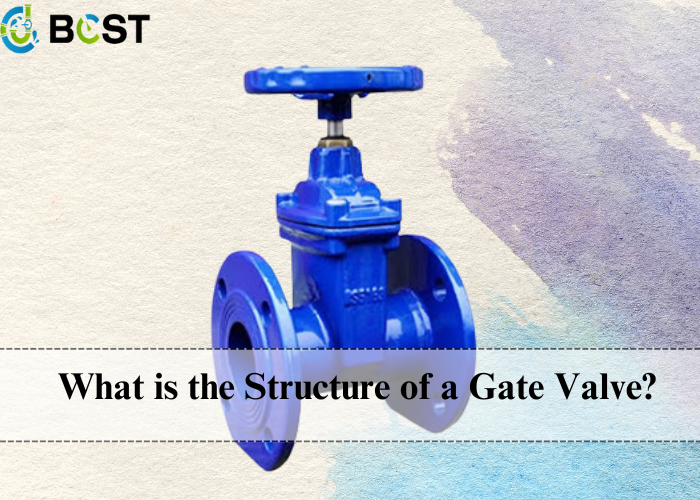
Ⅰ.The Definition of Gate Valve
A Vanne à guillotine is a type of valve that uses a gate or wedge-shaped disk that moves perpendicular to the fluid to open or stop the flow of fluid in a pipeline.
Lorsqu'un Vanne à guillotine is fully open, the valve plate of the Gate Valve is completely removed from the fluid and there is little resistance to flow.
For proper sealing, there needs to be 360° of surface contact between the valve plate and seat when the valve is fully closed.
II The Structure of Gate Valve
1. Hand wheel nut
2.Hand wheel hand wheel
3.Stem nut stem nut
4.Yoke bracket
5.Yoke bolting bracket bolts
6.Stem
7.Gland flange, packing gland
8.Gland
9. Gland eyebolts and nut gland eyebolts and nut

- Gland lug bolts(eye bolt pin) gland lug bolts(eye bolt pin)
- Nut
- Stem packing
- Drain plug
- Backseat bushing (Bonnet stem bushing) Upper seal seat sleeve (stem sleeve)
- Bonnet
- Bonnet gasket
- Bonnet bolts and nuts
- Gate (disc,wedge) plate
- Renewable seat ring replaceable seals
- Body valve
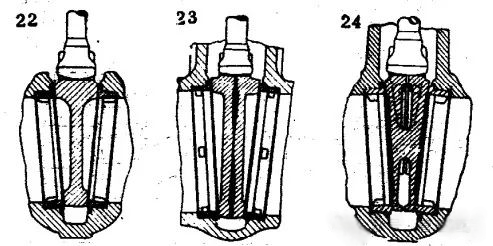
- Solid wedge wedge single gate
- Split wedge wedge double gate
- Flexible wedge Flexible wedge gate plate
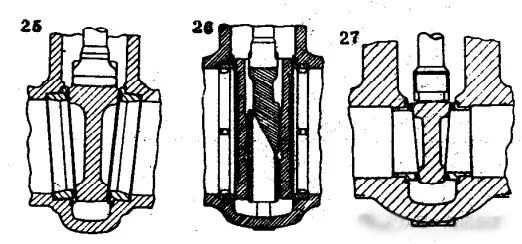
- Teflon seat ring Teflon seals
- Double disc, parallel seat parallel double gate
- Teflon insert in seat ring polytetrafluoroethylene insert seal ring
Ⅲ. The function of main parts of Gate Valve
Le soupape body is the main component of the valve that holds all the parts together. In most cases, it is connected to the pipeline by flanges and gaskets.
The bonnet is the second boundary of pressure. It is connected to the valve body by bolts or flanges.
The combination of stem, seat and disc is known as valve internals.
The seat and disk is the most important part of the Gate Valve. It contains a gate and a seat that fits closely to the gate.
The stem connects the actuator and the disk in a Gate Valve. By means of it the valve disk and seat can be opened and closed. There are two types of valve stems, a rising type, which rises when the valve is opened, and a non-rising type, which has no vertical movement.
Le soupape actuator is a manual wheel which operates the stem and the valve disc.

Ⅳ. Types of Gate Valves
1)Solid wedge Vanne à guillotine
It is suitable for almost all materials. Here a wedge disc is used which is mounted on the valve seat. It is suitable for medium pressure conditions but not for high pressure conditions as it gets stuck due to high pressure and leads to leakage. Sometimes, due to thermal expansion, the valve seat fails to open and gets stuck. This phenomenon is called thermal binding.

2) Parallel disk or Split Vanne à guillotine
This type overcomes the problem of thermal binding due to free movement. Here, the two disks and the valve seat are kept together by springs.

3) Flexible wedge Vanne à guillotine
It involves a small cut in the disk that fits into the valve seat. With this cutout, there is no leakage between the seat and the disk. It is used for steam applications.

4) Non-rising and rising stem Vanne à guillotine
In open stem (rising) Gate Valve, the stem rises when the gate is opened and falls when it is closed. In concealed stem (non-rising) Gate Valve, the stem does not move vertically and is used when the space is small.

V. Application of areas of Gate Valves
- Industrie pétrolière et gazière
Gate Valves perform important fluid control tasks in the extraction, transportation and refining of oil and gas. As these scenarios usually involve high pressure, high temperature and corrosive media, wedge Gate Valves and alloy Gate Valves are widely used in such working conditions. The sealing performance and durability of Gate Valves are especially critical in the oil extraction process, especially in high-pressure injection wells and oil and gas pipelines.
- Chemical industry
Chemical industry production process involves a large number of corrosive or toxic substances, so it is particularly important to choose materials with strong corrosion resistance Gate Valve. Fluorine lined Gate Valves or Gate Valves made of stainless steel, Hastelloy and other corrosion-resistant materials are commonly used in the chemical industry. They are usually used for acid, alkali, salt and other corrosive media transportation and control.
- Water supply and drainage systems
In municipal water supply systems, Gate Valves are usually used for the opening and closing operations of water pipe networks, especially for large-diameter piping systems. Due to the relatively low corrosiveness of water, cast iron or ductile iron Gate Valve is often used in such conditions. In the sewage treatment system, knife Gate Valve because it can effectively cut off the sewage fluid with solid particles, has been widely used.
- Power and energy industry
In power production, especially in thermal power plants, boilers and steam piping systems work at very high temperatures and pressures. To ensure the safe operation of the system, the power industry usually uses wedge Gate Valves with good sealing performance under high temperature and high pressure conditions. In addition, in nuclear power plants, radiation-resistant, corrosion-resistant Gate Valves of special materials are also essential.
- Metallurgy and mining
In the field of metallurgy and mining, Gate Valves are used to control the transportation of water, coal slurry, slurry and other media. Knife Gate Valves are widely used for their excellent cutting performance when dealing with media containing solid particles.
VI. Advantages and disadvantages of Gate Valves
Avantages
- Good sealing performance: Gate Valvemetal seal or soft seal structure, can effectively prevent the media leakage, especially suitable for high pressure, high temperature conditions.
- Wide range of application: Gate Valvecan be applied to a variety of media, including water, steam, oil, corrosive media and media with solid particles.
- Small friction, wear-resistant: gate in the opening and closing process with less contact with the media, reducing wear and tear, making the valve life longer.
- Bidirectional sealing: Gate Valvecan be sealed in both directions, suitable for piping systems with bidirectional flow requirements.
Inconvénients
- Slow switching speed: Due to the long travel of the gate, it takes a long time to open and close the valve, especially in large-diameter pipeline systems.
- Unsuitable for regulating flow: partially open state is prone to vibration and erosion, so it is not suitable for flow regulation.
- Occupy a large space: Gate Valves usually require a large installation space, especially when manually operated, the full stroke of the valve requires more space.
- Large weight: especially large-diameter, high-pressure Gate Valves, due to its high structural strength requirements, resulting in a large weight of the valve body.
VII. Conclusion
Gate Valves have become an indispensable and important equipment in the engineering field due to their excellent sealing performance, wide applicability and good durability. When selecting and using Gate Valves, materials, structure types and sealing forms should be reasonably selected according to specific working conditions to ensure safe and efficient operation of the system. Although the Gate Valve in some working conditions


 English
 Arabic
 Russian
 French
 Spanish