
A Practical Guide to High Pressure Butterfly Valves
Choosing the wrong valve for high-pressure service can risk system integrity and plant safety. You need a reliable, cost-effective solution for demanding industrial applications.
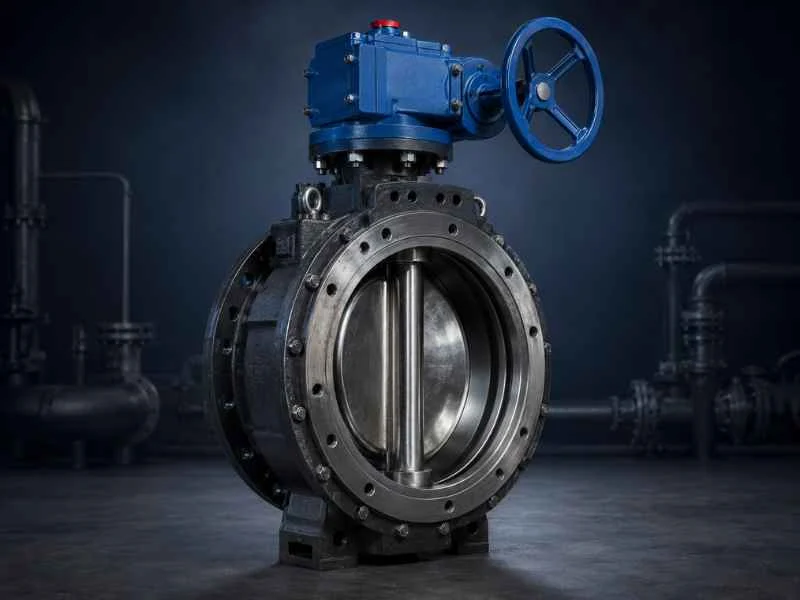
High pressure butterfly valves are built for tough service, usually starting at ASME Class 300. They use special designs like double or triple offsets. This ensures a tight seal and long life under high pressure. They are a compact choice compared to traditional gate or ball valves.
Knowing the key differences between these valves is important for plant safety and reliability. This guide will give you practical details. You will learn about pressure ratings, valve types, and materials for your high-pressure needs.
What Defines a High Pressure Butterfly Valve?
Choosing a valve without knowing its pressure class is a major risk. The term “high pressure” has a specific meaning based on engineering standards.
A valve’s ability to handle high pressure depends on its pressure-temperature rating. Standards like ASME B16.34 define this. High pressure butterfly valves are usually ASME Class 300, 600, 900, or higher. This makes them different from standard soft-seated valves used for lower pressures.
The main difference is their design and construction. Standard butterfly valves use a soft seat that gets squeezed to seal. High-pressure valves are different. Their bodies have thicker walls. They are made from strong materials like carbon steel (ASTM A216 WCB) or stainless steel (ASTM A351 CF8M). This helps them safely handle the high pressure inside. The ASME B16.34 standard sets the minimum wall thickness and material rules. It is based on pressure class and valve size. This ensures the body won’t crack under stress.
The internal parts, called the trim, are also built to last. The shaft is usually thicker. This helps it handle the high force needed to turn the valve against pressure. The disc is also designed to resist bending. This strong construction helps them work reliably. A standard butterfly valve would fail in these conditions.
Key Types: High Performance vs. Triple Offset
Not all high pressure butterfly valves are the same. The design of the disc and seat is very important. It affects the valve’s performance, how well it seals, and how long it lasts.
There are two main types: high-performance (double offset) and triple offset valves. A double offset valve uses two offsets to reduce wear on the seat. A triple offset valve adds a third offset. This removes all friction, giving the best seal and a very long life.
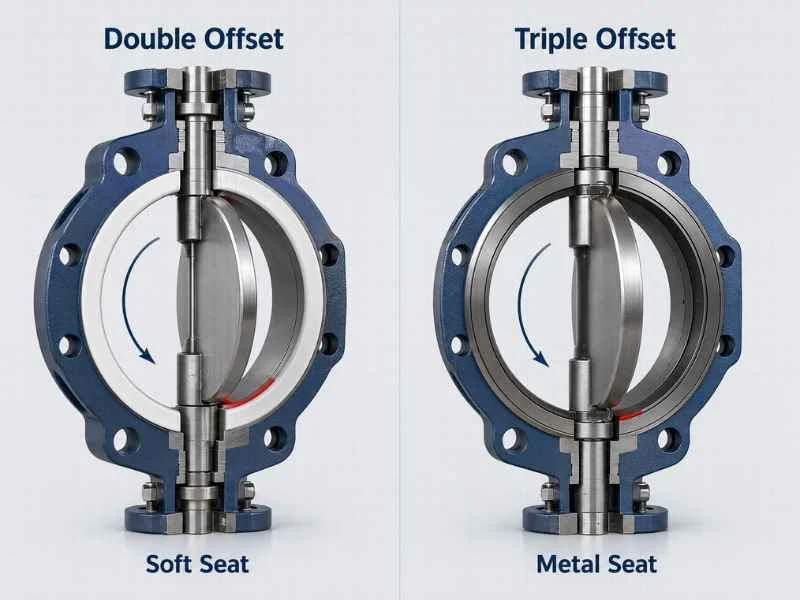
High-Performance (Double Offset) Valves
A high-performance butterfly valve has two offsets in its design. First, the shaft is behind the seat’s centerline. Second, the shaft is offset from the pipe’s centerline. This design makes the disc move away from the seat when it opens. This reduces contact and rubbing, except for the last few degrees of closing.
This reduced friction helps the seat last much longer than in a basic concentric valve. HPBVs often use soft seats made of materials like PTFE or RPTFE (Reinforced PTFE). These seats provide a very good seal for many chemical services. However, soft materials limit the operating temperature, usually to about 260°C (500°F). They are a good-value solution for many high-pressure jobs with clean liquids and gases, where a perfect, zero-leak seal is not required.
Triple Offset Butterfly Valves (TOVs)
Triple offset valves are the most advanced type of butterfly valve. They have the two offsets of an HPBV, plus a third one. The seat cone’s angle is offset from the disc’s centerline. This creates a special cam-like motion. The disc seal touches the body seat only at the final point of closing.
This design completely stops rubbing between the sealing surfaces during operation. Because of this, TOVs use metal-to-metal or laminated graphite/metal seats. This allows them to achieve a bi-directional, zero-leakage seal (following API 598). This tight seal is maintained for thousands of cycles. They are perfect for the toughest jobs, including high-pressure steam, hydrocarbons, and cryogenic fluids. They are naturally fire-safe (often certified to API 607). They can also handle extreme temperatures, from cryogenic to 815°C (1500°F). They can often replace traditional gate and ball valves in critical shut-off services.
| Fonctionnalité | High-Performance (Double Offset) | Triple Offset (TOV) |
|---|---|---|
| Sealing Action | Friction-based, squeezing seat | Torque-seated, no rubbing |
| Common Seat Material | Soft (PTFE, RPTFE, PEEK) | Metal or Laminated Graphite/Metal |
| Leakage Rating | Low leakage (ASME Class IV/V) | Zero Leakage (ASME Class VI, API 598) |
| Pressure Class | Up to Class 600 | Up to Class 2500 |
| Plage de température | -50°C to 260°C | Cryogenic to >600°C |
| Meilleur pour | Clean fluids, water, chemicals | Critical shut-off, steam, hydrocarbons |
Essential Selection Criteria for Your Application
Beyond the valve type, you must carefully check materials, temperature limits, and the actionneur. This ensures safe and reliable operation in your high-pressure system.
Your main selection checks must include body and trim materials, the pressure-temperature (P-T) chart, seat performance, and actuator force. If you miss any of these, the valve could fail early, leak, or cause a safety problem.
Material Compatibility and Standards
First, check that the valve materials are compatible with your process fluid. This includes the body, disc, shaft, and seat. For example, carbon steel (WCB) is common for high-pressure steam. However, stainless steel (CF8M) is often needed for corrosive chemicals. Always check your fluid’s concentration and temperature against corrosion data. For sour gas service (with H2S), materials must follow NACE MR0175 to prevent cracking.
Pressure-Temperature (P-T) Rating
A valve’s pressure rating is not just one number. The highest pressure a valve can handle changes with temperature. Every valve made to ASME B16.34 has a P-T chart for its body material. For example, a Class 600 carbon steel valve might be rated for 1480 psi at room temperature. This rating drops a lot as temperature increases. You must ensure your operating conditions are inside the published P-T limits for the valve.
Seat and Seal Selection
The seat material is key to getting the right shut-off performance. For HPBVs, choose a soft seat like PEEK that handles the temperature and chemicals. For TOVs, you can choose a laminated seat (Graphite/316SS layers) or a solid metal seat. Laminated seats give a great seal over a wide temperature range. But they can wear out faster with abrasive particles. Solid metal seats are more durable in erosive service. But they might need a stronger actuator to get a tight seal.
Actuation and Torque Requirements
High pressure creates a strong twisting force (torque) on the valve stem. The actuator, like a gearbox or motor, must be strong enough to turn the valve. It must overcome this torque with an extra safety margin. Manufacturers provide the required torque values for the highest differential pressure. If the actuator is too weak, the valve may not open or close fully. This is very dangerous in an emergency.
Questions fréquemment posées
What makes high pressure butterfly valves good for oil and gas?
Their strong design, zero-leakage ability (especially TOVs), and meeting standards like API 607 (fire-safe) make them a great fit. They offer a compact, light option for important shut-off tasks in oil and gas production, pipelines, and refineries. They handle fluids from hydrocarbons to high-pressure steam.
How do I choose between double and triple offset high pressure butterfly valves?
Choose a double offset valve for clean fluids where low leakage is okay and cost is a factor. Select a triple offset valve for critical jobs that need a perfect zero-leak seal, bi-directional shut-off, high temperatures, or frequent use. TOVs offer the best safety for critical shut-off.
Can high pressure butterfly valves achieve zero leakage?
Yes, triple offset butterfly valves (TOVs) are designed for zero leakage. Their metal-to-metal sealing design meets strict standards like API 598 and ASME Class VI. High-performance (double offset) valves with soft seats seal very well but are usually rated for low leakage (Class IV), not zero leakage.
What are common failure modes for high pressure butterfly valves?
Common failures include seat damage from particles or high flow, which causes leaks. The stem can get stuck or break if the actuator is too weak for the pressure. Leaks from the stem packing can also happen if not maintained. Choosing the wrong material can cause fast corrosion and weaken the valve body.
Are there specific standards for high pressure butterfly valves?
Yes. Main standards include ASME B16.34 for pressure-temperature ratings. API 609 covers valve design. Testing standards like API 598 define leak rates. For fire safety, API 607 is the key certification. These standards ensure valves are built and tested for safe use in high-pressure systems.
Dernière réflexion
Selecting the right high pressure butterfly valve is about matching the valve’s design—double or triple offset—and materials to your exact pressure, temperature, and fluid conditions. A triple offset valve offers the best safety and reliability for critical shut-off.
At BCST, we provide a wide range of high-performance and triple offset butterfly valves to meet your project’s demands. Contact our team to discuss your application and ensure you get the right valve for the job.


 English
 Arabic
 Russian
 French
 Spanish