
Where a Standard Knife Gate Valve Can’t Be Your Ideal Choice
That brand new vanne à guillotine you installed on the silo discharge is already jamming. It worked for a week, but now the actuator strains and the gate won’t fully close. This is a classic failure mode for the wrong application.
For dry bulk solids, a standard knife gate valve fails because material packs into the body cavity, jamming the gate, while abrasive particles destroy the seal. A purpose-built O-Port knife gate valve solves this by using a through-conduit design that eliminates the cavity and protects the seats, ensuring reliable shutoff.

Why Does a Standard Knife Gate Valve Fail with Dry Materials?
A valve that works perfectly on a water line can become your biggest headache with dry solids because its design has inherent flaws for that service. The core problem is the open body cavity at the bottom, which becomes a trap.

Inevitable Failure Mechanisms
A standard knife gate valve on a dry solids line fails in two predictable ways:
- Compaction and Jamming: Dry material fills the open body cavity. The descending gate compresses it into a solid brick, physically obstructing the gate and preventing closure.
- Abrasion and Seal Destruction: Abrasive particles get trapped on the valve’s seat. The closing gate crushes these particles into the soft elastomer, tearing the seat and causing permanent leaks.
| Mode de défaillance | Consequence |
|---|---|
| Body Cavity Packing | Valve will not fully close, causing leakage and operational failure. |
| Seat Abrasion | Seat is physically destroyed, eliminating the ability to provide a positive seal. |
How Does an O-Port Knife Gate Valve Solve These Problems?
The solution is a valve purpose-built for dry bulk solids: the O-Port knife gate valve. The gate has a circular hole—the “O-Port”—that, when open, aligns with the pipeline to create a smooth, unobstructed, full-bore path. There is no body cavity exposed to the process.
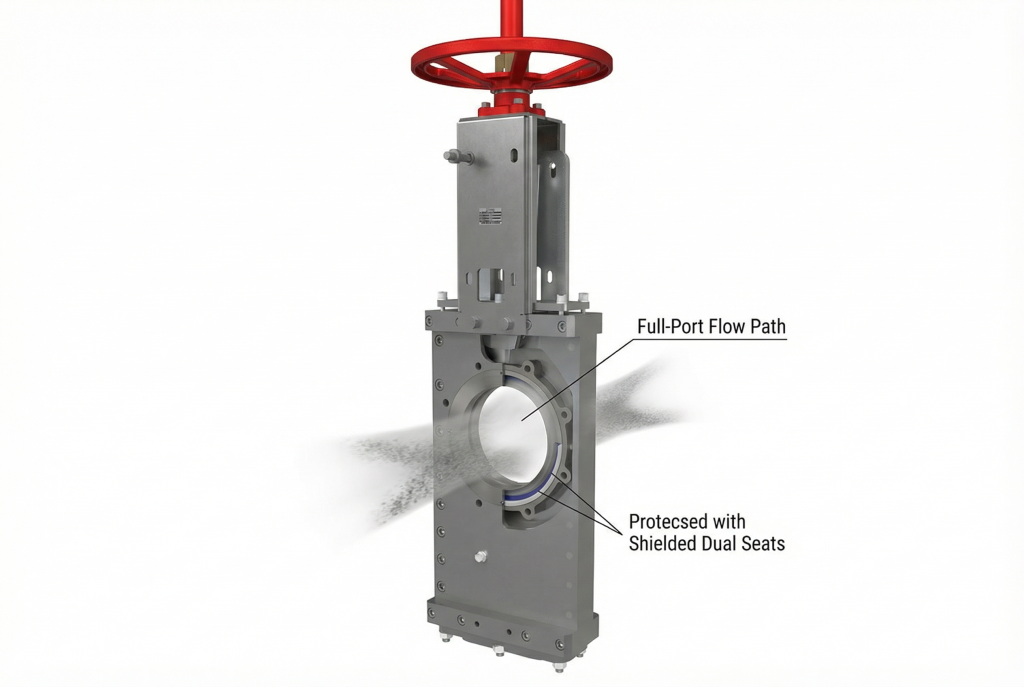
The Superior Engineering Solution
| Fonctionnalité | Soupape standard | O-Port Valve |
|---|---|---|
| Conception de la carrosserie | Has an open cavity at the bottom. | Fully enclosed with a through-conduit. |
| Sealing Method | Crushes particles onto a single seat. | Slides between two protected seats. |
| Avantage clé | - | Eliminates packing and protects seats. |
Conclusion
Stop the cycle of failure. For any dry bulk solid application like cement, sand, or pellets, a standard knife gate valve is the wrong tool. Make the professional choice by specifying an O-Port knife gate valve for reliable, long-term performance and eliminate jamming and leakage problems for good.


 English
 Arabic
 Russian
 French
 Spanish