
What Is a Programmable Ball Valve? The Ultimate Guide to Automated Flow Control
In an era defined by automation and precision, the ability to control fluid flow within industrial, commercial, and even residential systems has become more sophisticated than ever. Gone are the days when manual intervention was the only way to manage pipelines. Today, programmable ball valves stand at the forefront of this evolution, offering unparalleled accuracy, remote control, and integration into complex automated systems. According to industryresearch, in the $3.9 billion marine actuators and valves market growing at 4.7% CAGR to reach $5.9 billion by 2035 , programmable ball valves represent the critical evolution from reactive manual systems to predictive, automated, and remotely operable infrastructure essential for modern maritime operations.
But what exactly is a programmable ball valve, and how does it revolutionize fluid management? This ultimate guide from BCST Valve will demystify this critical technology. We’ll explore its core components, explain its working principles, delve into its diverse applications, and highlight the key factors for selection and setup. Whether you’re a design engineer, a system integrator, or simply curious about smart flow solutions, this article is your foundational resource.
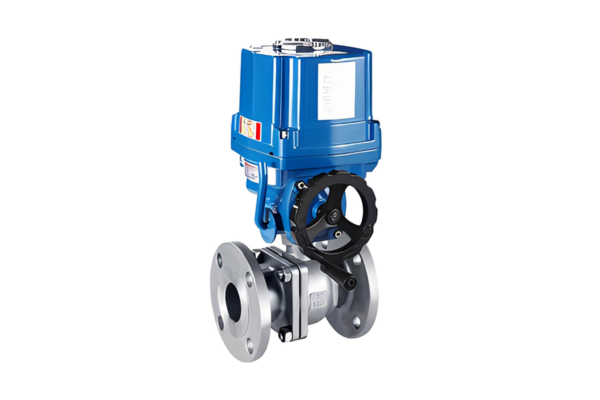
Deconstructing the Programmable Ball Valve: Two Key Components
At its core, a programmable ball valve is a symbiotic assembly of two distinct yet interconnected components:
1. The Ball Valve (The Mechanical Heart)
This is the physical part responsible for controlling the flow of media. Like any standard ball valve, it consists of a spherical ball with a bore (hole) through its center. When the valve is open, the bore aligns with the pipeline, allowing flow. A quarter-turn rotates the ball 90 degrees, positioning the bore perpendicular to the pipeline, thereby blocking the flow.
- Fonction : Provides rapid, positive on/off sealing or proportional flow control (with V-port designs).
- Matériaux : Typically bronze, brass, stainless steel, PVC, etc., chosen based on the media, pressure, and temperature.
2. The Actuator (The Intelligent Brain)
This is what makes the valve “programmable.” An actuator is a device that translates an electrical signal into mechanical motion to open or close the ball valve. While pneumatic and hydraulic actuators exist, programmable ball valves almost always feature electric actuators for precision control and integration with control systems.
- Contrôle : Receives commands from a Programmable Logic Controller (PLC), Distributed Control System (DCS), smart home hub, or dedicated controller.
- Mechanism: Contains a motor, gearing, and often sensors or feedback mechanisms (e.g., limit switches, position sensors) to precisely control the ball’s rotation.
- Programmability: This is where the magic happens. The actuator can be programmed to open/close based on time schedules, sensor inputs (e.g., temperature, pressure, flow rate), or remote commands.
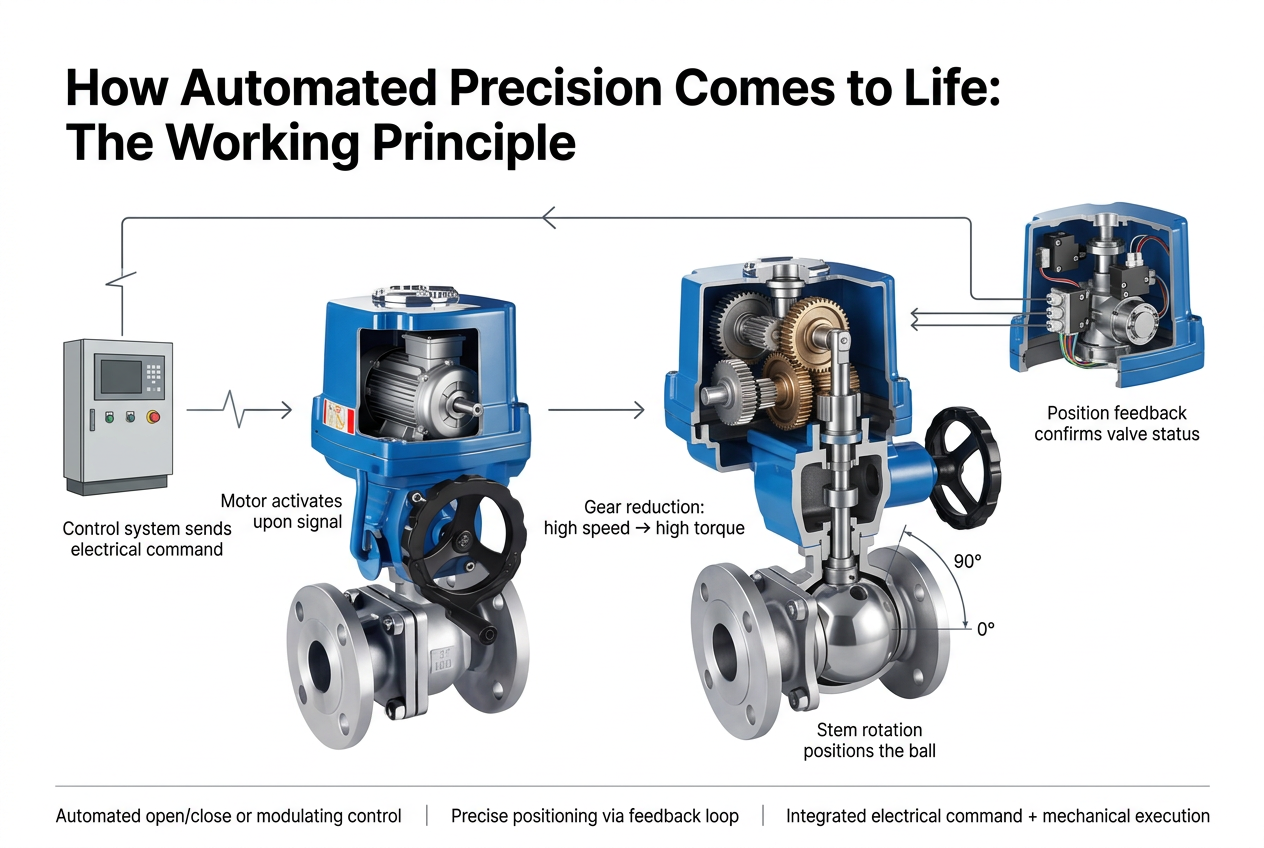
How Automated Precision Comes to Life: The Working Principle
The operation of a programmable ball valve is a seamless integration of electrical command and mechanical execution:
- Command Signal: A control system (e.g., a smart thermostat, a PLC in a factory, a smart irrigation controller) sends an electrical signal to the actuator. This signal could be based on a pre-programmed schedule, a sensor reading (e.g., “open valve when temperature reaches 80°C”), or a manual override command from a control panel.
- Actuator Activation: The electric actuator receives this signal. Its internal motor then begins to turn.
- Gearing & Rotation: A system of gears within the actuator translates the motor’s high-speed, low-torque rotation into a slower, high-torque rotation, powerful enough to turn the ball valve’s stem.
- Valve Position: The rotating stem turns the ball within the valve, moving it from fully closed to fully open, or to any intermediate position for throttling applications.
- Feedback & Control: Many programmable actuators include limit switches or position sensors. These provide feedback to the control system, confirming that the valve has reached its commanded position. This feedback loop allows for precise control and error detection.
Smart Control: Enhancing Efficiency with Programmable Functionality
The “programmable” aspect is key to these valves’ power. It moves beyond simple remote on/off by allowing for sophisticated, automated flow management:
- Timed Operations: Open/close at specific times of day, week, or year (e.g., irrigation schedules).
- Sensor-Driven Control: React to changes in temperature, pressure, flow rate, pH levels, or liquid levels.
- Remote Access: Operate and monitor valves from a central control room or even a smartphone, essential for large facilities or inaccessible locations.
- Proportional Control: Many actuators can precisely modulate the ball’s position (e.g., 0-100% open) for fine-tuning flow rates, not just on/off.
- Safety Interlocks: Integrate into safety systems to automatically shut off flow in emergencies (e.g., fire suppression, leak detection).
Versatility in Action: Top Applications of Programmable Ball Valves
The ability to control flow on a schedule or based on sensor input makes these valves incredibly versatile, improving efficiency and safety across numerous sectors.
Common Industries & Uses:
- Industrial Automation: Process control (chemical, food & beverage, pharmaceuticals), automated batching, water treatment.
- Systèmes CVC : Controlling water or coolant flow in heating, ventilation, and air conditioning systems for optimal climate control and energy efficiency.
- Agriculture & Irrigation: Smart irrigation systems that adjust water flow based on soil moisture, weather forecasts, or crop schedules, conserving water.
- Smart Home & Building Management: Automated water shut-off valves for leak detection, zone-based water control, or irrigation systems.
- Energy Management: Automating manifold systems to divert flow to maximize heat exchange or reduce waste.
We explore their most common uses in our dedicated guide: Top 5 Applications for Programmable Ball Valves.
Key Considerations for Selecting a Programmable Ball Valve
Choosing the right programmable ball valve involves more than just pipe size; you must match the actuator’s capabilities to your needs and ensure entire system compatibility. Here are crucial factors:
- Valve Body Material: Must be compatible with the media (e.g., corrosive fluids, potable water).
- Pressure & Temperature Ratings: Ensure they meet your system’s operating conditions.
- Actuator Power (Torque): Must be sufficient to reliably turn the valve, especially under differential pressure.
- Control Type: On/off, modulating (proportional), or multi-port.
- Input Signal: What type of signal does your control system output (e.g., 0-10V, 4-20mA, digital on/off, WiFi, Zigbee)?
- Fail-Safe Options: What happens during a power loss? (e.g., spring return to open or close, battery backup).
- Environmental Rating: IP rating (ingress protection) against dust and water for the actuator.
Learn how to navigate these choices in our comprehensive guide: Buyer’s Guide to Selecting a Programmable Ball Valve.
Installation and Programming: Bringing Your System to Life
Once selected, proper installation and programming are key to reliable operation and maximizing the benefits of your automated system. While installation of the valve body is similar to manual valves, the actuator requires careful wiring and configuration.
- Mechanical Installation: Mount the valve securely in the pipeline, ensuring correct flow direction and preventing undue stress on the piping.
- Electrical Wiring: Connect the actuator to the power supply and control signals according to the manufacturer’s instructions. This typically involves power, ground, and signal wires.
- Programming the Actuator/Controller: Configure the actuator’s settings or program your central control system (PLC, BMS, smart hub) to send the desired commands. This includes setting operating parameters, schedules, and response to sensor inputs.
- Testing and Calibration: Thoroughly test the valve’s operation in all programmed scenarios and calibrate any modulating functions to ensure precise flow.
For detailed, actionable steps, consult our full guide: Step-by-Step Guide on How to Install and Program Your Valve.
Programmable Ball Valve vs. Solenoid Valve: A Brief Comparison
While excellent for many tasks, programmable ball valves are often compared to solenoid valves, another type of electrically controlled valve. Both automate flow, but operate differently and serve distinct best-fit applications.
| Fonctionnalité | Programmable Ball Valve | Électrovanne |
|---|---|---|
| Mécanisme | Motorized actuator rotates ball | Electromagnet moves plunger/diaphragm |
| Vitesse de fonctionnement | Slower (seconds to tens of seconds) | Very fast (milliseconds) |
| Power Consumption | Only consumes power during state change | Continuous power to hold state (for energized-open/closed) |
| Chute de pression | Low (full port allows unrestricted flow) | Higher (restricted orifice) |
| Meilleur pour | Large pipe sizes, high flow rates, modulating control, energy efficiency, less frequent cycling. | Small pipe sizes, rapid cycling, precise dosing, fail-safe (many designs). |
We break down the crucial differences in: Programmable Ball Valve vs. Solenoid Valve: Which Should You Use?
Conclusion: The Future of Fluid Control is Programmable
Programmable ball valves represent a significant leap forward in fluid management technology. By seamlessly integrating the robust mechanical reliability of a ball valve with the intelligent control of an electric actuator, they offer a flexible, efficient, and precise solution for an expansive range of applications.
From optimizing industrial processes and conserving water in agriculture to enhancing smart building automation, these valves empower users to achieve unprecedented levels of control. At BCST Valve, we specialize in manufacturing high-quality programmable ball valves designed for reliability and seamless integration into your automated systems. Embrace the future of flow control with BCST Valve.
Ready to integrate intelligent flow control into your system?


 English
 Arabic
 Russian
 French
 Spanish