
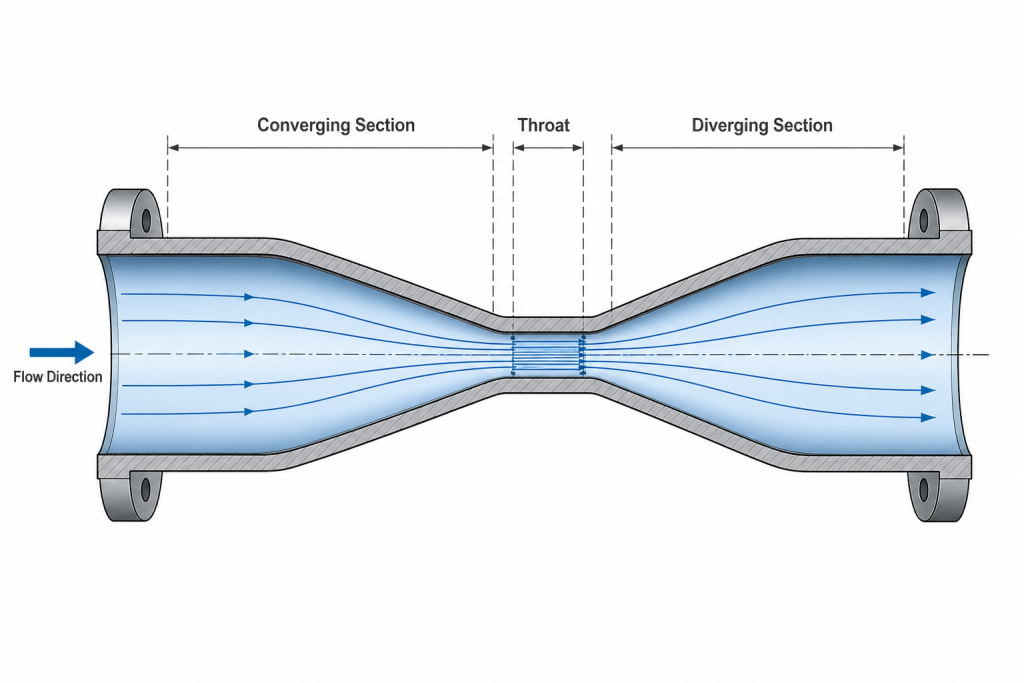
Venturi Valve Control System Troubleshooting & Root Causes | BCST
Solving costly downtime: A practical guide for diagnosing Venturi control valve malfunctions in the field.
A sudden, unexpected shutdown or erratic behavior from a critical control valve—especially a high-performance Venturi valve—can bring an entire process to a grinding halt. When production is on the line, quickly identifying the root cause of the malfunction is paramount. Often, the issue isn’t with the Venturi valve itself, but rather with its peripheral control system components like the actuator or positioner, or even an upstream process disturbance. This guide is built to serve as an indispensable troubleshooting checklist for I&C Engineers, Maintenance Supervisors, and Reliability Engineers facing the pressure of getting systems back online.
Urgent Action: Before delving into complex diagnostics, always ensure all safety protocols are followed, LOTO (Lockout/Tagout) procedures are in place, and appropriate PPE is worn. The stability of the Venturi valve’s control system is crucial for operational integrity and personnel safety.
At BCST Valve, our commitment to reliability extends beyond manufacturing. We provide the expertise needed to keep your systems running smoothly. This article breaks down common failure points, provides diagnostic steps, and helps you distinguish between true valve failure and related system anomalies. Understanding these failure modes requires a solid grasp of the core technology, as detailed in our Ultimate Guide to Venturi Valves.
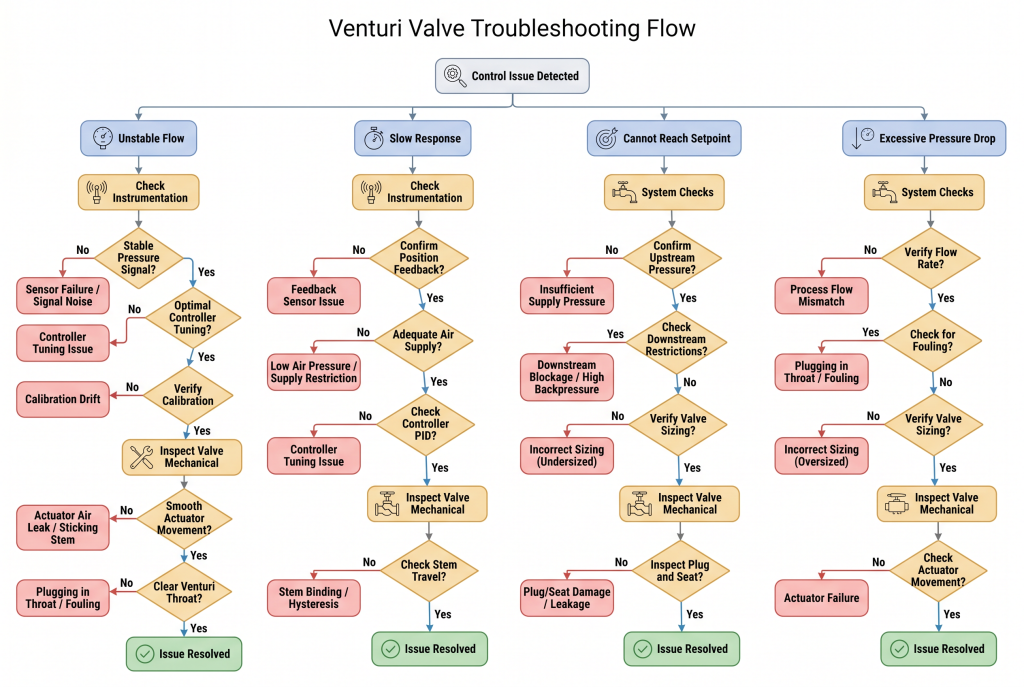
Systematic Diagnostics: Where to Begin
A systematic approach is critical when a Venturi valve control system is acting up or has completely shut down. Start from the most accessible and common failure points, working your way towards more complex internal valve issues.
1. Actuator Concerns (The Muscles)
The actuator provides the motive force to move the Venturi valve. Problems here are often mechanical or pneumatic/electrical in nature.
- Loss of Supply Pressure/Power:
- Pneumatic: Check air supply pressure to the actuator. Is the instrument air dry and clean? Blockage or water in lines (>10 psi minimum required).
- Electric: Verify power supply and proper voltage/current. Check circuit breakers, fuses.
- Mechanical Binding/Damage: Inspect linkage between actuator and valve stem. Look for bent rods, loose connections, signs of external damage. Lubrication issues can also cause sluggish movement.
- Diaphragm/Piston Leaks (Pneumatic): Listen for air leaks. A ruptured diaphragm or worn piston seal will prevent the actuator from generating enough force.
- Motor burnout/Gearing Issues (Electric): Can often be identified by humming without movement, or unusual noises.
2. Positioner Malfunctions (The Brains)
The positioner translates the control signal into the precise movement of the actuator. This is a common culprit for erratic behavior or no response.
- Loss of Control Signal:
- Analog (4-20mA): Use a multimeter to verify the signal from the DCS/PLC. Is it stable? Is it within the expected range (e.g., 4mA = 0% demand, 20mA = 100% demand)?
- Digital (HART/Fieldbus): Check communication links, device addresses, and master communication.
- Calibration Drift/Error: Positioners require periodic calibration. A drifted calibration can lead to incorrect valve positioning or hunting. Perform a field calibration if possible.
- Feedback Mechanism Failure: The positioner’s internal feedback (e.g., potentiometer) might be damaged or disconnected, preventing it from knowing the actual valve position.
- Internal Blockage (Pneumatic Positioners): Small particles or moisture can block internal air pilot tubes, preventing proper air flow to the actuator.
3. Control Signal Issues (The Nerves)
Problems originating higher up the control loop can appear as valve issues. Always check the signal at the source and at the valve.
- Faulty Wiring/Loop Resistance: Damaged wires, loose connections, or excessive loop resistance can degrade or lose the signal.
- DCS/PLC Fault: The control system itself might be sending an incorrect or no signal. Check the output card in the control room.
- Sensor/Transmitter Failure: If the valve’s position is based on a feedback sensor (e.g., flow transmitter), a failure here can send incorrect signals to the controller, which then sends the wrong signal to the valve.
4. Process-Related Problems (Mimicking Valve Failure)
Sometimes, the Venturi valve is working perfectly, but external process conditions are causing the perceived malfunction.
- Upstream/Downstream Pressure Fluctuations: Sudden changes in line pressure can affect the flow rate through the valve, even if its position is correct. A common issue is a starved pump upstream or a blocked filter downstream.
- Line Blockage/Fouling: Debris or build-up within the pipe leading to or from the valve can restrict flow, making it seem like the valve isn’t opening enough.
- Flashing/Cavitation (though rare in Venturi): While Venturi valves are designed to resist these, extreme process conditions (e.g., fluid exceeding its vapor pressure due to high temperature or sudden pressure drop) can still lead to these phenomena, causing noise and flow instability that might be mistaken for valve failure.
- Incorrect Sizing: An improperly sized Venturi valve (too large or too small) will struggle to maintain accurate control across the full operating range, leading to perceived “failure.”
5. Internal Venturi Valve Issues (The Core)
While Venturi valves are robust, internal issues can occur, especially in harsh conditions or after significant operational hours.
- Plug/Disc Binding: Accumulation of process media, crystallization, or foreign objects can prevent the control element (plug or disc) from moving freely.
- Stem Damage/Wear: A bent or worn valve stem can lead to binding or inconsistent positioning.
- Seat Leakage: While not a “shutdown” cause, excessive seat leakage can lead to poor control or failure to isolate, mimicking a control problem.
- Erosion/Corrosion: In abrasive or corrosive services, internal valve components might degrade over time, leading to altered flow characteristics or mechanical failure.
Conclusion: Prompt Diagnosis, Minimal Downtime
When a Venturi valve control system shuts down, the cost implications can be significant. A methodical root cause analysis—starting from the actuator, moving through the positioner and control signal, and finally considering process and internal valve issues—is the most effective way to restore operations efficiently. While Venturi valves are known for their resilience, their performance is inherently tied to the health of their surrounding control loop.
BCST Valve is your partner in maintaining peak operational performance. Our technical support and expertise ensure that whether it’s a diagnostic challenge or a need for reliable replacement parts, you have the resources to minimize downtime and optimize your process control.
Facing a Venturi valve control system issue?


 English
 Arabic
 Russian
 French
 Spanish