
You’re facing unexpected downtime and costly emergency repairs again. A critical valve has failed without warning, halting production and compromising safety, leaving you to wonder how this could have been avoided.
A successful valve maintenance plan prevents failures by scheduling regular inspections and service based on the valve’s type, application, and criticality. This proactive approach combines preventive checks, predictive monitoring, and a clear repair-versus-replace strategy to maximize reliability and uptime.

I learned the true value of a maintenance plan not in our factory, but from a client. Years ago, a plant manager named David called me in a panic. A critical globe valve in his steam line had seized, causing a shutdown that cost his company tens of thousands per hour. He asked, “Emily, your valve failed!” When I arrived on-site, I saw the valve was caked in grime, its stem unlubricated and bent. It hadn’t “failed”; it had been neglected. We walked through his plant, and I saw dozens of valves in similar condition. He had no schedule, no checklists, no designated personnel. Together, we sat down and drafted his very first valve maintenance plan, categorizing valves by how critical they were. It was a turning point for him, and for me. It cemented my belief that our job isn’t just to sell valves, but to ensure they have a long, safe, and productive life in our customers’ plants.
What Are the Core Types of Valve Maintenance Strategies?
You hear terms like “preventive” and “predictive” maintenance, but they sound like jargon. You need a simple way to understand these concepts so you can apply them effectively in your own facility.
The three core maintenance strategies are: corrective (fixing what’s broken), preventive (servicing on a schedule to prevent breaks), and predictive (using data and monitoring to service just before a break occurs).
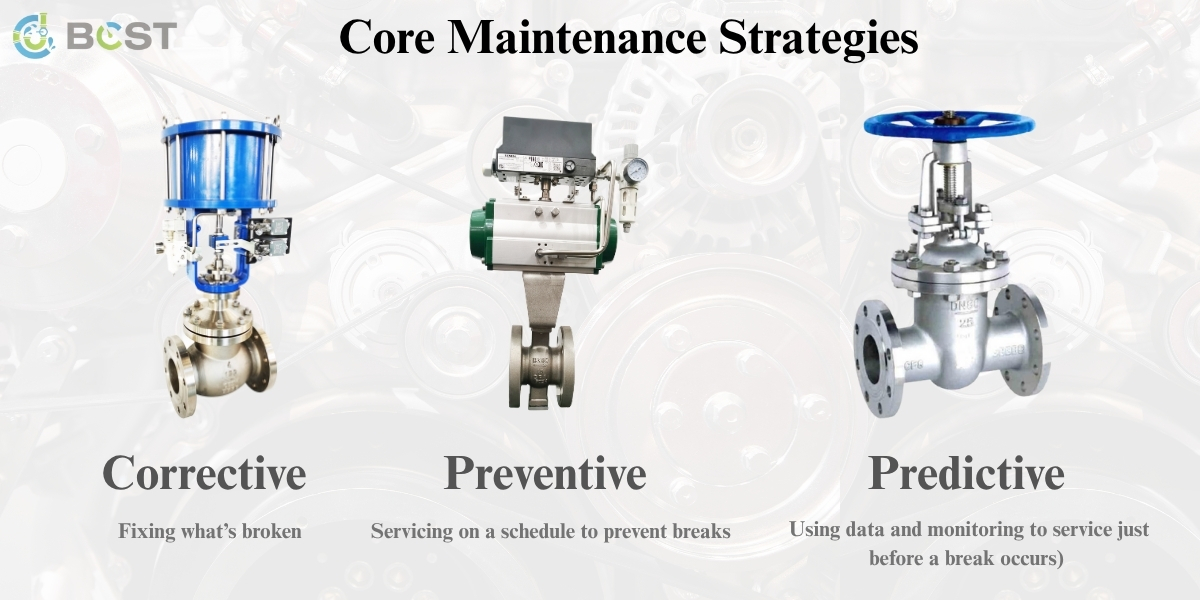
Understanding the difference between these strategies is the first step in building a robust plan. Each has its place, and the best programs use a blend of all three. Think of it as a journey from reactive to proactive control. Corrective Maintenance is the most basic, often called “run-to-failure.” You simply wait for a valve to break down and then you fix or replace it. This is the most expensive and disruptive approach, reserved only for non-critical valves where a failure has little impact.
Preventive Maintenance (PM) is a huge leap forward. This is a time-based strategy. You create a schedule to inspect, lubricate, and service valves at regular intervals, regardless of their current condition. This approach is based on manufacturer recommendations and historical failure data. It dramatically reduces unexpected failures but can sometimes lead to performing maintenance on a perfectly healthy valve, which costs time and money.
Predictive Maintenance (PdM) is the most advanced strategy. It is condition-based. Instead of relying on a calendar, you use monitoring tools and data analysis to predict when a valve is likely to fail, then you intervene just in time. This is the most efficient approach, optimizing both reliability and resource use.
| Maintenance Strategy | Description | When to Use It | Pros | Cons |
|---|---|---|---|---|
| Corrective | Fix it when it breaks. | Non-critical systems, low-impact failures. | No upfront planning needed. | High downtime, safety risks, expensive emergencies. |
| Preventive | Service on a fixed schedule. | Critical systems, predictable wear components. | Increases reliability, prevents many failures. | Can result in unnecessary maintenance. |
| Predictive | Service based on condition monitoring. | Highly critical systems, complex valves. | Maximizes uptime, minimizes maintenance costs. | Requires investment in tools and training. |
How Do You Build a Practical Preventive Maintenance Checklist?
Knowing you need to do preventive maintenance is one thing. Actually creating a useful, step-by-step checklist that your team can follow is the real challenge that separates planning from doing.
A practical preventive maintenance checklist is built by first identifying the valve and its function, then listing specific, actionable tasks for inspection like checking for leaks, verifying actuation, and performing lubrication on a set schedule.
A good checklist removes guesswork. It ensures that every technician, whether a seasoned veteran or a new hire, performs the same essential checks every single time. This consistency is the key to reliability. Start by creating a template, then customize it for different valve types and service conditions. A checklist for a simple manual ball valve will be very different from one for a pneumatically actuated control valve.
Your checklist should be organized logically, moving from external visual checks to more hands-on tasks. Start with safety by ensuring the valve is properly isolated if required. Then, perform a visual inspection of the valve body, packing, and connections. Look for any signs of corrosion, damage, or external leaks. Next, check the valve’s operation. For a manual valve, does the handwheel turn smoothly through its full range? For an actuated valve, does it stroke fully and respond correctly to its control signal? Finally, perform routine service tasks. The most important of these is lubrication. Applying the correct grease to the valve stem, stem nut, and gearbox fittings is critical for preventing seizure and ensuring smooth operation.
Sample Quarterly Checklist for a Manual Gate Valve:
-
Valve ID/Tag: _______________
-
Location: _______________
-
Date: _______________
-
Technician: _______________
Safety Check:
-
Confirm line is isolated/depressurized (if required for task).
-
Area is clear of hazards.
Inspection visuelle :
-
Check valve body for corrosion or damage.
-
Inspect bolting for tightness and corrosion.
-
Check for leaks at flanges and packing gland. (Note location/severity)
Operational Check:
-
Cycle the valve from fully open to fully closed.
-
Note any roughness, binding, or excessive force needed.
Lubrification :
-
Clean grease fitting on yoke nut.
-
Apply manufacturer-specified lubricant until clean grease appears.
-
Lubricate handwheel bearing.
When Should You Repair a Valve Versus Replacing It?
A critical valve is leaking, and you have a decision to make. Do you pull it from the line for a potentially complex and time-consuming repair, or do you just swap it out for a new one?
Decide to repair or replace a valve by conducting a cost-benefit analysis. A repair is viable if the cost of labor and parts is significantly less than a new valve’s price and the repaired valve’s expected lifespan is acceptable.

This decision is a constant balancing act for every plant engineer. There is no single right answer; it always depends on the situation. The primary driver is almost always cost, but you must consider the total cost, not just the price of a new valve. Think about the “Three C’s”: Cost, Criticality, and Condition.
First, Coût. Calculate the estimated cost of the repair. This includes the technician’s labor hours (for removal, disassembly, repair, reassembly, and re-installation), the price of the required repair kit or spare parts (like seats, seals, and packing), and any specialized tools or testing needed. Compare this total to the purchase price of a new, equivalent valve. A common rule of thumb is that if the repair cost exceeds 50-60% of the replacement cost, replacement is usually the better financial choice.
Second, Criticality. How important is this valve to your operation? For a highly critical valve where failure would cause a major shutdown or a safety incident, replacing it with a new valve that comes with a full factory warranty provides the highest level of assurance. For less critical services, a properly executed repair can be a perfectly acceptable and cost-effective option.
Finally, assess the Condition of the valve’s core components. If the soft parts like seats and seals are worn, that’s a standard repair. However, if the main valve body or ball/disc is severely corroded, eroded, or warped, a repair is often impossible or impractical. The integrity of the core pressure-retaining components is the ultimate deciding factor.
Conclusion
A well-structured valve maintenance plan is your best defense against unplanned downtime. It transforms maintenance from a reactive fire-fight into a proactive strategy, ensuring safety, reliability, and operational efficiency for your plant.


 English
 Arabic
 Russian
 French
 Spanish