
Understanding Flow (Cv) in Miniature Ball Valves: A Critical Guide
In any fluid control system, whether large-scale industrial pipelines or intricate miniature setups, understanding flow dynamics is paramount. For miniature ball valves, whose very purpose is to manage the passage of liquids or gases in confined spaces, a specific technical parameter stands out: the Flow Coefficient, or Cv (pronounced ‘C-v’). This seemingly simple number holds the key to predicting a valve’s performance, preventing system inefficiencies, and ensuring the accurate operation of your compact fluid paths.
This guide from BCST Valve will demystify Cv for miniature ball valves. We’ll explain what it is, why it’s crucial for smaller valves, how various factors influence it, and how you can use this knowledge to select the perfect valve for your precise flow requirements.
For a foundational understanding of these components, start with our comprehensive overview: What Is a Miniature Ball Valve? A Complete Guide.
What is Flow Coefficient (Cv)? The Core Definition
The Flow Coefficient (Cv) is an empirically determined value that quantifies the ability of a valve to pass fluid. In simpler terms, it’s a measure of how much fluid a valve can flow for a given pressure drop. A higher Cv value indicates that a valve can pass more fluid with less resistance.
Standard Reference Conditions:
Cv is typically defined under standard conditions to allow for consistent comparison:
- The volume of water (in US Gallons) at 60°F (15.5°C).
- That will flow through a wide-open valve.
- In one minute.
- While maintaining a pressure drop of exactly 1 pound per square inch (psi) across the valve.
Why Cv is Especially Important for Miniature Ball Valves
For larger industrial valves, a slight deviation in Cv might not dramatically impact system performance. However, for miniature ball valves used in compact, sensitive systems, Cv takes on elevated importance:
- Precise System Design: In microfluidics, instrumentation, or pneumatic circuits, even small variations in flow capacity can severely disrupt sensor readings, actuator speeds, or overall process accuracy.
- Efficacité énergétique : A valve with too low a Cv can cause excessive pressure drop, forcing pumps to work harder and consume more energy.
- Avoiding Undersizing/Oversizing:
- Undersized Valve (Too Low Cv): Restricts flow, causes high pressure drop, reduces system output, and can lead to cavitation or flashing.
- Oversized Valve (Too High Cv): Can result in difficult flow control, especially at low flow rates, and potentially higher cost and space requirements.
- Critical Performance Metrics: For applications where flow rates are critical (e.g., cooling lines for sensitive electronics, dosing in chemical analysis), Cv directly determines whether the valve will meet the performance specifications.
Factors Affecting a Miniature Ball Valve’s Cv
Several design characteristics directly impact the flow coefficient of a miniature ball valve:

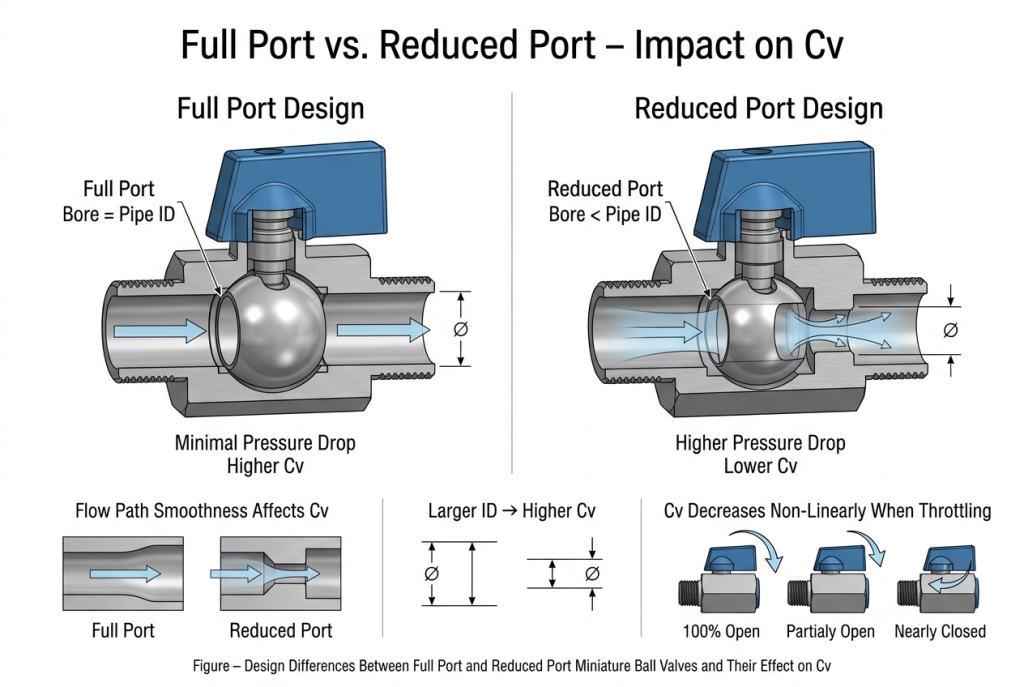
1. Port Size and Type:
- Port complet : The bore through the ball has the same inner diameter (ID) as the pipeline it’s connected to. Offers maximum flow with minimal pressure drop, resulting in a higher Cv.
- Reduced Port: The bore through the ball is smaller than the pipeline’s ID. This design is often chosen for miniature valves to achieve a more compact body or reduce cost. It leads to a lower Cv and a greater pressure drop. For mini valves, reduced port is common, so confirming this is essential.
2. Internal Valve Geometry:
- Flow Path Smoothness: Any sharp edges, abrupt changes in direction, or rough internal surfaces will create turbulence and resistance, lowering the Cv.
- Internal Diameter: Generally, a larger internal diameter (for a given connection size) will result in a higher Cv.
3. Valve Opening Degree:
While ball valves are primarily used for on/off applications, their Cv clearly varies with the degree of opening. The maximum Cv is achieved when the valve is fully open (100% open). As the valve closes, the effective flow area decreases, and so does the Cv. This is why ball valves are generally considered poor for throttling—the Cv changes non-linearly, making precise flow control difficult (for precise control, consider the alternative, as discussed in Miniature Ball Valve vs. Needle Valve: Which to Choose?).
Using Cv in System Design: Formulas and Practical Application
Manufacturers typically provide Cv values for their valves. However, you might need to calculate the required Cv for your application to select the correct valve, or calculate expected flow rates and pressure drops for a given Cv.
Basic Cv Formula for Water:
Cv = Q × √(Gf / ΔP)
Where:
- Q = Flow rate in US Gallons per minute (GPM)
- Gf = Specific Gravity of the fluid (1.0 for water at 60°F)
- ΔP = Pressure drop across the valve in psi
For Gases and Other Liquids:
More complex formulas are required for gases (considering temperature, pressure, and compressibility) and liquids with different specific gravities or viscosities. These calculations often involve additional factors and are best performed using specialized engineering software or by consulting manufacturer’s detailed data tables. Always use the manufacturer’s published Cv for their specific valve to ensure accuracy.
Selecting Your Miniature Ball Valve Based on Cv
When selecting a miniature ball valve, use the Cv information in conjunction with other critical parameters, as discussed in our guide to Choosing Your Miniature Ball Valve: A Guide to Materials, Connections & Ratings.
- Determine Required Flow Rate (Q): What is the maximum or nominal flow your system needs?
- Set Acceptable Pressure Drop (ΔP): What is the maximum pressure loss you can tolerate across the valve without affecting other components?
- Identify Fluid Properties (Gf): Especially for liquids other than water.
- Calculate Required Cv: Use the appropriate formula for your fluid.
- Consult Manufacturer’s Data: Compare your calculated Cv with the published Cv values of available miniature ball valves. Aim for a valve whose Cv meets or slightly exceeds your requirement.
Remember, a well-chosen Cv ensures that your fluid system operates at its peak efficiency, delivering the expected flow with minimal energy waste and consistent performance.
Conclusion
The Flow Coefficient (Cv) is far more than just a technical specification—it’s a fundamental metric for intelligent valve selection, especially when dealing with the nuanced demands of miniature fluid systems. By understanding Cv, you gain the power to design more efficient, precise, and reliable processes, avoiding common pitfalls associated with flow restrictions and pressure imbalances.
At BCST Valve, we believe in empowering our clients with the knowledge and the quality components they need. Our range of miniature ball valves is designed with meticulously documented Cv values, ensuring you can make confident choices for every critical application.
Need help calculating Cv or selecting the right valve?


 English
 Arabic
 Russian
 French
 Spanish