
The True Cost of a Solvent Weld Ball Valve (It’s Not the Purchase Price)
For many in industrial and commercial plumbing, the seemingly low upfront PVC ball valve cost of a basic solvent weld ball valve can be highly attractive. It’s a commodity item, often chosen based solely on its price tag. However, relying on this single metric for critical fluid control applications is a common, and often costly, mistake. The initial purchase price is merely a fraction of the total cost of ownership valve (TCO).
At BCST Valve, we believe in transparency about the full financial implications of valve selection. This guide will challenge the conventional wisdom, revealing the hidden layers of expenditure that contribute to the actual solvent weld ball valve true cost over its operational lifespan. Understanding these factors is crucial for purchasing managers, plant owners, and senior contractors looking to optimize their industrial valve cost management strategies.
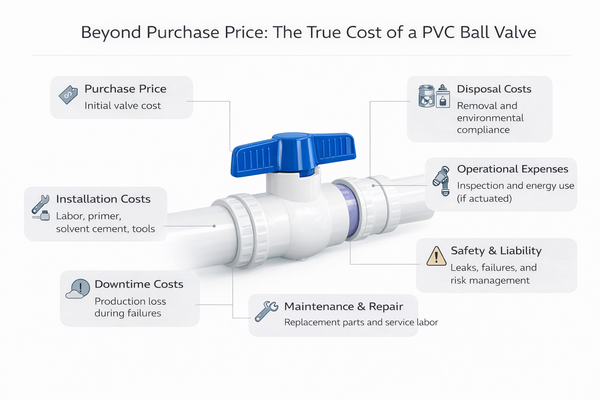
Beyond the Sticker Price: Understanding Total Cost of Ownership (TCO)
The concept of Total Cost of Ownership extends far beyond the point of purchase. For a solvent weld ball valve, it encompasses every expense incurred from specification through disposal. A robust lifecycle cost analysis includes:
- Purchase Price: The immediate, visible cost of the valve itself.
- Installation Costs: Labor, consumables (primer, cement), and any specialized tools.
- Operational Expenses: Energy consumption (if actuated), inspection labor.
- Maintenance and Repair Costs: Parts, labor for repair, or replacement.
- Downtime Costs: Loss of production, labor idling, missed sales targets due to system outages.
- Disposal Costs: Environmental compliance and removal at end-of-life.
- Safety and Liability Costs: Expenses arising from failures, leaks, or accidents.
For a basic PVC ball valve cost, the purchase price often makes up a disproportionately small percentage of this overall TCO, with significant expenses accumulating in the “hidden cost” categories.
The Hidden Multipliers: Where Solvent Weld Ball Valve Costs Soar
1. Installation Errors: The First Chink in the Armor
The solvent welding process, while seemingly straightforward, is surprisingly unforgiving. Environmental conditions, surface preparation, primer application, and cement setup time all critically impact joint integrity. What appears to be a rapid and cost-effective installation method can quickly become a liability.
A poorly executed solvent weld joint might hold initially but fail catastrophically weeks or months later under pressure or thermal cycling. This leads to expensive callbacks, material waste, and the urgent need for a repair. The labor cost and subsequent material loss often far exceed the saving made on the initial pvc ball valve cost. These hidden costs of valves are often underestimated.
Deeper Dive: The most common source of these hidden costs is a rushed installation. A seemingly minor error in the solvent weld process can lead to a complete joint failure weeks later, as we detail in The 5-Minute Mistake That Causes a Solvent Weld Joint to Fail.
2. Misapplication: A Recipe for Catastrophe and Expense
A significant portion of a solvent weld ball valve true cost comes from using a valve not designed for its specific service. While PVC is excellent for many applications (water, dilute chemicals), it has limitations regarding temperature, pressure, chemical compatibility, and pressure surge resistance. Implementing poor valve selection criteria can lead to disaster.
- Temperature and Pressure Limits: Over-pressurizing or exceeding temperature limits can lead to valve body cracking, seat deformation, and complete system failure.
- Chemical Compatibility: Exposure to incompatible chemicals can degrade plastic, seals, and O-rings, causing leaks and premature failure.
- Pressure Surge: Water hammer can severely stress plastic components, leading to fatigue and sudden rupture.
The highest costs are incurred during misapplication failures. Using a standard valve in the wrong service can have disastrous safety and financial consequences. A prime example is detailed in our safety warning: Do NOT Use a Standard PVC Valve for Compressed Air.
3. Non-Serviceable Design: The Downtime Trap
Most basic solvent weld ball valves are designed as “one-piece” or “single union” units, meaning they cannot be easily disassembled for repair or seal replacement. When they fail—whether due to worn seals, a jammed ball, or internal damage—the entire valve must be cut out of the pipeline. This inherent design limitation is a major driver of elevated operational expenses valve systems face.
Cutting out an old valve, re-preparing pipe ends, and solvent welding a new valve in place is a time-consuming process. During this period, the affected system or even an entire plant section can be inoperable, directly impacting productivity and generating significant downtime costs. These expenses often dwarf the initial PVC ball valve cost difference compared to more robust, easily serviceable alternatives.
Efficiency Gains: The inability to service a cheap valve means a simple leak requires cutting pipe and a multi-hour shutdown. We contrast this with a modern solution in From Cutting Out Failed Valves to a 10-Minute Swap: The Case for True Union.
Calculating Your True Cost: A Formula for Decision-Makers
To truly understand the solvent weld ball valve true cost, consider the following formula for a realistic lifecycle cost analysis:
True Cost = Purchase Price + (Labor to Install) + (Cost of Callback/Repair x Failure Rate) + (Cost of System Downtime)
- Purchase Price: The easy one.
- Labor to Install: Calculate man-hours for installation x hourly rate. Factor in consumables.
- Cost of Callback/Repair: Estimate the cost of a full repair (labor, replacement valve, pipe).
- Failure Rate: Based on historical data, what percentage of these valves fail prematurely or require significant intervention (e.g., 5%, 10%)? Multiply this by the ‘Cost of Callback/Repair.’
- Cost of System Downtime: This is often the largest hidden cost. Calculate lost production, idle labor, and missed deadlines per hour of shutdown, then multiply by estimated repair time.
By applying this formula, decision-makers can uncover the surprising reality that a valve with a slightly higher initial PVC ball valve cost but superior reliability, ease of maintenance, and appropriate material construction can deliver a significantly lower overall total cost of ownership valve in the long run.
Conclusion: Investing in Value, Not Just Price
The lure of a low-cost solvent weld ball valve can be strong, but the astute professional understands that true economy lies in minimizing the total cost of ownership valve over its entire service life. Focusing solely on the initial PVC ball valve cost blinds an organization to the substantial downstream expenses driven by installation failures, misapplication, and non-serviceable designs.
At BCST Valve, we advocate for a holistic view of industrial valve cost management. Our commitment is to provide valves that deliver superior performance, reduce operational risks, and, ultimately, lower your overall lifecycle cost analysis. By making informed choices based on a comprehensive understanding of the solvent weld ball valve true cost, businesses can optimize their capital and operational expenditures, ensuring reliable and profitable fluid handling systems for years to come.
Ready to make informed valve investment decisions?
“`


 English
 Arabic
 Russian
 French
 Spanish