
Triple Eccentric Butterfly Valve Design: Offsets, Sealing, and Benefits
Leaking valves cause expensive downtime and safety risks in your plant. You need a reliable solution that lasts. The triple eccentric butterfly valve design offers bubble-tight sealing for critical applications.
This advanced valve uses three separate offsets to move the disc. This unique geometry creates a cone-in-cone sealing action. It completely eliminates friction during opening and closing, which prevents wear and ensures a perfect, long-lasting seal for your most demanding processes.
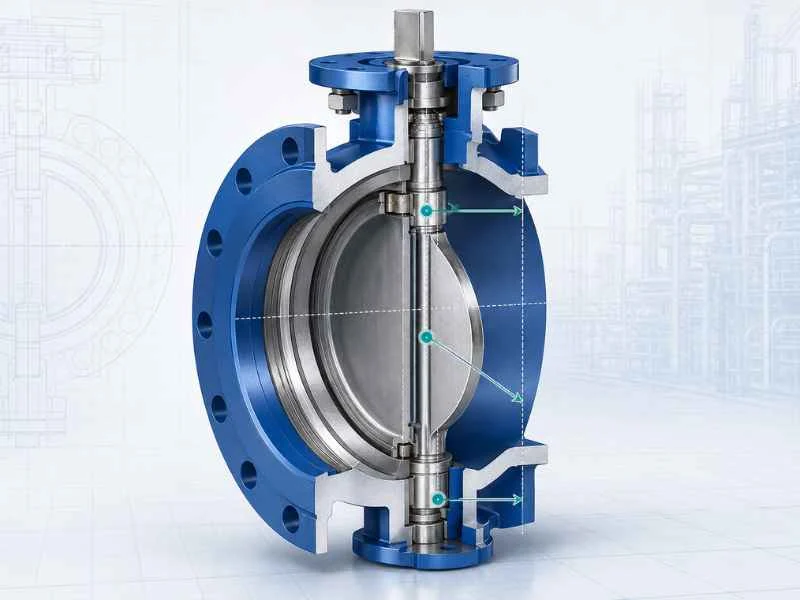
As an engineer, you need equipment that performs without failure. A standard valve might seem good enough, but in high-pressure or high-temperature systems, “good enough” can lead to serious problems. You need certainty. The technology behind the triple eccentric butterfly valve provides that certainty. Let’s break down how each part of this design works together to give you the performance and reliability your projects demand. You will see why it is the top choice for engineers who cannot afford to compromise on quality and safety.
The First Offset Centers the Disc
Your standard butterfly valves wear out too fast. The disc constantly rubs against the seat, causing leaks and requiring frequent maintenance. A small design change can fix this expensive problem.
The first offset moves the shaft backward from the centerline of the seat. This is a simple but important step. It reduces the area of contact between the disc and the seat, minimizing wear during the valve’s rotation and extending its operational life.
To truly appreciate the first offset, you need to understand the problem with basic butterfly valves. These are often called concentric or zero-offset valves. In these valves, the stem passes directly through the center of the disc, and the disc is always in contact with the soft seat. Every time the valve opens or closes, the disc scrapes against the seat. This constant rubbing action quickly degrades the sealing material. This leads to leaks, process inefficiencies, and the need for frequent replacements. It is a major issue in any industrial setting. The first offset directly addresses this by shifting the shaft’s position. This simple change means the disc can swing away from the seat more effectively, reducing the constant pressure and friction that causes so much damage in concentric designs.
How the First Offset Improves Durability
This initial adjustment is the first step toward a more durable and reliable valve. It sets the foundation for the other two offsets.
| Type de vanne | Shaft Position | Seat Contact | Primary Issue |
|---|---|---|---|
| Concentric (Zero Offset) | Center of disc and seat | Constant contact | High friction and rapid wear |
| Single Offset | Behind the seat centerline | Reduced contact | Less friction, better lifespan |
For a project manager like Hassan, who designs entire chemical plants, this increased durability is critical. It means fewer scheduled shutdowns for valve maintenance and a more reliable process overall.
The Second Offset Creates a Cam Action
Even with one offset, the disc still rubs the seat during the first and last parts of its rotation. This friction is a weak point. It can still lead to wear over thousands of cycles.
The second offset solves this problem. It moves the shaft’s centerline to the side, away from the pipe’s centerline. This creates a smooth, cam-like action. The disc lifts off the seat almost instantly as it begins to open, avoiding any rubbing or scraping.
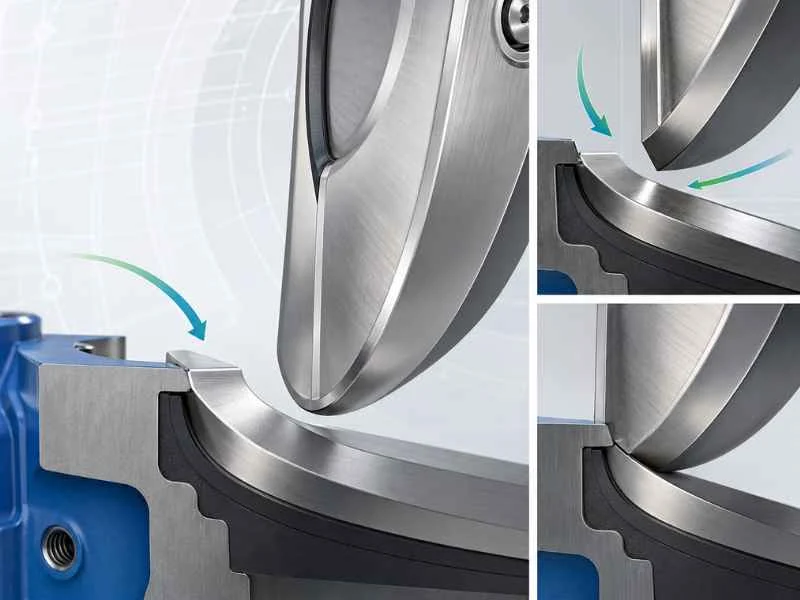
This cam action is what really separates double and triple eccentric valves from simpler designs. The combination of the first and second offsets means the disc moves like a pendulum swinging away from a wall. It doesn’t just rotate; it moves away from the seat in a continuous, frictionless arc. The only time the disc touches the seat is in the final few degrees of closing. This is a huge advantage in high-cycle applications where a valve may open and close thousands of times. I remember when I first started working in my family’s factory. I saw two valves side-by-side: a concentric valve and a double eccentric one. Both had been through a cycle test. The concentric valve’s seat was visibly torn and worn. The double eccentric valve’s seat looked almost new. That visual comparison showed me the real-world impact of this design feature.
How Cam Action Reduces Wear
This clever movement drastically reduces wear and tear. It ensures the valve’s sealing integrity over a much longer period.
- Initial Opening: The disc immediately lifts off the seat.
- Rotation: The disc rotates freely without any contact.
- Final Closing: The disc only makes contact with the seat at the very last moment to create a tight seal.
This is why double and triple eccentric valves are known for their longevity. For your projects, this means better long-term performance and lower total cost of ownership.
The Third Offset Eliminates All Friction
The first two offsets greatly reduce friction, but they do not eliminate it. For a truly bubble-tight seal in critical services, you need a perfect design. Any remaining friction is a potential point of failure.
The third and final offset is what defines the triple eccentric butterfly valve design. It is an angular adjustment of the sealing cone’s axis relative to the valve’s centerline. This ensures the sealing components only touch at the exact moment of full closure, with zero friction during rotation.
This third offset is the key to superior performance. It creates what we call a “cone-in-cone” seating geometry. Imagine two cones fitting perfectly together. The valve disc seal is machined into the shape of an angled cone, and the valve body seat is also machined into a matching cone shape. Because of the three offsets, the disc’s conical seal moves in a path that does not touch the body’s conical seat until the valve is fully closed. At the moment of shutoff, the two cones wedge together perfectly, creating a uniform, compression-based seal around the entire perimeter. This action is completely frictionless. It allows the use of metal-to-metal seals that can handle extreme temperatures and pressures without wearing out. This is impossible with other butterfly valve designs that rely on friction.
The ‘Cone-in-Cone’ Sealing Principle
This principle is what allows the valve to deliver zero-leakage performance, even in the toughest conditions.
| Offset | Fonction | Résultat |
|---|---|---|
| First | Moves shaft behind the seat | Reduces initial seat wear |
| Second | Moves shaft to the side | Creates cam action, lifting disc off seat |
| Third | Tilts the cone axis | Eliminates all friction during rotation |
Le triple eccentric butterfly valve design provides bi-directional, bubble-tight shutoff. It is the ultimate solution for critical applications in oil and gas, chemical processing, and power generation.
Choosing Materials for Harsh Conditions
A great design is not enough if the materials cannot handle the service conditions. In a refinery or chemical plant, using the wrong material can lead to dangerous and costly failures.
A triple eccentric butterfly valve design allows for the use of robust materials. Laminated metal seals and solid metal seats are common choices. These materials enable the valve to perform reliably in extreme temperatures, high pressures, and corrosive environments where soft-seated valves would fail instantly.
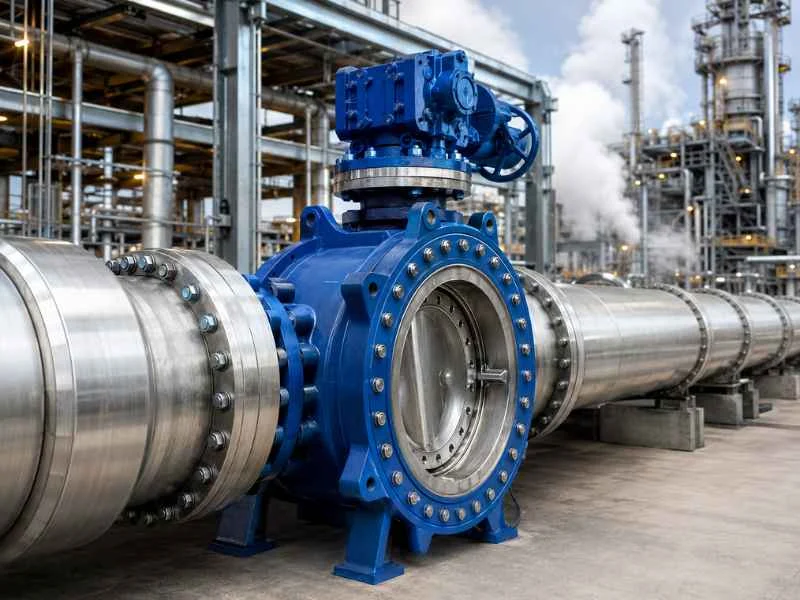
The frictionless nature of the design is what makes these strong materials possible. Soft seats in other valves deform to create a seal, but they cannot withstand high heat or abrasive media. The triple eccentric valve does not need a soft, deformable material. Its seal is achieved through precise geometry and compression. The most common seal type is a laminated seal, made of alternating layers of flexible graphite and strong stainless steel. The graphite provides the flexible sealing capability, while the stainless steel provides rigidity and strength. This combination is excellent for high temperatures. For the body seat, a hard material like Stellite is often welded onto the base metal. Stellite provides an extremely hard, wear-resistant surface that ensures a tight seal for thousands of cycles.
Common Materials for Key Components
Choosing the right material combination is critical for safety and longevity, especially when dealing with hazardous media.
| Composant | Common Material | Raison |
|---|---|---|
| Corps | Carbon Steel, Stainless Steel | Provides strength and corrosion resistance. |
| Disque | Duplex, Stainless Steel | Offers high strength for pressure and flow. |
| Seal Ring | Laminated Graphite/SS316 | Handles high temperatures and ensures a tight seal. |
| Siège | Stellite Hardfacing | Delivers extreme durability and wear resistance. |
For an engineer like Hassan, who must perform risk analyses like HAZOP, specifying a valve with these materials provides confidence. It ensures the plant’s safety and operational integrity.
Triple Eccentric Valves Offer Key Advantages
You have many valve options for your projects, including traditional gate and ball valves. Choosing the wrong type can increase costs, reduce efficiency, and introduce unnecessary risks into your system.
Compared to gate and ball valves, the triple eccentric butterfly valve gives you a more compact, lightweight solution. It provides zero-friction operation and true bubble-tight shutoff. This often leads to lower installation costs and much better performance in the most critical applications.
Let’s look at the practical differences. A gate valve is very heavy and bulky. It also requires many turns to open or close, making it slow to operate. Its sealing mechanism relies on a gate sliding between two seats, which creates friction and is prone to wearing down, especially if the media contains particles. A ball valve offers a good seal and quick quarter-turn operation. However, its seats can trap particles, and it can be heavy and expensive in larger sizes. The triple eccentric butterfly valve design combines the best of both worlds. It is a quarter-turn valve like a ball valve, making it fast and easy to automate. But it is much lighter and more compact than both ball and gate valves, especially in large pipe diameters. This reduces the need for expensive pipe supports and makes installation easier in tight spaces.
Head-to-Head Comparison
The choice depends on the application, but for high-performance needs, the triple eccentric valve often comes out on top.
| Fonctionnalité | Triple Eccentric Butterfly | Vanne à guillotine | Soupape à bille |
|---|---|---|---|
| Scellement | Zero-Friction, Bubble-Tight | Sliding Friction, Prone to Wear | Wiping Action, Good Seal |
| Size/Weight | Compact, Lightweight | Bulky, Heavy | Moderate to Heavy |
| Fonctionnement | Quarter-Turn (Fast) | Multi-Turn (Slow) | Quarter-Turn (Fast) |
| Application | High-P, High-T, Critical Shutoff | General On/Off Isolation | On/Off, Some Throttling |
For a chief engineer designing a complex plant, the lower weight and smaller footprint can significantly reduce structural costs and simplify the piping layout. It’s a smarter, more efficient choice for modern industrial projects.
Questions fréquemment posées
Q1: What makes the triple eccentric butterfly valve design suitable for high-pressure applications?
A: The design uses a solid metal seat and a conical sealing geometry. When closed, the disc wedges into the seat, creating a high-integrity, compression-based seal. This metal-to-metal contact, free from friction, can withstand very high pressures without leaking or getting damaged, unlike soft-seated valves.
Q2: How does the triple eccentric butterfly valve design achieve zero leakage?
A: Zero leakage, or bubble-tight shutoff, is achieved through the cone-in-cone seating principle. The three offsets ensure the disc’s conical seal perfectly matches the body’s conical seat only at the moment of closure. This creates a uniform, tight seal around the entire circumference, preventing any fluid from passing through.
Q3: Can a triple eccentric butterfly valve be used for throttling?
A: Yes, it can be used for throttling, but it excels in shutoff applications. For throttling, the disc is held in a partially open position. The valve’s inherent strength and design make it more capable of handling flow control than other butterfly valves. However, for continuous, precise throttling, a globe valve is often preferred.
Q4: What is the main benefit of the third offset in the triple eccentric butterfly valve design?
A: The main benefit of the third offset is the complete elimination of friction between the seat and seal during the valve’s rotation. This allows for the use of durable metal seals, prevents wear and tear, extends the valve’s life significantly, and ensures a repeatable, tight seal over thousands of cycles.
Q5: How does material selection complement the triple eccentric butterfly valve design for corrosive services?
A: The design’s frictionless nature allows the use of highly corrosion-resistant materials like Duplex, Super Duplex, or other alloys for all wetted parts (body, disc, and seat). Since there is no rubbing, there is no need for soft, less-resistant materials, ensuring long life even with aggressive chemicals.
Dernière réflexion
The triple eccentric design offers friction-free, reliable sealing for your toughest jobs. For critical applications, choosing the right valve is key. BCST has the expertise and quality products to ensure your project’s success. Let’s build it right, together.


 English
 Arabic
 Russian
 French
 Spanish