
What Makes Top Entry Ball Valves So Easy to Maintain?
Your critical process valve is leaking, but it’s welded into the line. Now you face a massive, multi-day shutdown to cut it out, repair it, and re-weld it, costing you a fortune in lost production. According to datahorizzonresearch,the dedicated top entry ball valves market at about USD 5.2 billion in 2024, projecting roughly USD 8.6 billion by 2033, a CAGR of about 6.5% from 2025–2033
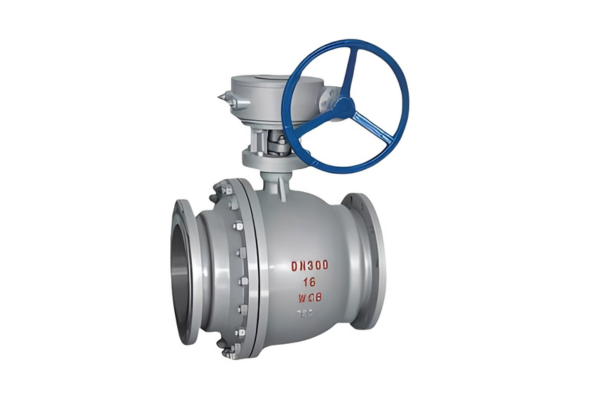
Top entry ball valves completely solve this problem. Their key advantage is that all internal parts can be accessed and replaced from the top while the valve body remains in the pipeline, turning a week-long repair job into a matter of hours.
How Does In-Line Repair Save You Time and Money?
You’re facing a week of downtime because removing a welded valve involves cutting, re-welding, and extensive testing. The cost in labor and lost production is enormous.
Top entry valve design eliminates this entirely. You simply unbolt the top bonnet to access all the internals. This turns a complex, multi-day job into a simple mechanical procedure that can be completed in hours.
Dive Deeper: The Economics of Downtime
For an engineer like Hassan, who oversees massive and complex facilities, minimizing plant downtime is the single most important factor in maintaining profitability. The cost difference between servicing a standard valve versus a top entry valve in a welded line is staggering.
The Nightmare of Removing a Welded-In Valve
When a standard end-entry or split-body valve fails, the maintenance process is a logistical and financial burden:
- Extensive Preparation: The line must be shut down, drained, isolated, and purged of any hazardous materials. This alone can take hours.
- Major Construction Work: Scaffolding is often required. A “hot work” permit is needed for cutting and welding. A maintenance crew must precisely cut the valve body out of the pipeline.
- Removal and Replacement: The old, heavy valve must be lifted and removed. The new valve is lifted into place, perfectly aligned, and then welded back into the line.
- Post-Weld Verification: The new welds must be inspected using Non-Destructive Testing (NDT), such as radiography (X-ray) or ultrasonic tests, to ensure their integrity. Depending on the material and code requirements, Post-Weld Heat Treatment (PWHT) may be required, involving wrapping the pipe in heating blankets for hours.
- Testing and Restart: The entire line segment has to be pressure tested before it can be returned to service.
This entire process can take anywhere from two to five days and involves multiple specialized crews, representing a massive cost.
The Simplicity of Top Entry Maintenance
The top entry valve turns this major construction project into a straightforward mechanical task:
- Preparation: The line is still shut down and isolated.
- Access: The crew simply unbolts and lifts the top bonnet or cover of the valve.
- Repair: All valve internals (the ball, seats, and stem, often as a single cartridge) can be lifted directly out. The crew can drop in a new set of replacement parts or a complete new cartridge.
- Reassembly: The bonnet is placed back on, the bolts are torqued, and the valve is ready for service.
This entire procedure can be completed by a small team in just a few hours. The savings in labor, equipment, and—most importantly—lost production time are immense.
| Task | Standard Welded Valve | Top Entry Valve |
|---|---|---|
| Action | Cut out of line | Unbolt top cover |
| Hot Work Permit | Required | Not Required |
| Welding/NDT | Required | Not Required |
| Temps d'arrêt | Days | Hours |
| Labor Cost | Très élevé | Low |
Why Is the Unibody Design a Major Structural Advantage?
You’re specifying a valve for a high-stress application, like a line with potential bending forces or extreme temperatures. A standard multi-piece valve has body joints that can flex and leak under these conditions.
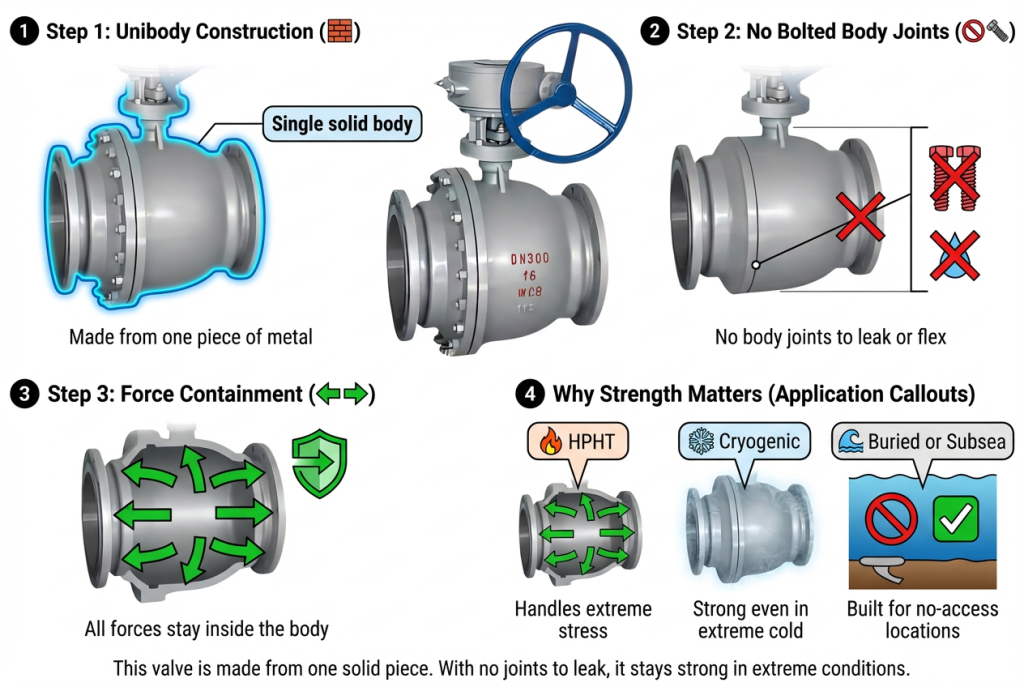
A top entry valve has a solid, one-piece body with no external flanges other than the top bonnet. This unibody construction is inherently stronger and more rigid, making it highly resistant to pipeline stresses and eliminating major potential leak paths.
Dive Deeper: The Power of a Single Piece
The body of a valve is its foundation. The method of its construction has profound implications for its performance and safety, especially in the demanding world of petrochemicals.
The Weakness of Multi-Piece Bodies
Valves are typically made in one of three ways:
- Three-Piece Body: Two end caps are bolted to a central body. This creates two gasketed body joints that are potential leak paths.
- Split-Body: The body is made of two halves bolted together. This creates one very large gasketed joint that can be a point of weakness and leakage.
Under stress, these body joints are liabilities. Pipeline loads from thermal expansion or ground settlement can put immense bending forces on a valve. In a multi-piece valve, this force can cause tiny movements at the body flanges, leading to a loss of gasket compression and a dangerous external leak of flammable or toxic material. For Hassan, who is responsible for the safety of his entire plant, this is an unacceptable risk.
The Inherent Strength of a Unibody
A top entry valve starts as a single, solid piece of metal. This unibody design has no bolted body joints to flex or leak. All pipeline forces are contained within this solid structure, providing superior rigidity and safety. This makes top entry valves the preferred choice for:
- High-Pressure / High-Temperature (HPHT) Service: Where the combination of pressure and temperature puts enormous stress on materials.
- Cryogenic Service: In LNG applications, extreme cold can make materials brittle. The robust, often forged, unibody design provides the highest possible structural integrity.
- Buried or Subsea Service: Where external access is impossible and reliability is paramount. The elimination of potential leak paths is a massive advantage.
Furthermore, these unibody designs are typically manufactured from forged steel rather than cast steel. Forging produces a refined and aligned grain structure, resulting in a material that is stronger, tougher, and more resistant to fatigue and defects than a casting. This is the ultimate guarantee of body integrity for the most critical applications.
How Do Top Entry Valves Ensure Reliable, Long-Term Sealing?
You need a valve that provides a bubble-tight shutoff and will continue to do so for years. Standard floating ball valves can wear unevenly, leading to passing seats and costly process or safety issues.
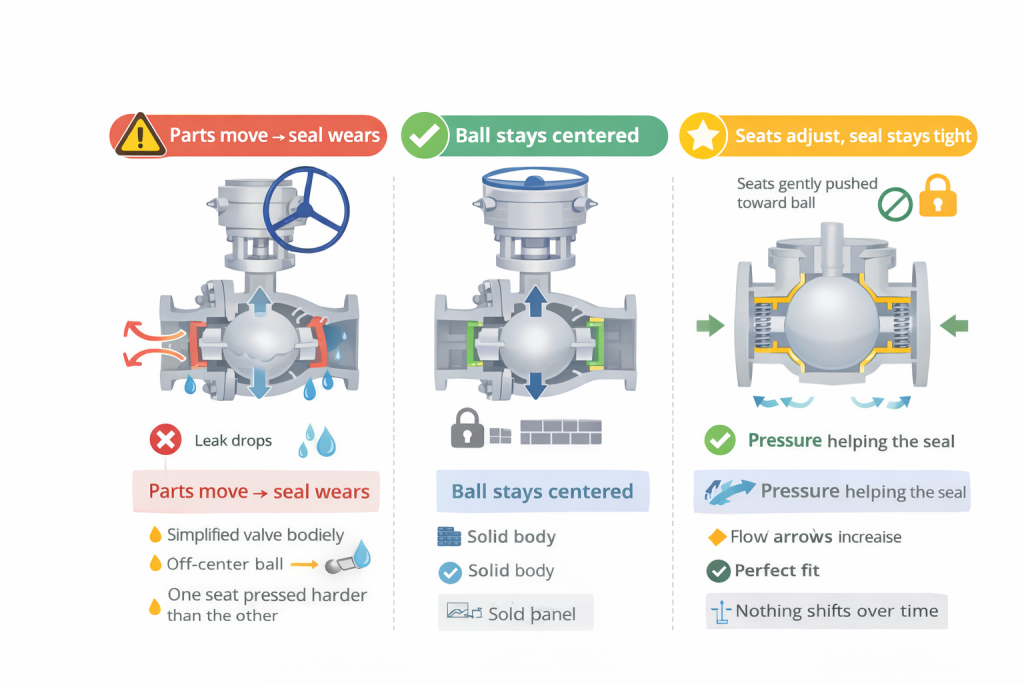
Top entry valves almost always use a trunnion-mounted ball design. This, combined with the rigid unibody, ensures the ball and seats remain in perfect alignment, providing consistent, low-friction sealing and a much longer service life.
Dive Deeper: The Engineering of a Perfect Seal
A valve is only as good as its ability to seal. The design of a top entry valve is engineered from the ground up to protect the integrity of its seals and ensure reliable performance over decades of service.
The Problem of Misalignment
In a less rigid, multi-piece valve body, pipeline forces can squeeze the valve body. This distortion, even if microscopic, can cause the ball to become misaligned with the seats. This leads to uneven seat loading, accelerated wear on one part of the seat, and eventual leakage. In a floating ball design, the problem is worse, as the entire line pressure is focused on the downstream seat, creating high friction and wear.
The Top Entry Sealing System
Top entry valves create a perfect environment for a reliable seal:
- Trunnion-Mounted Ball: By mechanically fixing the ball in place with upper and lower trunnions, the ball cannot shift or float. The massive structural loads from the line pressure are absorbed by the trunnion bearings and the valve body, not the seats.
- Spring-Energized Seats: Since the ball is fixed, the seats are designed to move. The valve seats are energized by springs that constantly push them against the ball with a light, predetermined force. This ensures a tight seal even at very low pressures. When high pressure is applied, the pressure itself helps push the seat more firmly onto the ball (a concept called self-relieving seats), but the initial seal is always guaranteed by the springs.
- Locked-In Alignment: The rigid unibody construction prevents any external forces from disturbing the precise alignment between the fixed ball and the spring-loaded seats. The system is designed to maintain its perfect geometric relationship regardless of pressure, temperature, or pipe stress.
This combination results in very low, consistent operating torque and minimal seat wear. The valve seals reliably for a much longer time, ensuring positive shutoff when it is needed most, which is a critical performance factor for any safety-instrumented system.
Conclusion
Top entry ball valves offer unmatched in-line maintainability, superior structural integrity, and long-term sealing reliability, making them the premier choice for critical, high-cost applications where downtime is unacceptable.
Eliminate Expensive Downtime in Your Critical Lines.
Contact our experts to find the right top entry ball valve for your process.


 English
 Arabic
 Russian
 French
 Spanish