
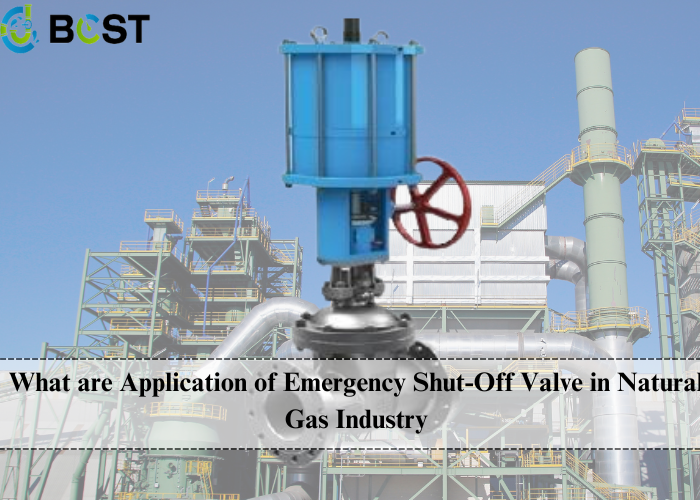
L'industrie du gaz naturel joue un rôle crucial dans la consommation mondiale d'énergie, en fournissant des combustibles pour le chauffage, la production d'électricité et divers procédés industriels. Cependant, comme pour toute source d'énergie, la manipulation et le transport du gaz naturel comportent des risques inhérents, notamment des fuites, des incendies, des explosions et des dangers pour l'environnement. Pour atténuer ces risques et garantir la sécurité, l'utilisation de vannes d'arrêt d'urgence (ESOV) dans les gazoducs, les réseaux de distribution et les installations de traitement du gaz naturel est d'une importance capitale.
I. Qu'est-ce qu'une vanne d'arrêt d'urgence (ESOV) ?
An emergency shut-off valve (ESOV) is a critical safety device used in the natural gas industry to quickly stop the flow of gas in the event of a detected hazard or abnormal condition. These valves can be activated automatically or manually in response to various emergency situations such as gas leaks, pressure surges, or system malfunctions. The primary function of an ESOV is to prevent further damage to equipment, reduce the risk of fire or explosion, and protect human life and the environment.ESOVs are typically installed at strategic locations within gas pipelines, at the interfaces between different system components (e.g., pipeline-to-pipeline, pipeline-to-compressor station), and at critical points in gas distribution networks. In large-scale installations, a network of ESOVs is often used in conjunction with monitoring systems to provide comprehensive coverage.
II. Types de vannes d'arrêt d'urgence
Emergency shut-off valves can be classified into several types based on their design and operation:1.Ball Valves: These are commonly used in the gas industry due to their quick shut-off capabilities. Ball valves feature a rotating ball with a hole through the center, which aligns with the pipe to allow flow. When the valve is closed, the hole is perpendicular to the pipe, completely stopping the flow of gas.

2. les robinets-vannes : Les robinets-vannes offrent une ouverture à passage intégral, ce qui est idéal pour les applications à haut débit telles que les gazoducs. Ces vannes fonctionnent en soulevant une porte ou un coin à l'intérieur du corps de la vanne, ce qui bloque ou autorise le flux de gaz.
 4.Pressure-Relief Valves (PRVs): In some applications, pressure-relief valves may be installed in tandem with ESOVs to release gas when system pressure exceeds a predefined threshold, helping to protect equipment from pressure-related failures.5.Fail-Safe Valves: These are designed to automatically close in the event of power loss, control system failure, or detection of a hazardous situation. Fail-safe ESOVs are essential for remote and unattended facilities where human intervention may not be immediately possible.
III. Applications des vannes d'arrêt d'urgence
Le rôle principal des vannes d'arrêt d'urgence est d'améliorer la sécurité en fournissant un mécanisme permettant d'isoler des parties du gazoduc ou du réseau de gaz en cas d'urgence. Voici quelques-unes des principales applications des vannes d'arrêt d'urgence dans l'industrie du gaz naturel :
1. Sécurité des pipelines
In natural gas pipelines, any disruption in pressure or a detected gas leak can lead to catastrophic consequences, including explosions, fires, or environmental contamination. ESOVs are strategically installed at regular intervals along the pipeline to monitor pressure, flow, and gas composition. If a fault is detected, the valve closes automatically, preventing further gas flow and reducing the risk of disaster.In addition to detecting leaks, ESOVs also play a role in managing pipeline integrity. For instance, during routine maintenance or emergency repair work, operators can use ESOVs to isolate damaged sections of the pipeline. This limits the potential impact of a failure and allows for safer intervention by maintenance crews.
2. Réseaux de distribution de gaz
The gas distribution network, which brings natural gas to homes, businesses, and industrial facilities, relies heavily on emergency shut-off valves. These valves are installed at key points within the distribution system, including entry points to major urban areas and sensitive regions, such as schools, hospitals, and residential areas.In the event of a gas leak or sudden pressure drop, ESOVs can quickly isolate the affected section of the network to contain the situation. For example, if a pipeline bursts or is punctured in a populated area, the shut-off valve can prevent the spread of gas and reduce the chances of a fire or explosion. Moreover, during extreme weather conditions such as earthquakes or heavy flooding, these valves are vital in preventing a large-scale disaster.
3. Stations de compression
Compressor stations are facilities that increase the pressure of natural gas to enable its transportation over long distances. These stations are equipped with various mechanical components, and failure of any part can have serious consequences for both the local environment and the larger gas distribution system.In these critical facilities, ESOVs serve as fail-safes to immediately stop gas flow when a problem is detected. This could include overpressure situations, valve malfunctions, or catastrophic failures of machinery. By cutting off the gas supply rapidly, ESOVs prevent further damage to equipment and minimize the risk of fire or explosion within the station.
- Processing Plants
Les usines de traitement du gaz naturel, qui sont chargées d'éliminer les impuretés et de séparer les liquides de gaz naturel du gaz brut, sont soumises à une réglementation très stricte. Les ESOV sont déployés à différents stades du cycle de traitement afin de garantir que toute anomalie, telle qu'un problème de qualité du gaz ou une surchauffe de l'équipement, déclenche un arrêt immédiat.
Par exemple, en cas d'augmentation soudaine de la pression du gaz ou de libération incontrôlée de composés volatils, la vanne d'arrêt d'urgence peut rapidement fermer la section concernée de l'usine. Cela limite le risque d'incendie ou de propagation de gaz dangereux, garantissant ainsi la sécurité des travailleurs de l'usine et de la communauté environnante.5. Terminaux GNL (gaz naturel liquéfié)
LNG terminals handle the import, export, and storage of liquefied natural gas, which involves significant hazards due to the cryogenic temperatures of LNG and the potential for rapid phase changes. ESOVs in LNG terminals are designed to act as part of the emergency response system, quickly halting the flow of gas in the event of an accident or detected fault.Whether it is a malfunction in a pipeline, a leak in storage tanks, or a disturbance during the unloading or loading process, ESOVs offer a rapid solution to prevent further escalation of the hazard. Their role in LNG terminals is critical in preventing large-scale disasters and minimizing environmental and economic impact.IV. Avantages des ESOV dans l'industrie du gaz naturel
Enhanced Safety: ESOVs are the first line of defense in protecting human life and the environment by automatically or manually halting the flow of gas during an emergency.Operational Continuity: By isolating damaged sections of the pipeline or system, ESOVs enable operators to address issues without shutting down the entire network, minimizing service interruptions.Regulatory Compliance: In many regions, the installation and maintenance of ESOVs are mandatory to meet safety standards and industry regulations. Compliance with these standards ensures safe operation and avoids legal liabilities.Cost Efficiency: Early detection and response to potential hazards reduce the risk of large-scale disasters, which can be costly to repair and can also result in significant downtime and loss of production.V. Conclusion
The natural gas industry is inherently risky due to the flammable and pressurized nature of the substance being transported. The application of emergency shut-off valves is a critical safety measure that helps mitigate these risks, protecting both human lives and the environment. From pipeline safety to LNG terminals, ESOVs play a pivotal role in ensuring the integrity of gas networks and processing systems, as well as minimizing the potential for catastrophic accidents. With the continued growth of the natural gas sector, the importance of reliable, efficient, and well-maintained ESOVs will only increase, making them an indispensable component of the industry's safety infrastructure.


 English
 Arabic
 Russian
 French
 Spanish