
Choosing Valve Materials for Pipeline Service: A Guide to API & NACE Standards
In the demanding world of pipeline engineering, the long-term integrity and reliable performance of a valve are fundamentally determined by the materials from which it is constructed. A seemingly minor misjudgment in material selection can lead to catastrophic failures, costly downtime, environmental hazards, and significant safety risks. Engineers must meticulously consider every aspect of a valve’s material composition, from the body and bonnet to the internal trim and sealing components.
At BCST Valve, we understand that selecting the appropriate materials is not just a technical challenge but a critical safety and operational imperative. This guide is dedicated to equipping pipeline engineers with the knowledge to navigate the complex landscape of valve material selection, adhering to vital industry standards like API 6D et NACE MR0175. For a broader perspective on overall ball valve selection in pipelines, refer to our foundational article: The Engineer’s Guide to Ball Valves in Pipeline Applications.

The Crucial Role of Material Selection in Pipeline Integrity
The materials chosen for a pipeline valve must reliably perform under specific conditions over its entire lifecycle. These conditions include:
- Résistance à la corrosion : Protection against media, atmospheric, and soil corrosion.
- Temperature & Pressure Capability: Maintaining structural integrity and sealing performance across operational ranges.
- Résistance à l'érosion : Withstanding abrasive particles in the fluid stream.
- Mechanical Strength: Resisting pipeline stresses, operating forces, and surge pressures.
- Service Life: Ensuring long-term reliability and reducing Total Cost of Ownership (TCO).
Primary Factors Influencing Material Choice
1. Fluid Properties
- Corrosivity: Is the fluid acidic, alkaline, or neutral? Does it contain chlorides, sulfides (e.g., H2S in sour gas), or other corrosive agents?
- Abrasiveness: Are there solid particles (sand, scale) present that could cause erosion, particularly at high velocities?
- Température : What are the minimum and maximum operating temperatures? (e.g., cryogenic LNG vs. high-temperature steam).
- Toxicity/Hazard: Extremely hazardous fluids require materials that offer absolute containment integrity.
2. Operating Conditions
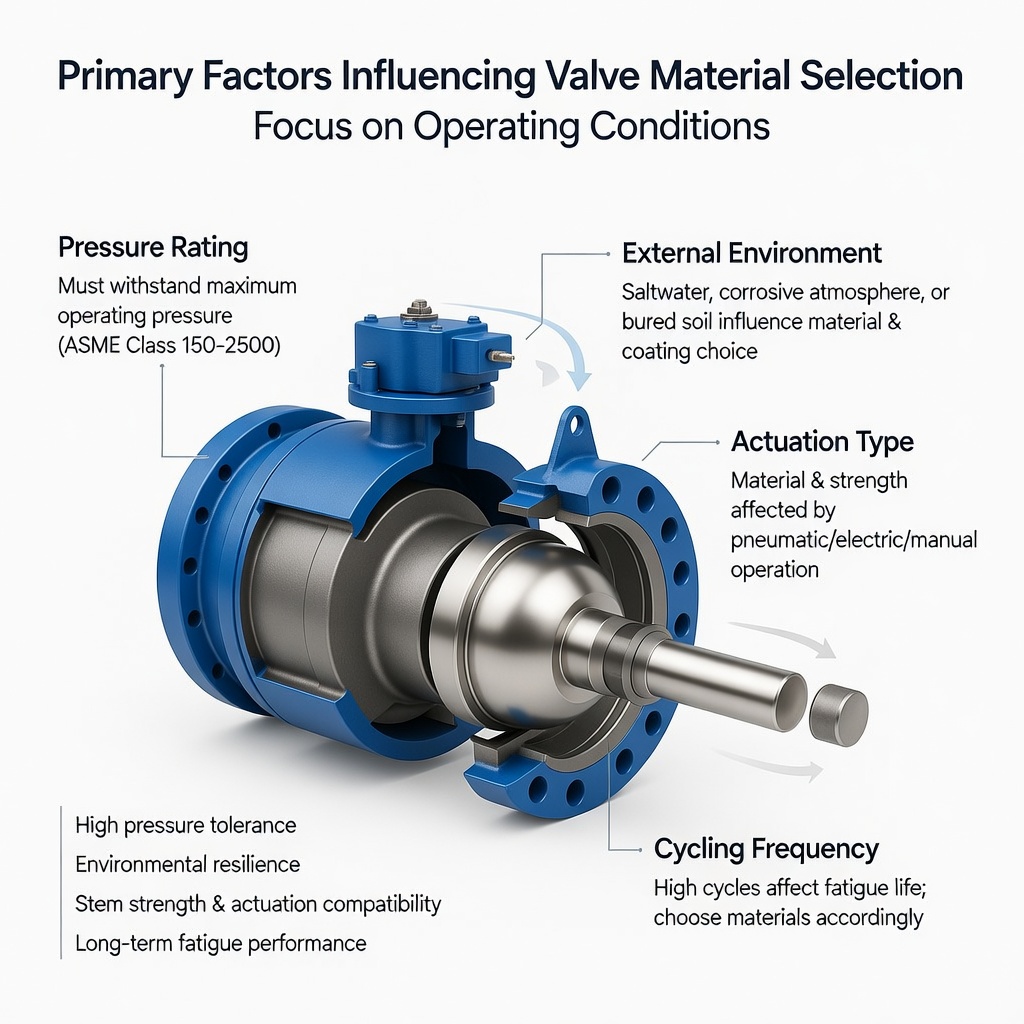
- Pression nominale : Materials must be able to withstand the maximum operating pressure, specified by ASME classifications (e.g., Class 150, 300, 600, 900, 1500, 2500).
- External Environment: Is the valve exposed to saltwater, corrosive atmospheres, or buried in aggressive soil? Environmental conditions can dictate external coating requirements or even body material.
- Actuation Type: Can influence stem material and strength requirements.
- Cycling Frequency: High cycle counts can impact fatigue life of certain materials.
3. Industry Standards & Specifications
- API 6D (Pipeline Valves): Specifies requirements for material testing, traceability, and performance for pipeline valves.
- NACE MR0175 / ISO 15156: Crucial for pipelines containing sour gas (H2S). These standards define specific material requirements and hardness limits to prevent sulfide stress cracking (SSC), a brittle failure mode in certain metallic alloys when exposed to H2S environments.
- ASME B16.34: Provides pressure-temperature ratings and material requirements for valves.
- API 6FA/API 6FD (Fire-Safe): Defines fire-safe design and testing requirements, particularly relevant for soft-seated valves carrying flammable media.
Common Materials for Pipeline Valve Components
Body & Bonnet Materials (Pressure Containing Parts)
- Carbon Steel (e.g., ASTM A105, WCB, WCC): The workhorse for general, non-corrosive service in oil & gas pipelines. Excellent mechanical properties and cost-effective. Limited for sub-zero temperatures (below -29°C) and corrosive fluids.
- Low-Temperature Carbon Steel (LTCS) (e.g., LCC, LCB): Used for pipeline applications down to -46°C, common in colder climates or refrigeration processes.
- Stainless Steel (e.g., 304, 316, CF8M, CF3M): Offers superior corrosion resistance compared to carbon steel, especially 316/CF8M for chloride-containing environments. Used for chemical, water, and some gas applications.
- Duplex & Super Duplex Stainless Steel (e.g., F51, F53, F55 / 2205, 2507): Provide exceptional corrosion resistance (especially stress corrosion cracking and pitting) and high strength. Ideal for offshore, seawater, and highly corrosive applications.
- Special Alloys (e.g., Inconel, Monel, Hastelloy): Reserved for extremely aggressive corrosive environments, very high temperatures, or specific chemical processing, due to their high cost.
Trim Materials (Ball, Stem, Seats)
Often require higher strength and corrosion resistance than the body, as they are directly exposed to the flow and subject to mechanical wear.
- Stainless Steel (e.g., 316, 17-4PH): Most common for excellent corrosion resistance. 17-4PH offers higher strength.
- Hard Coatings (e.g., Tungsten Carbide, Chrome Carbide): Applied to balls and metal seats for abrasive service or very high cycle applications to prevent erosion and surface wear.
Seat Materials (Sealing Components)
- Soft Seats (e.g., PTFE, Reinforced PTFE, PEEK, Nylon): Provide excellent bubble-tight shut-off. Chosen based on temperature limits, chemical compatibility, and pressure. Often used for gas applications. PEEK offers higher temperature and pressure resistance than PTFE.
- Métal Sièges : Used for high-temperature service, abrasive media, or where fire-safe requirements necessitate a metal-to-metal seal after soft seat burnout. Often hard-faced with materials like Tungsten Carbide (TC) or Stellite for wear resistance.
Material Compatibility and Special Considerations
Beyond individual component properties, the interaction between different materials is crucial:
- Galvanic Corrosion: When dissimilar metals are in electrical contact within an electrolyte, one metal will corrode preferentially. Avoid inappropriate pairings.
- Hydrogen Embrittlement: Certain high-strength steels can become brittle and fracture when exposed to atomic hydrogen, particularly in sour service (H2S). NACE MR0175 is specifically designed to mitigate this risk.
- Chloride Stress Corrosion Cracking (CSCC): Stainless steels can be susceptible to CSCC in warm, chloride-rich environments. Duplex and super duplex stainless steels offer superior resistance.
- Elastomer Compatibility: O-rings and stem packings (e.g., Viton, EPDM, HNBR) must be compatible with the fluid, temperature, and operating pressure to prevent leaks.
Conclusion
Choosing the correct valve materials for pipeline service is an intricate task demanding a thorough understanding of fluid properties, operating conditions, and adherence to industry-specific standards like API 6D and NACE MR0175. It requires a holistic approach, considering not just the individual components but also their interactions and the overall system environment.
At BCST Valve, our expertise lies in engineering and manufacturing pipeline valves that meet the most rigorous material and performance specifications. Our team works closely with engineers to ensure optimal material selection, guaranteeing durability, safety, and long-term operational efficiency for your critical pipeline infrastructure.
Need expert guidance on valve material selection?


 English
 Arabic
 Russian
 French
 Spanish