
Picking between a knife valve and a gate valve is a small choice with big consequences. Get it wrong, and you’re looking at clogged lines and costly shutdowns. You need the right valve for the right job.
It all boils down to what’s in your pipe. A knife valve has a sharp, thin gate that slices through thick stuff like slurries and solids. A regular gate valve uses a thick wedge to seal off clean liquids and gases under pressure.
Trust me, picking a valve isn’t just a tiny detail on a spec sheet. It’s a make-or-break decision for your whole system. I’ve personally seen projects grind to a halt and budgets get torched all because of the wrong valve choice. That’s a mistake you don’t want to learn from experience. So, let’s walk through this together and make sure you have what you need to get it right from day one.
The Key Differences Between Knife Valves et Vannes à guillotine
Thinking a knife valve and a gate valve are the same is a common trap. That mistake leads straight to leaks, jams, and system failures. You must understand how they are built differently to work.
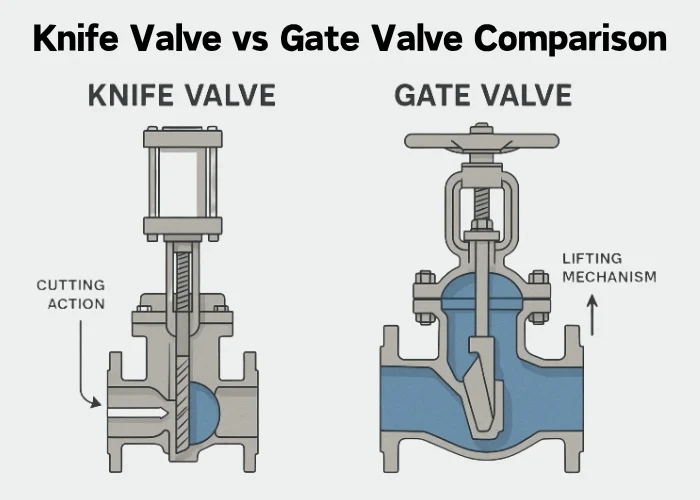
Look at the “gate” and you’ll see the whole story. A knife valve’s gate is a thin metal plate with a sharp edge, made for one thing: slicing. A gate valve’s gate is a thick wedge that drops into a seat for a tight seal, but it only works if the fluid is clean.
Core Differences in Design and Functionality
My father had a great way of explaining this when I was starting out. He’d hold up both valves and say, “Emily, one is a butcher’s knife, the other is a bank vault door. You wouldn’t use a vault door to slice bread.” That analogy has always stuck with me because it gets to the heart of the knife valve vs gate valve choice. Let’s look closer at the mechanics.
Gate and Seat Design
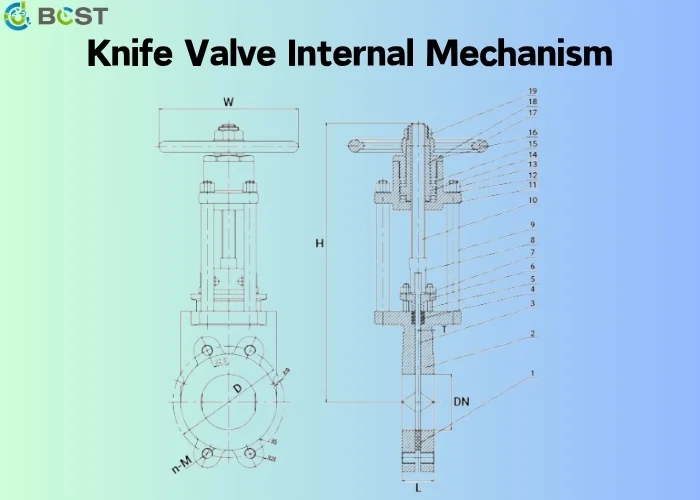
The defining feature of a knife valve is its gate—a thin plate with a sharp, beveled edge. It isn’t built to hold back immense pressure. Its job is to power through thick media, like pulp in a paper mill or sludge in a treatment plant. It shoves aside anything that would jam a normal valve. The seat is simple and sometimes includes a resilient lining, like rubber, to create a better seal against liquids.
A gate valve, on the other hand, is all about sealing power. Its gate is a thick, heavy wedge that fits perfectly into a matching seat. This tight contact creates a strong, bi-directional seal that handles serious pressure. The design, however, leaves a pocket at the bottom where gunk builds up, which stops the valve from closing all the way.
Application and Media
This is the number one thing to consider when choosing between a knife valve vs a gate valve.
- Knife Valves: These are your go-to when your media is thick, has solids mixed in, or is a dry powder. Think wastewater plants, mining operations, and food processing. The gate slices through the gunk, so the valve cleans itself and doesn’t clog.
- Vannes à guillotine : They are the industry standard for simple on/off jobs with clean liquids or gases. You’ll find them everywhere in water supply lines, oil and gas pipelines, and steam systems. Putting one of these in a slurry line is asking for trouble.
Installation and Operation
Knife valves are lighter and much thinner from end to end. This makes them perfect for tight spots and means you don’t need heavy-duty pipe support. Gate valves are the opposite—they’re heavy and bulky because they need that mass to handle high pressure.
| Fonctionnalité | Knife Valve | Vanne à guillotine |
|---|---|---|
| Fonction principale | On/Off for slurries & solids-heavy fluids | On/Off for clean liquids & gases |
| Gate Design | Thin, sharp blade | Thick, wedge-shaped slab |
| Scellement | Good, but not bubble-tight for gas | Excellent, high-pressure, two-way seal |
| Médias communs | Pulp, sludge, wastewater, powders | Water, steam, oil, gas, clean chemicals |
| Clogging Risk | Very low; the blade cuts through buildup | High if solids are present; gunk gets trapped |
| Size/Footprint | Very short and compact | Long and bulky, needs more space |
| Pression nominale | For lower pressures | Designed for very high pressures |
Knowing how they’re built is the first step. Next, you need to think about how they actually perform in the real world.
Advantages and Disadvantages of Knife and Gate Valves
Don’t just grab the cheapest or most available valve off the shelf. That’s a recipe for disaster if it’s not right for your application. You must weigh the real-world pros and cons first.
Here’s the simple rule: if you have slurries, pulp, or messy wastewater, you need a knife valve to cut through it. If you have clean liquids or gas and need a heavy-duty, high-pressure seal, you need a gate valve.
Practical Pros and Cons of Each Valve
I remember working with a great project engineer named Hassan. He was designing a chemical plant and did what a lot of people do—he put standard gate valves on a line with a chemical slurry. He figured they were the standard for shut-off. Weeks after start-up, the valves wouldn’t close. The slurry was packing the bottom of the valves and jamming them open. This is a classic knife valve vs gate valve mistake. We swapped them for knife valves, and the problem vanished. Hassan’s story is a perfect example of why this choice matters so much.
The Case for Knife Valves
Knife valves are special tools. In the right situation, nothing else will do the job.
Avantages :
- They Cut Through Gunk: This is their superpower. The blade slices through thick media and solids, avoiding the clogs that shut down other valves.
- Lightweight and Small: Because they are thin and light, they fit into cramped spaces and don’t require heavy, expensive pipe supports.
- Cost-Effective: For low-pressure jobs, knife valves are cheaper than gate valves of the same size.
- Quick to Open and Close: They don’t take as many turns of the wheel to go from fully open to fully closed.
Inconvénients : - Not for High Pressure: Standard knife valves are not built to handle high-pressure systems.
- Will Not Provide a Bubble-Tight Seal: They stop the bulk of the flow but do not provide a perfectly bubble-tight seal, especially with gas.
- Vibrates When Throttling: They are for on or off service. Using one to control flow makes the gate vibrate, which causes it to wear out fast.
| Knife Valve | Details |
|---|---|
| Pros | Slices through solids, lightweight, compact, affordable, fast-acting. |
| Cons | Lower pressure, not a tight seal, bad for flow control. |
The Case for Gate Valves
Gate valves are industry workhorses when used correctly.
Avantages :
- Incredible Sealing Power: They’re made to provide a tight, reliable seal in high-pressure and high-temperature situations.
- Seals in Both Directions: Most gate valves shut off flow coming from either side.
- Tough and Long-Lasting: These things are built like tanks. In clean service, they last for years with minimal fuss.
- Clear Flow Path: When a gate valve is fully open, the gate is pulled completely out of the way, so it doesn’t disrupt the flow.
Inconvénients : - Terrible with Solids: The cavity at the bottom is a magnet for debris, which will jam the valve and ruin the seal.
- Slow to Operate: Get ready for a workout. It takes many turns to open or close a gate valve.
- Heavy and Big: Their strong build makes them heavy and they take up a lot of room in the pipeline.
- A Pain to Repair: Fixing the internal seats means you have to cut the valve out of the line completely.
| Vanne à guillotine | Details |
|---|---|
| Pros | High-pressure seal, works both ways, super durable, no flow restriction when open. |
| Cons | Jams with solids, slow to use, heavy and bulky, hard to fix in-line. |
Ultimately, getting the knife valve vs gate valve decision right is about being honest about your media and your operating conditions.
Choosing the right valve isn’t just about reading a catalog; it’s about having a partner who’s been there and understands your challenges. At Valve BCST, that’s what we do. It’s a family business, and we’ve seen how the right valve can make or break an operation. We help engineers like Hassan every day, recommending the perfect valve by listening first.
Frequently Asked Questions (FAQ)
Can I use a knife valve for gas or steam?
No. A standard knife valve’s metal-to-metal seal is not tight enough for gases and will leak. While special versions exist, a gate valve is the correct choice for gas or steam.
What does “unidirectional” vs “bidirectional” knife valve mean?
It’s simple: a unidirectional valve is built to seal against pressure coming from only one direction. A bidirectional valve has seals on both sides of the blade, so it handles pressure from either side.
Why is a knife valve better for wastewater treatment?
Wastewater is full of stringy material, grit, and solids. A knife valve’s blade slices right through all that junk, preventing the clogs that instantly jam up a gate valve and shut down the plant.
Are gate valves better for high temperatures?
Both are made from high-temp materials. But a gate valve’s thick and heavy body gives it a required structural advantage in systems with both very high pressure and high temperature, like main steam lines.
Dernière réflexion
In the end, the knife valve vs gate valve choice is all about what’s in your pipe. Don’t guess. Talk to an expert at BCST Valve. We’ll help you get it right and avoid expensive problems down the road.



 English
 Arabic
 Russian
 French
 Spanish