
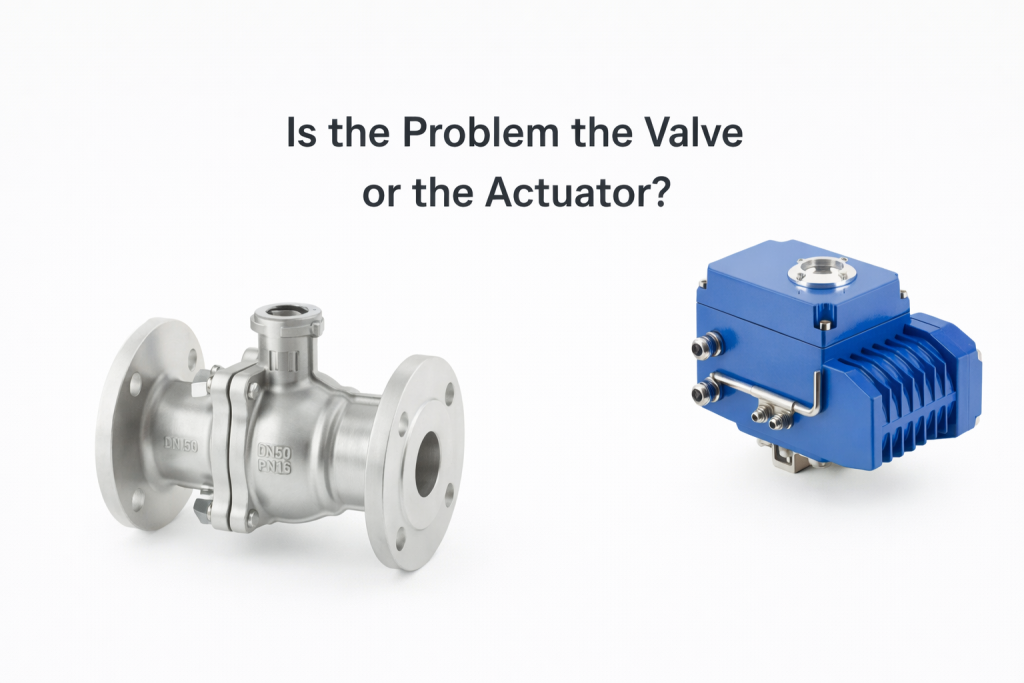
Is it the Valve or the Actuator That Causes the problem?
An alarm is blaring and your automated valve is stuck. Do you pull the entire heavy unit for a shop overhaul? This field guide helps you quickly pinpoint if the problem is the valve or the ball valve actuator.
To find the root cause, you must isolate the components. First, check the actuator’s inputs (air and signal). If those are good, the next step is to see if the actuator can move on its own. This simple process, also highlighted in component studies, can save you hours of unnecessary work.
Symptom 1: The Entire Unit Won’t Move. Where Do I Start?
You send a signal, but nothing happens. The most common cause is a loss of power, either electrical or pneumatic. Before you ever touch the valve or actuator, you must verify the ‘motive force’ is present and correct.
Dive Deeper: Verifying the Inputs
Votre ball valve actuator package has two power sources: the electrical signal that tells it what to do, and the pneumatic air supply that gives it the muscle to do it. If either is missing, it will not function.
| Étape | Action | Ce qu'il faut rechercher |
|---|---|---|
| 1. Check Air Supply | Check pressure at the actuator inlet with a gauge. | Is pressure at the specified level (e.g., 80-100 PSI)? No air points to an upstream issue. |
| 2. Check Electrical Signal | Use a multimeter at the solenoid terminals. | Does the voltage match the coil rating (e.g., 24VDC, 120VAC)? No voltage points to a control system issue. |
| 3. Check the Solenoid | Listen for a “click” when the signal is applied. | No click? The coil may be burnt out or jammed. This is a common point of failure. |
Symptom 2: The Actuator Moves, But the Valve Doesn’t. What’s Broken?
You hear the ‘whoosh’ of air, and you see the ball valve actuator‘s drive shaft turning, but the valve’s position indicator hasn’t budged. This points to a mechanical failure in the driveline—the torque is not being transferred to the valve stem.

Dive Deeper: The Mechanical Driveline
- Inspect the Stem Adapter: If the actuator drive turns but the valve stem doesn’t, the adapter connecting them has likely sheared or fallen out.
- Check the Mounting Bracket: Is the bracket holding the ball valve actuator to the valve cracked or loose? This causes severe misalignment.
- Suspect a Sheared Stem: This is the most serious failure. If the actuator and adapter turn but the valve position doesn’t change, the valve stem itself has likely sheared. This requires valve replacement.
Symptom 3: The Unit Won’t Fully Open or Close. Where’s the Hang-Up?
The valve starts to move but stops part-way. This is a classic “insufficient torque” problem. Either the ball valve actuator is not producing enough force, or the valve is requiring too much.
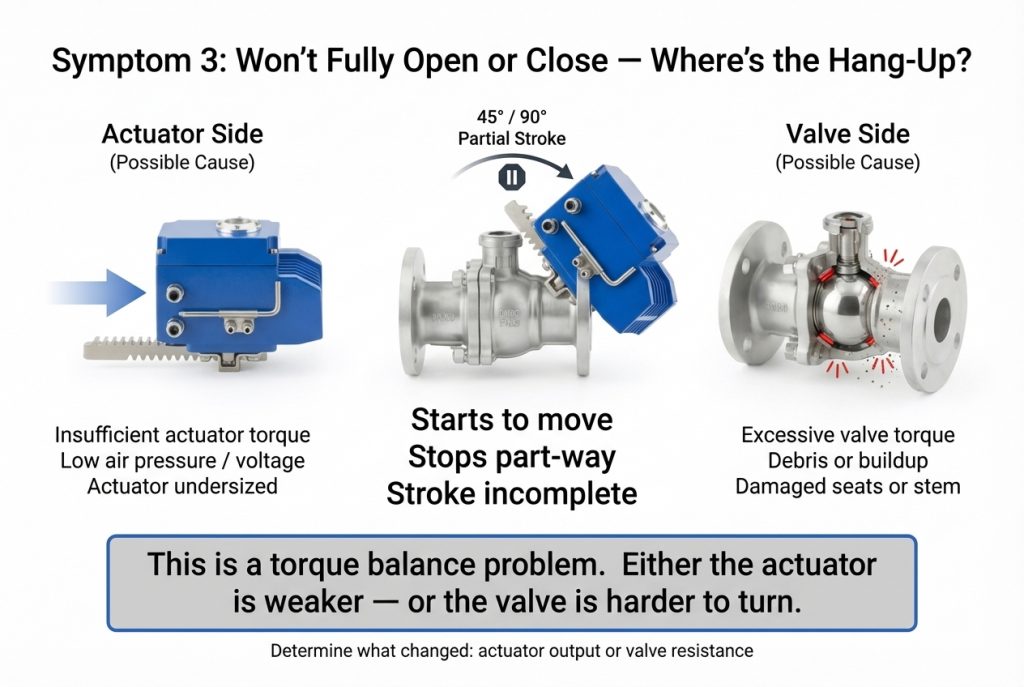
Dive Deeper: Actuator Output vs. Valve Demand
Is it the Actuator?
- Low Air Pressure: A drop from 100 PSI to 70 PSI can cripple torque output.
- Internal Seal Failure: Air leaking past worn piston seals reduces force. Listen for hissing from the exhaust.
- Broken Spring: In a spring-return unit, a broken spring will cause a failure to fully stroke.
Is it the Valve?
- Process Debris: Scale or solids can physically block the valve from seating.
- Hardened Seats: Over time, seats can harden, requiring much more torque to operate.
- Over-Tightened Packing: Packing nuts tightened too far create excessive friction on the stem.
Conclusion: Test, Don’t Guess
By systematically checking inputs, isolating components, and observing symptoms, you can confidently diagnose the true source of failure in your ball valve actuator package. This saves time, money, and ensures the right repair is made the first time.


 English
 Arabic
 Russian
 French
 Spanish