
Picking the wrong gate valve size is a recipe for system failures and expensive shutdowns. You need a simple, reliable way to choose correctly for your critical projects, every single time.
The right gate valve size matches your pipe’s standard (NPS or DN). But for real-world performance, factors like flow rate, pressure, and the fluid itself are just as vital. Getting these right guarantees optimal flow, safety, and a long service life for your system.
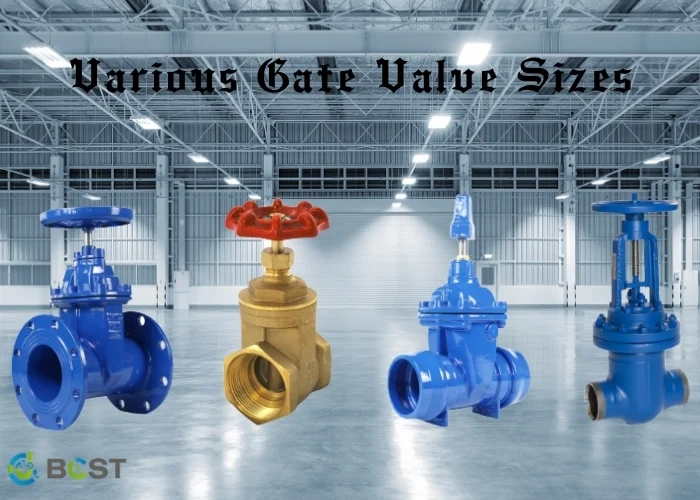
I learned this lesson early, walking the factory floor with my father. Getting the gate valve size right is one of the most important decisions in any project. I’ve seen how a small mismatch creates huge problems down the line. A valve that’s too small chokes your system, causing a big pressure drop and killing efficiency. One that’s too large is a waste of money and leads to poor control and seat damage. It’s all about finding that sweet spot for performance and safety. Let me show you how to find it.
An Overview of Vanne à guillotine Sizing
Mixing up NPS and DN on a project order is a costly mistake. It leads to shipping delays and forces you to explain budget overruns. The fix is simple: get a firm grip on the two main sizing standards before you order anything.
These standards, Nominal Pipe Size (NPS) and Diameter Nominal (DN), give everyone a common language. NPS is used in North America, while DN is the global metric standard. Knowing which one your project uses ensures pipes, flanges, and valves all fit together seamlessly.
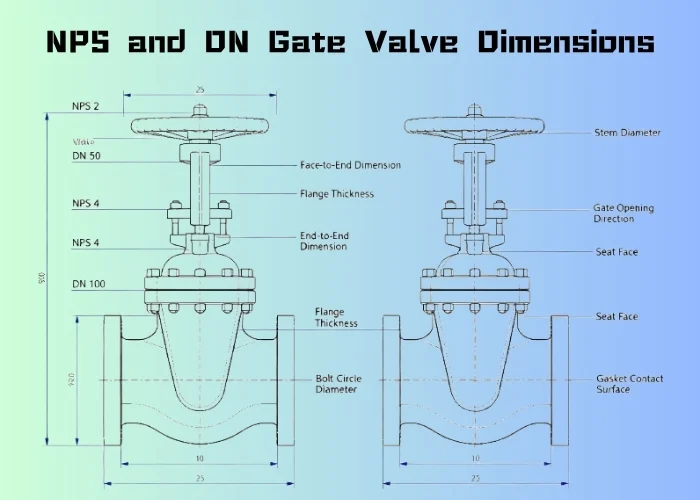
As an engineer like Hassan, you live by the P&IDs. Think of these sizing standards as the basic grammar of your piping system. Get it wrong, and nothing else communicates correctly. You must be crystal clear on the standards your project uses, because a small misunderstanding at this stage has huge consequences later on. Let’s dig into what these terms mean for your valve choice.
Understanding NPS and DN
First things first, NPS and DN are not a direct measurement of a valve’s inside or outside diameter. They are reference sizes. A 2” NPS gate valve is designed to connect to a 2” NPS pipe, and a DN 50 valve connects to a DN 50 pipe. The key is consistency. If your project is specified in NPS, then all your components—valves, pipes, fittings—must be NPS. This table shows how the two standards relate to each other.
| NPS (Inches) | DN (Millimeters) |
|---|---|
| 1/2” | 15 |
| 3/4” | 20 |
| 1” | 25 |
| 2” | 50 |
| 4” | 100 |
| 6” | 150 |
| 12” | 300 |
| 24” | 600 |
The Role of Pressure Ratings
Sizing isn’t just about the pipe connection. You must match the valve’s pressure rating, or Class, to your system’s needs. These classes (like ASME B16.34) tell you the maximum pressure a valve safely handles at various temperatures. Common classes you’ll see are 150, 300, 600, 900, and up. A Class 300 valve is heavier and has different flange dimensions than a Class 150 valve of the same pipe size. So, you don’t just order “a 6-inch gate valve.” You must specify “a 6-inch Class 300 gate valve” to get what you need.
Don’t Forget Face-to-Face Dimensions
Finally, consider the physical space the valve will take up. The face-to-face dimension is the distance between the two ends of the valve. This length is standardized by codes like ASME B16.10, so a valve from one manufacturer can be replaced by another’s. Checking this dimension ensures the valve will drop right into place without you having to cut or extend pipes on-site—a major headache you must avoid.
Common Gate Valve Sizes and Their Applications
Staring at a catalog with hundreds of valve sizes is overwhelming. A wrong choice will compromise an entire process line.
Simplify it. Group gate valve sizes into three main categories based on where they’re used in a plant. Small sizes are for utilities, medium sizes are the process workhorses, and large sizes handle the main transport lines.
Using these categories narrows down your options fast. I remember my father explaining this to me. He pointed to a small 2-inch valve and said, “That’s for a steam trace or a drain line.” Then he gestured to a massive 24-inch valve being fitted with an actuator and said, “That one shuts down an entire section of the refinery.” Each size has its place. Let’s look closer at these applications so you can pick your gate valve sizes with confidence.
Small Gate Valve Sizes (NPS 1/2” – 4” / DN 15 – 100)
These are the bread-and-butter valves of any plant. Their compact size makes them ideal for auxiliary systems with lower flow rates.
- Applications :
- Utility Lines: Handling steam, compressed air, nitrogen, and plant water.
- Drain and Vent Lines: Draining vessels, tanks, and low points in piping systems.
- Sample Points: Allowing operators to take small samples of the process fluid.
- Bypass Lines: Installed around larger equipment like control valves to allow for maintenance.
- Caractéristiques principales :
- Are operated by a simple handwheel since the force needed is low.
- Available in many materials, from basic bronze for water lines to stainless steel for more corrosive fluids.
- They are inexpensive and easy to install and maintain.
Medium Gate Valve Sizes (NPS 6” – 12” / DN 150 – 300)
These valves form the backbone of most process units. They manage significant flow rates and are the main isolation points connecting major equipment.
- Applications :
- Process Isolation: Blocking flow to entire units for shutdowns or maintenance.
- Feed and Product Lines: Controlling the primary flow of raw materials and finished products.
- Pump and Compressor Isolation: Used on the suction and discharge sides to isolate equipment for service.
- Caractéristiques principales :
- As the size increases, so does the torque required to operate them. These require a gear operator (a gearbox with a handwheel) to make them easier to turn.
- For sizes 10” and above, or in critical services, powered actuators (electric or pneumatic) are the standard for remote or automated control.
Large Gate Valve Sizes (NPS 14” and Larger / DN 350 and Larger)
These are the giants of the valve world. You’ll find these massive gate valve sizes where you need to move the maximum amount of fluid.
- Applications :
- Main Pipelines: Transporting crude oil, natural gas, or water into and out of a facility.
- Tank Farm Isolation: Providing a positive shutoff for huge storage tanks.
- Cooling Water Mains: Controlling the flow in main cooling water headers for power plants and large sites.
- Caractéristiques principales :
- Require a powered actuator because of their immense size and the huge force required to operate them.
- Their installation is a serious project, requiring cranes and special pipeline supports.
- Their failure has a massive operational and financial impact.
Factors to Consider When Selecting Gate Valve Sizes
It’s a frustrating situation: the valve size matches the pipe, but the system is underperforming. You’re seeing excessive pressure drop or valve erosion. This means the initial selection focused on the wrong thing.
The secret is to look beyond just the pipe diameter. Real-world performance lives in the engineering details, like flow coefficient (Cv), fluid velocity, and pressure drop. Getting these right is what separates a good design from a future failure.
This is where your skills as an engineer shine. Like Hassan designing a refinery, you must think about the whole system. A gate valve is an on/off device. Its job is to get out of the way when open and seal tight when closed. The fluid doesn’t care about the NPS label on the valve body; it only responds to the path you give it. Let’s examine the factors that define that path.
Flow Rate and Flow Coefficient (Cv)
The Flow Coefficient, or Cv, is a valve’s capacity rating. It answers the question: how much fluid will this valve handle? It measures how many US gallons per minute (GPM) of water pass through the fully open valve with a 1 psi pressure drop. For a gate valve, this number must be high, meaning it creates very little restriction. You must ensure the valve’s Cv handles your max flow rate without creating a bottleneck. But don’t go too big—an oversized valve is wasted money.
Perte de charge (ΔP)
Because a gate valve’s job is just to open or close, the pressure drop (ΔP) across it must be as low as possible when it’s open. A high pressure drop is a sign the valve is too small, forcing your pumps to work harder and wasting energy. If your calculations show a high ΔP for a given valve size, you must step up to the next size.
Fluid Velocity and Media Type
High fluid velocity is a silent killer. It erodes valve internals, causes noisy vibration, and leads to premature failure. This is especially true if the fluid has abrasive particles or is a liquid that flashes to vapor. You must keep fluid velocity within industry-accepted limits for your piping. If the velocity is too high, choosing the next gate valve size up is the solution to slow things down and protect your asset.
| Facteur | Recommended Action for High Values |
|---|---|
| High Velocity | Go up a valve size to reduce speed and prevent erosion damage. |
| Abrasive Fluid | Select a larger size; also specify hardened trim materials. |
| High Pressure Drop | Choose a larger valve with a higher Cv to save pump energy. |
Operation and Actuation
The size of a gate valve directly dictates how you operate it. The force needed to close a valve against pressure increases dramatically with size and pressure class. A small 2-inch valve is easy to turn by hand. A 12-inch Class 300 valve is not. You must plan for this.
- Handwheel: For small valves, up to 4” or 6” in low-pressure classes.
- Gear Operator: Required for medium-sized valves to give the operator the mechanical advantage to turn it.
- Actuator (Electric, Pneumatic): Required for large gate valve sizes and any valve that needs to be operated remotely or in an emergency.
Choosing the right gate valve sizes is a detailed process, and getting it right makes a project successful. In all my years helping clients, I’ve seen that the best results come from working with a supplier who understands these technical details. A good supplier is a partner. That’s the principle my father built our business on, and it’s how we operate at Groupe BCST today. We have the expertise to help you get it right.
Frequently Asked Questions (FAQs)
Q1: Can I use a gate valve that is smaller than my pipeline?
A: You can by using pipe reducers, but you must analyze the impact. This increases fluid velocity and pressure drop. Make sure that’s acceptable for your system’s performance and safety.
Q2: What does NPS mean for gate valve sizes?
A: NPS means Nominal Pipe Size. It’s a standard North American size reference for pipes and valves. Think of it as a label, like a shoe size, not a direct measurement of the valve itself.
Q3: Are larger gate valve sizes always better?
A: No. Oversizing a valve is a common mistake that costs more, takes up more space, and leads to poor performance and damage if someone uses it for throttling.
Q4: Why is pressure class so important for choosing a size?
A: Pressure class determines the valve’s strength. A valve with the right pipe size but the wrong pressure class will fail under your system’s pressure, creating a serious safety hazard.
Dernière réflexion
Selecting the correct gate valve size goes far beyond matching pipe diameters. It requires a solid understanding of your system’s flow, pressure, and media. Making the right choice is fundamental to safety and efficiency. At BCST, we help you get every detail right, ensuring your project’s long-term success.



 English
 Arabic
 Russian
 French
 Spanish