
Understanding the Mechanics: How a Schrader Valve Works
Le Schrader valve might seem like a simple component, often overlooked until you need to add air to a tire. However, its ingenious design is a marvel of engineering, allowing it to reliably seal pressurized air inside a system while also providing an easy way to inflate or deflate. Research from the NHTSA (referenced in Sensata financial literature) indicates that under-inflated tires—often caused by faulty valve cores or missing caps—increase the likelihood of a crash by 300%. So understanding how a Schrader valve works is key to appreciating its widespread use in everything from car tires to air conditioning systems and bicycle tires.
This article will delve into the precise mechanics of the Schrader valve mechanism, breaking down its internal components and explaining the physics behind its effective operation. We’ll explore how this small, spring-loaded device maintains pressure, handles inflation, and prevents leaks, ensuring your pneumatic systems perform as expected. For a broader overview of this versatile component, refer to our Complete Guide to the Schrader Valve.
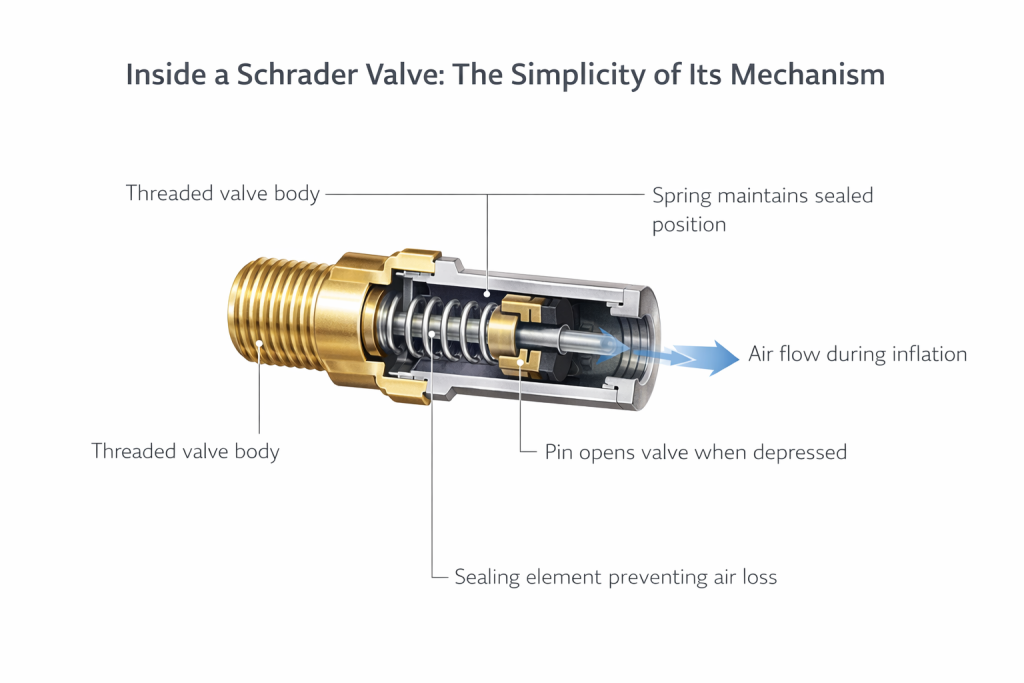
The Schrader Valve Mechanism: A Spring-Loaded Principle
At its heart, the Schrader valve operation relies on a clever interplay of a spring, a movable pin, and the pressure within the system itself. This combination creates a one-way valve that allows air in but prevents it from escaping.
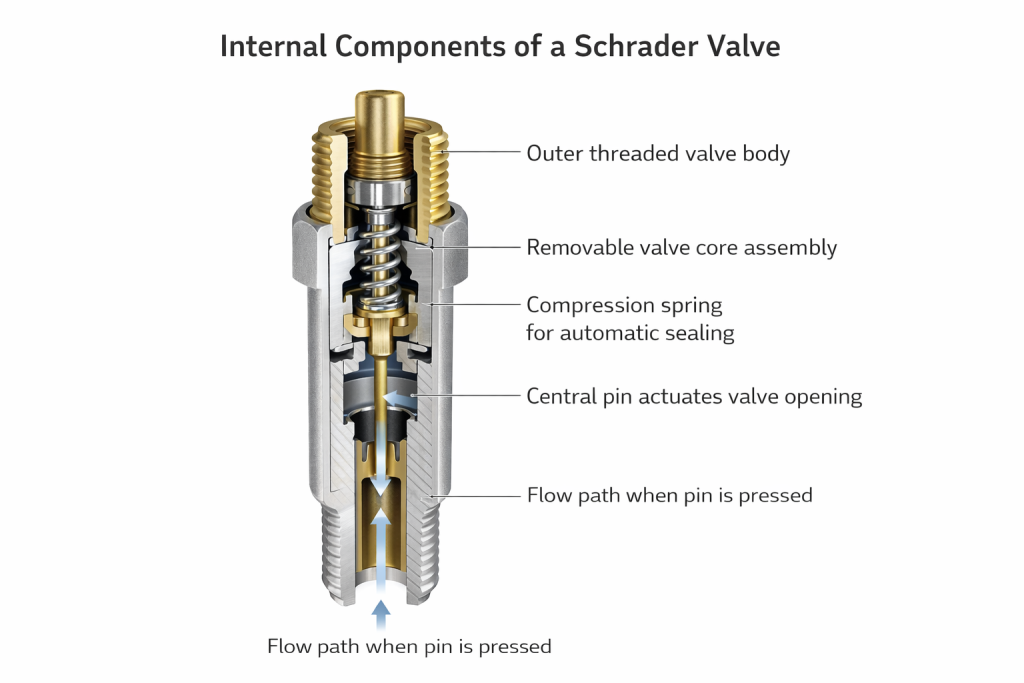
Key Components of the Schrader Valve:
- Outer Casing (Valve Stem): The visible part that screws into the tire rim or system. It has external threads for a protective cap and internal threads where the valve core sits.
- Valve Core: The removable heart of the valve. This small, cylindrical piece contains the critical sealing elements.
- Central Pin: A tiny, movable pin located in the center of the valve core. This is what you push to release air or what the pump depresses during inflation.
- Spring: A small, conical spring inside the valve core that pushes the central pin outwards, helping to keep the valve closed.
- Rubber Gasket/Seal: An essential rubber ring or washer around the central pin that creates an airtight seal against the inside of the valve stem.
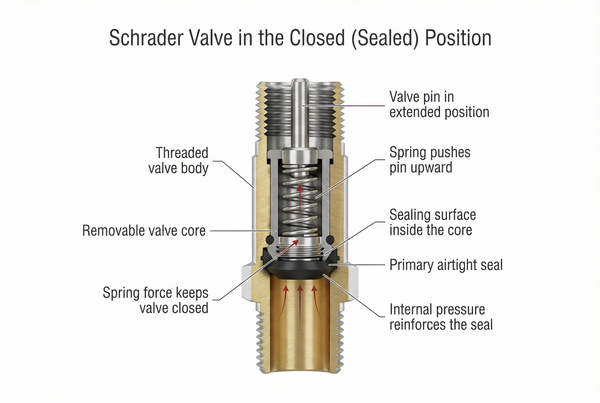
The Sealing Action (Valve Closed):
When the valve is in its normal, closed state, the central pin is extended outwards by the force of the internal spring. This pin, with its attached rubber gasket, is pressed firmly against an internal seat within the valve core. This creates the primary airtight seal. Crucially, the internal pressure from the tire or system (e.g., a car tire at 30 PSI) pushes against the central pin, further reinforcing this seal. The higher the pressure inside, the tighter the seal becomes, making it incredibly reliable for pressure retention.
The Inflation Action (Valve Open):
To add air, a pump or compressor connection pushes down on the central pin. This action compresses the internal spring and moves the pin (and its rubber gasket) away from its seat. This opens a pathway, allowing air from the pump to flow past the pin and into the tire or system. The incoming air pressure is higher than the internal pressure, overcoming the spring’s force and effortlessly pushing the pin inward.

The Deflation Action:
To deflate, you manually depress the central pin (often with a fingernail or a specialized tool). This opens the seal, allowing the pressurized air inside the tire or system to rush out around the pin until the pressure equalizes or is fully released. Once you release the pin, the spring and any remaining internal pressure push it back, re-sealing the valve.
Why This Design is So Effective and Universal
The simplicity and effectiveness of its operation are what make the Schrader valve so universally adopted. Its ingenious design offers several key advantages:
- Reliable Sealing: The use of both spring force and internal pressure ensures a robust, fail-safe seal, often capable of holding hundreds of PSI without leakage.
- Unidirectional Flow: It’s designed to let air in easily but keep it from escaping automatically, crucial for maintaining tire pressure.
- Universal Compatibility: Its standardized size means almost any air pump or pressure gauge can be used with a Schrader valve.
- Replaceable Valve Core: If the valve starts to leak, the entire valve core mechanism can be easily unscrewed and replaced using an inexpensive Schrader valve core removal tool, fixing leaks without replacing the entire stem.
- Protection: The external threads allow for a protective cap, safeguarding the pin and rubber seal from dirt, moisture, and corrosion, which could otherwise compromise its operation.
This combination of features solidifies the Schrader valve‘s place as a fundamental component in numerous pressurized systems.
Troubleshooting and Maintenance Related to Schrader Valve Operation
Even with its robust design, Schrader valves can occasionally present issues. Understanding how a Schrader valve works helps in quickly diagnosing and resolving problems.
Common Issues:
- Slow Leaks: Most often caused by a faulty, dirty, or loose rubber gasket on the valve core. A simple solution is often to tighten or replace the core.
- Difficulty Inflating: Can be due to a stuck central pin (dirt or corrosion), or a damaged spring inside the core, preventing the valve from opening properly.
- Air Escaping While Pumping: Often a sign of an improperly seated pump head or a faulty pump chuck not depressing the central pin correctly.
Maintenance Tips:
- Keep Caps On: Always replace the valve cap after inflation to protect the delicate core from debris and moisture. The cap acts as a secondary seal.
- Inspection régulière : Periodically check valve stems for physical damage, corrosion, or signs of air leakage (e.g., using soapy water).
- Replace Cores as Needed: Schrader valve cores are inexpensive and easy to replace. If you suspect a leak, try a new core before replacing the entire valve stem.
FAQ — Common Questions About How a Schrader Valve Works
Q1: What is the main principle behind how a Schrader valve works?
The main principle is a spring-loaded central pin with a rubber gasket. This pin is pushed outward by the spring and further sealed by the internal pressure of the tire/system, creating a one-way mechanism that allows air in when depressed but prevents it from escaping when released.
Q2: What role does the internal air pressure play in a Schrader valve’s operation?
Internal air pressure is crucial. After the valve is sealed by its spring, the air pressure inside the tire or system acts directly on the central pin, pushing it against its rubber gasket and seat. This force reinforces the seal, making it tighter as the internal pressure increases, thus preventing leaks.
Q3: Why can you remove the inner part (valve core) of a Schrader valve?
Le valve core is designed to be removable for easy maintenance. If the valve itself starts to leak (usually due to a worn or dirty rubber gasket on the core), you can simply unscrew and replace the core, rather than needing to replace the entire valve stem or tire/tube.
Q4: How does a pump open a Schrader valve to inflate?
When you attach a pump and press down, a small protrusion inside the pump’s chuck engages and depresses the Schrader valve‘s central pin. This action pushes the pin and its rubber seal away from its seat, compressing the internal spring and opening a pathway for air to flow into the tire or system.
Q5: What makes a Schrader valve’s seal so reliable?
The reliability comes from its dual-sealing mechanism: a small spring provides the initial closing force, and critically, the internal air pressure acts on the central pin, forcing its rubber gasket more tightly against its seat as pressure increases. This positive feedback loop enhances the seal’s integrity.
Conclusion
Le Schrader valve is a testament to effective, understated design. Its widespread application is a direct result of its reliable self-sealing capabilities and straightforward method of operation. By understanding how a Schrader valve works—from the interplay of its spring-loaded pin and rubber gasket to the critical role of internal air pressure—you gain a deeper appreciation for this small but vital component.
This knowledge not only demystifies everyday tasks like tire inflation but also empowers you to troubleshoot basic issues and perform simple maintenance, ensuring the longevity and optimal performance of your pneumatic equipment.
Explore more about valve technology.


 English
 Arabic
 Russian
 French
 Spanish