
Feeling lost in a sea of confusing quotes? The right valve is critical for your project, and making the wrong choice on price sinks your budget. You need clarity, not just another number.
What really sets the final gate valve price is its material, size, pressure rating, brand, and any special certifications it needs. Getting a handle on these details is the first step to getting a fair price for the quality you’re looking for.
I get it. The world of industrial valves is confusing. I’ve been working in this industry since I graduated in 2008, but my family’s story with valves goes back much further. I grew up watching my father build his valve factory, and from an early age, I knew I wanted to be part of it. A question I hear almost daily is about the gate valve price. It seems like a simple question, but the answer is anything but. A project’s success hangs on this single detail. You have to look past the number on a quote and understand what you’re really paying for. I will show you how to get smart about the gate valve price and make choices that will pay off for your project.
The Importance of Understanding the Vanne à guillotine Price
Your project budget is tight. Every dollar has a job. Choosing a valve just because it has the lowest price leads to expensive failures and project delays down the road.
Knowing what goes into a gate valve price is your best tool to avoid budget problems and operational breakdowns. It empowers you to invest in reliability and make sure the valve truly fits your project’s needs, protecting your whole investment in the long run.
Dive Deeper: Beyond the Initial Price Tag
I see this all the time: people focus only on the upfront gate valve price, and it’s a huge mistake. The real number you should be looking at is the Total Cost of Ownership (TCO). A friend of mine, Hassan, is a Chief Engineer who designs entire refineries. He never just looks at the initial price. He taught me to always think about the bigger picture. A tempting, low gate valve price today hides serious expenses tomorrow.
The Total Cost of Ownership (TCO)
So what is TCO? It’s all the hidden costs.
- Maintenance and Repair Costs: Let’s be honest, a cheaply made valve causes you trouble. It leaks, sticks, and fails. That means you’re stuck paying maintenance crews, buying spare parts, and dealing with repair shutdowns. All those costs add up fast. Paying a little more upfront for a better-quality valve saves you thousands later on.
- Downtime Costs: This is the real killer. In a plant, one bad gate valve shuts down an entire production line. The money lost from that stopped production is massive. It makes the savings from that cheap valve look tiny. When Hassan designs a plant, he always weighs the
gate valve priceagainst the risk of downtime. He knows that a reliable plant is a profitable plant.
Impact on Project Timelines and Safety
Le gate valve price also tells a story about your project schedule. If a supplier gives you a great price but delivers the valves late, your project gets delayed. Delays cost money in labor and lead to penalties. And let’s not forget safety. This isn’t something we cut corners on. A valve that fails under pressure is a disaster waiting to happen. Those certifications you see, like API 600 or ISO 9001, add to the gate valve price, but they are your guarantee of quality and safety. Paying for a certified valve isn’t an expense; it’s a critical investment in keeping your people and your plant safe.
The Key Factors That Determine Gate Valve Price
You’re looking at two gate valves. They look pretty much the same, but one costs a lot more than the other. It’s confusing and makes you wonder if you’re missing something.
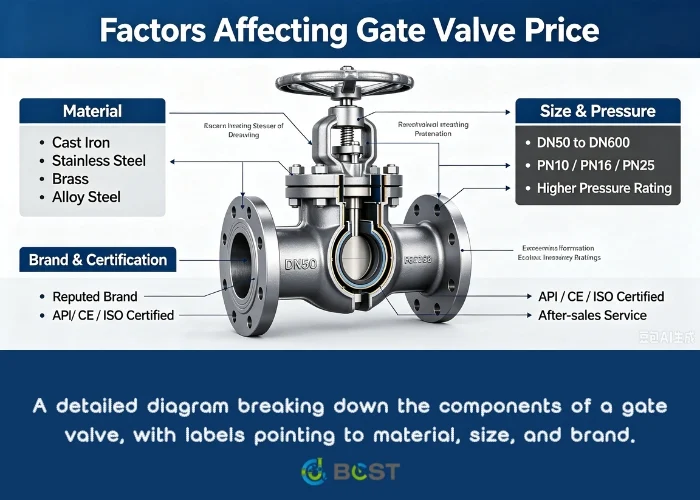
The real difference is in the details you can’t see right away. The gate valve price is set by the metal it’s made of, its size, how much pressure it can handle, the manufacturer’s name, and the paperwork that comes with it. These are the things that determine how well it works and how long it lasts.
Dive Deeper: A Breakdown of Cost Factors
Let’s pull back the curtain on what makes up the gate valve price. When you ask a supplier for a quote, these are the details you need to give them. If you just ask for a “gate valve,” the price you get back is just a shot in the dark. This table shows you how each piece of the puzzle affects the final gate valve price.
| Facteur | Description | Impact on Gate Valve Price |
|---|---|---|
| Body Material | The metal used for the valve body, like Carbon Steel (WCB) or Stainless Steel (CF8M). | High. Stainless steel and special alloys are just more expensive than basic carbon steel because they fight corrosion better and cost more as raw materials. |
| Valve Size (DN) | The diameter of the valve’s opening, from a small DN50 (2 inches) to a huge DN500 (20 inches). | High. It’s simple really: bigger valves use a lot more metal and are harder to make, so the gate valve price goes up fast. |
| Pressure Class | The maximum pressure the valve can handle, like Class 150 or Class 2500. | High. Higher pressure means the valve needs thicker walls and stronger parts. That means more material and a higher gate valve price. |
| Actionnement | How you open and close the valve. It could be a simple handwheel, a gearbox, or an automated electric or pneumatic actuator. | Medium. A manual handwheel is standard and the cheapest. Once you add a gearbox or an actuator, the cost jumps significantly. |
| End Connection | How the valve connects to the pipe. Usually, it’s with flanges (RF, FF) or welded directly (BW). | Low to Medium. Standard flanges are common. Special connections for very high pressure add to the price. |
| Brand & Certs | Who made the valve and what certifications (like API, CE, SIL) it has. | Medium. Big, well-known international brands cost more. Getting a valve certified is an expensive process, so that cost is part of the gate valve price. |
This is why a big 6-inch, Class 300 gate valve made of stainless steel with an electric motor has a much, much higher gate valve price than a simple 2-inch, Class 150 carbon steel one with a handwheel. When you compare quotes, make sure you’re truly comparing the same valve specs.
How to Choose the Right Gate Valve Within Your Budget
You have a set budget, but you absolutely need a valve that won’t fail you. The fear of picking a cheap valve that breaks is real, but you cannot afford to overspend either. So how do you find that perfect middle ground?
Start by getting super clear on what you actually need—pressure, temperature, what’s in the pipe. Then, talk to a few good suppliers. When you get their quotes, don’t just look at the gate valve price. Look at the whole package, including long-term value and who you’ll be working with.
Dive Deeper: A Practical Strategy for Procurement
Finding that balance between price and quality is an art, but it’s one you will master. It’s not about finding the cheapest gate valve price. It’s about getting the best value for your money. Here is a practical way to approach it.
Step 1: Define Your Exact Technical Requirements
Before you even think about asking for a price, you have to know what you need. Vague requests lead to vague quotes that you can’t compare. Sit down with your engineering team and pull the details from your P&ID:
- Les médias : What’s flowing through the pipe? Water? Steam? A nasty chemical? This picks the material.
- Pressure and Temperature: What are the operating conditions? This sets the pressure class.
- Size and Connections: Make sure they match your piping.
- Fonctionnement : Manual or automated?
- Standards: Do you need specific paperwork, like an API 6D stamp?
A detailed spec sheet is your best friend. It makes sure every supplier is bidding on the exact same thing.
Step 2: Compare Apples to Apples
Once the quotes arrive, don’t just look at the bottom line. This sounds simple, but you’d be surprised. I always tell my clients to make a simple spreadsheet. Compare every detail: material, pressure class, brand, what documents are included. Sometimes a slightly higher gate valve price comes with a warranty or test reports that you’d have to pay extra for from another supplier.
Step 3: Evaluate the Supplier, Not Just the Price
Honestly, the supplier you choose is just as important as the valve itself. A great partner is worth more than a small discount. Ask yourself:
- How’s their reputation? Do they provide references?
- Do they answer your technical questions, or do they just pass you along?
- What happens if there’s a problem? Will they be there to help you fix it?
A lowgate valve pricefrom a supplier you can’t get on the phone is a huge red flag. Your project depends on a partner you can count on.
Because I’ve spent my life in this business, I know how vital a trustworthy supplier is. This is why I’m proud of the work we do at Groupe BCST. We don’t just ship boxes; we provide solutions. We listen to your needs and help you find that perfect balance betweengate valve priceand performance. I’d be happy to see how we can help.
Frequently Asked Questions (FAQs)
What is a reasonable gate valve price?
There’s no such thing as a “reasonable” price without context. It all depends on the valve’s size, material, and pressure needs. A small carbon steel valve costs under $100; a large alloy one costs many thousands.
Are Chinese-made gate valves good quality?
Yes, many are fantastic. Quality comes from the manufacturer, not the country. A good Chinese factory with international certificates like API and CE produces great valves at a very competitive gate valve price.
How can I get a better gate valve price?
Be super clear and detailed with your technical specs. Ordering more valves at once secures a discount. And building a good, long-term relationship with a supplier you trust leads to better pricing over time.
Dernière réflexion
At the end of the day, the gate valve price tells a story about quality, safety, and reliability. By investing smartly, you’re not just buying a piece of metal, you’re buying peace of mind for your project. Let BCST help you find that perfect balance.


 English
 Arabic
 Russian
 French
 Spanish