
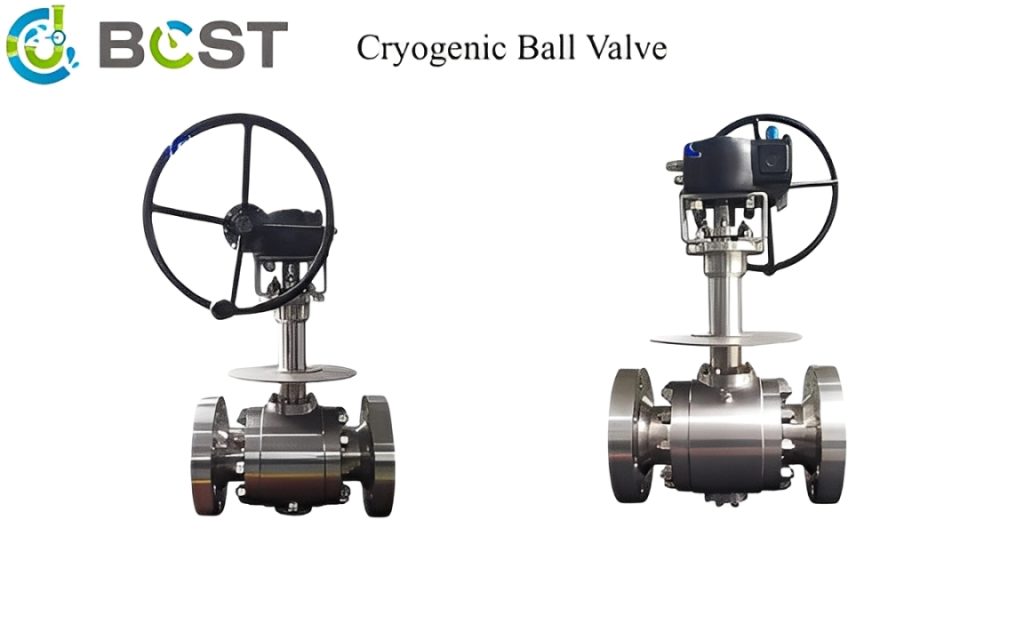
This comprehensive 2025 guide explains exactly why these specialized features are non-negotiable, reveals the precise temperature thresholds that define cryogenic service, exposes why bonnets shorter than 250 mm are never sufficient (with the simple thermal calculation), compares standard versus cryogenic designs, details the BS 6364 helium testing protocol, covers trunnion versus floating configurations, and explores real-world applications from LNG terminals to rocket propulsion systems – all backed by global standards and more than two decades of manufacturing experience.
What Temperature Defines a Cryogenic Ball Valve?
| Plage de température | Classification | Typical Fluids | Required Design Features |
|---|---|---|---|
| –50 °C to –100 °C | Low-temperature | Chilled water, cold ethylene | Low-temperature materials, optional extended stem |
| –101 °C to –150 °C | Cryogenic | LNG, liquid argon | Extended bonnet and PCTFE seats mandatory |
| Below –150 °C (≈ –196 °C) | Ultra-cryogenic | Liquid nitrogen, oxygen, hydrogen | Full cryogenic package plus helium leak testing |
These classifications align with industry-accepted practice and cryogenic valve standards such as MSS SP-134, which defines requirements for body/bonnet extensions in low-temperature service.
Why Standard Ball Valves Fail in Cryogenic Service
Standard ball valve designs often fail in extreme cold environments due to several critical issues:
- PTFE seats become brittle and may shatter below –150 °C, leading to leakage.
- Short bonnets allow frost to accumulate on the stem and packing, freezing moving parts.
- Thermal contraction may loosen standard packing, increasing risk of fugitive emissions.
- Without cavity pressure relief, trapped liquid can expand during warm-up and damage the valve body.
Why Cryogenic Ball Valves Need Extended Bonnets
The extended bonnet design ensures the stem packing and seals remain above the frost line (typically around –50 °C). This prevents ice formation on moving parts and keeps the valve operable even after prolonged exposure to liquid nitrogen.
The Thermal Calculation: Why a 200 mm Bonnet Is Not Enough
Industry insight from BCST engineering:
“Any bonnet shorter than 250 mm marketed as ‘cryogenic’ risks ice formation on the stem. In true –196 °C service, that’s not safe.”
A commonly used rule-of-thumb formula is:
Minimum bonnet length = insulation thickness + vapor column + operator clearance + safety margin
- Insulation: 100 mm
- Vapor column (to keep packing > –50 °C): 150 mm
- Handwheel/operator clearance: 100 mm
- Safety margin: 50 mm
Total required bonnet length: ~400 mm. Using a 200 mm bonnet risks leaving the packing in the “cold zone,” which can lead to ice accumulation, torque spikes, and operational failure.
In practice, many cryogenic ball valve manufacturers specify bonnets of 320–400 mm for valves ≥ 6″.
What Materials Are Used for Cryogenic Ball Valve Seats?
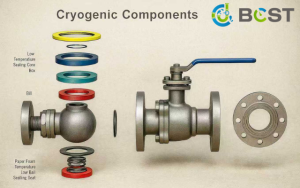
| Matériau du siège | Lowest Reliable Temp | Behavior at –196 °C | Typical Application |
|---|---|---|---|
| PTFE | Approximately –100 °C | Brittle / not suitable | General service only |
| PCTFE (Kel-F) | Down to –269 °C (per manufacturer data) | Remains flexible | All true cryogenic ball valves |
| PEEK | Down to about –150 °C | Reduced flexibility, less commonly used | Limited low-temp applications |
PCTFE is widely regarded as the soft-seat material of choice for cryogenic ball valves due to its low-temperature flexibility and sealing performance.
Key Differences: Standard vs Cryogenic Ball Valves
| Fonctionnalité | Standard Ball Valve | Robinet à bille cryogénique |
|---|---|---|
| Bonnet | Short (50–100 mm) | Extended (250–400 mm) |
| Matériau du siège | PTFE | PCTFE soft seats |
| Stem Seal | Standard packing | Live-loaded seal (Belleville washers) |
| Cavity Relief | None or minimal | Relief hole or self-relieving seat |
| Body Material | Acier inoxydable 316 | 316L / controlled metallurgy per cryogenic requirements |
| Essais | Ambient leak test (air / water) | Helium leak test at –196 °C per BS 6364:contentReference[oaicite:1]{index=1} |
| Fire Safety | API 607 optional | API 607 fire-safe plus cryogenic design |
How Cryogenic Ball Valves Are Tested (2025 Standards)
Most cryogenic ball valve manufacturers follow the BS 6364 test protocol:
- Perform shell strength test at ambient temperature.
- Immerse the valve in a liquid nitrogen bath to reach –196 °C.
- Conduct helium seat and external leakage testing per standard.
- Cycle the valve (open/close) multiple times at cryogenic temperature.
- Warm the valve back to ambient and perform a final seat leakage test.
This rigorous testing ensures the valve remains leak-tight, functional, and structurally sound at extreme cold.
Trunnion vs Floating Cryogenic Ball Valve Designs
| Design Type | Preferred Size Range | Advantages in Cryogenic Service |
|---|---|---|
| Floating Ball | Up to ~4″ (depends on manufacturer) | Simpler design, cost-effective, lighter |
| Trunnion Mounted | 6″ and above | Supports heavy extended bonnet and reduces torque |
For large cryogenic applications such as LNG, trunnion-mounted valves are typically preferred because they handle the weight and thermal stress better.
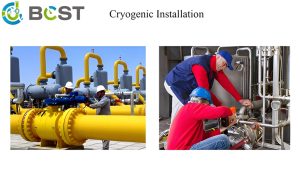
Installation & Maintenance of Cryogenic Valves
Even a well-designed cryogenic ball valve can fail if installed or maintained improperly. Below are best practices:
Pre-Installation
- Purge the system with dry nitrogen to remove contaminants.
- Verify material certifications (e.g., ASTM A182 F316L) for body and trim
- Confirm “stem vertical” orientation or per manufacturer instructions for optimal performance.
Cold Commissioning
- Cool the valve gradually (recommended ≤ 5 °C/min until near operating temperature).
- Cycle the valve 5+ times through intermediate temperatures before final immersion.
- Once at operating temperature, perform a helium seat leakage test per BS 6364.
Maintenance Schedule
| Interval | Action | Critical Checkpoints |
|---|---|---|
| Weekly | Inspection visuelle | Ice formation, frost buildup |
| Monthly | Operational test | Torque changes, smooth operation |
| Quarterly | Essai d'étanchéité | Compare against baseline leakage data |
| Annually | Partial stroke / full cycle test | Seat wear, torque drift |
Special Tools Recommended:
- Cryogenic torque wrench
- Liquid nitrogen (LN₂) test setup
- Thermal imaging camera (to detect frost lines)
- Stem load cell / seal-load tester
How Cryogenic Ball Valve Works?
Cavity Pressure Relief: A Non-Negotiable Feature
Cryogenic liquids expand dramatically when they vaporize (on the order of 600× for many gases). Without cavity pressure relief, trapped liquid can cause a dangerous over-pressure situation during warm-up. That is why every high-quality cryogenic ball valve should include a relief hole or self-relieving seat in the ball to protect the body.
Live-Loaded Stem Seal for Fugitive Emissions Control
Live-loaded packing using Belleville washers maintains constant compression through thermal cycling. This helps reduce fugitive emissions and ensures long-term sealing performance. Many cryogenic valves built for hydrogen or LNG service meet ISO 15848-1 fugitive emission standards (or similar).
Low-Temperature Material Requirements (316L and Beyond)
The valve’s body and trim are often made from stainless steel such as ASTM A182 F316L or CF3M, with controlled carbon content and ferrite to prevent brittle fracture even at –196 °C. Based on available material standards and industry practice, 316L alloys are among the most reliable for cryogenic service.
Lip-Seal Design: Combining Fire Safety & Cryogenic Performance
A lip seal (often in combination with graphite) provides zero external leakage at cryogenic temperatures, even in fire conditions. This hybrid sealing arrangement helps maintain tightness and safety after fire exposure.
Cryogenic Applications
Pétrole et gaz
- LNG storage and transfer valves
- Loading arm systems for ship bunkering
- Ethylene and propylene cold-service lines
- Regasification and peak-shaving terminals
Liquid Nitrogen, Oxygen & Hydrogen Applications
In air separation plants, cryogenic ball valves often use top-entry or trunnion designs. These allow seat replacement without body removal, minimizing downtime. For liquid oxygen or hydrogen and aerospace systems, high-purity, helium-leak tested designs are essential.
Rocket & Aerospace Systems
Rocket propulsion and cryogenic aerospace systems use liquid hydrogen (LH₂) and liquid oxygen (LOX). These systems typically require extremely tight helium leak rates, often in the order of 1 × 10⁻⁹ mbar·l/s or better. I cannot confirm specific leak rate data for BCST without internal test reports, but industry-accepted cryogenic testing often demands such tight tolerances.
Food-Grade Cryogenic Applications
Cryogenic ball valves also find use in food and beverage freezing lines (CO₂ or liquid nitrogen). Three-piece sanitary bodies, PCTFE seats, and extended bonnets ensure low contamination risk and reliable isolation.
Specifying the Best Cryogenic Ball Valve for LNG Service in 2025
For LNG applications, engineers often specify:
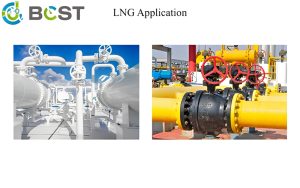
- Trunnion-mounted, full-bore ball design
- Extended bonnet (≥ 320 mm)
- PCTFE soft seat
- Live-loaded stem seal
- Helium leak-tested per BS 6364 protocol
- API 607 fire-safe rating with cryogenic design
Relevant Cryogenic Valve Standards (2025)
- ANSI / MSS SP-134-2025 – Standard practice for cryogenic valves including body/bonnet extensions.
- BS 6364 – Cryogenic valve testing protocol for helium seat leakage at –196 °C.
- ASME B16.34 / API 6D / ISO 17292 – General valve pressure-temperature ratings used in cryogenic sizing.
The Challenge of Thermal Contraction
Materials contract differently at cryogenic temperatures. Without live-loaded stem seals, differential contraction can open gaps, compromising sealing. A properly designed cryogenic valve compensates for this through spring-loaded or bellows-loaded sealing systems.
Extended-Stem Valves for Cold-Box Penetration
In cold box or insulated vessel applications, an extended stem brings the operator interface outside the cold zone. This improves operator safety and ensures maintenance access without compromising the insulation integrity.
Frequently Asked Questions (FAQ)
- Why do cryogenic ball valves need extended bonnets?
- To keep stem packing above the frost line and prevent ice seizure on critical sealing parts.
- What materials are used in cryogenic ball valve seats?
- Typical materials include PCTFE for soft seats and 316L / CF3M for body and trim.
- What is the difference between standard and cryogenic ball valves?
- Standard valves often use PTFE seats and short bonnets. Cryogenic valves use extended bonnets, PCTFE seats, cavity pressure relief, and helium leak tests at –196 °C.
- How are cryogenic ball valves tested?
- They are typically tested per BS 6364: immersion in liquid nitrogen at –196 °C, helium seat leakage testing, multiple cryogenic cycles, and final inspection.
- What is the best cryogenic ball valve for LNG service?
- A trunnion-mounted, full-bore, extended-bonnet, PCTFE-seat valve that meets BS 6364 and API 607 is commonly specified in LNG applications.
- What seat material works at –196°C?
- PCTFE (Kel-F) is the proven soft-seat technology for true cryogenic service down to –196 °C.
Réflexions finales
Cryogenic ball valves are not simply ball valves made cold. They require engineered solutions — extended bonnets, PCTFE seats, live-loaded seals, cavity relief, and validated low-temperature metallurgy. When specified correctly and tested to standards like MSS SP-134 et


 English
 Arabic
 Russian
 French
 Spanish