
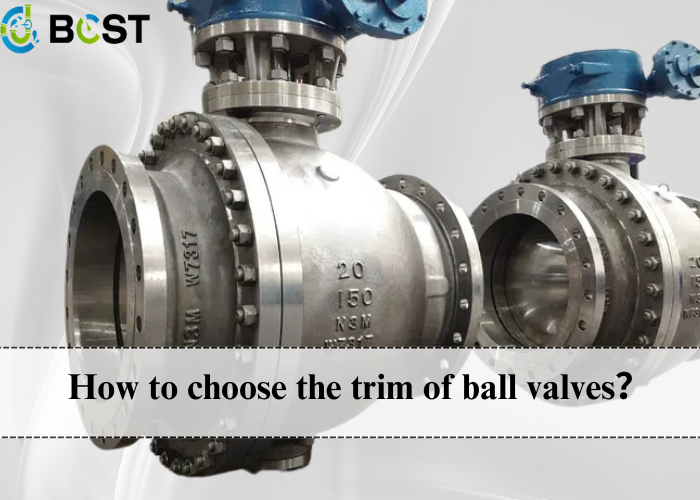
As a common fluid control device, ball valves are widely used in various industries due to their simple structure, good sealing and convenient operation.
In actual use, in order to meet the needs of different working conditions, it is necessary to reasonably select the valve trim of the ball valve. The valve trim mainly includes the valve core, valve seat, seal, embedded and bearing parts.
1. Sélectionner la garniture de la vanne en fonction des caractéristiques du fluide
        1.1 Sélectionner les matériaux du noyau et du siège de la soupape en fonction de la stabilité du fluide
    Lors de la manipulation de fluides, le noyau et le siège du robinet à boisseau sphérique doivent présenter une résistance à la corrosion plus élevée.
        1.1.1 Milieux acides et alcalins forts
    Use corrosion-resistant metal materials such as Hastelloy, Monel or nickel-based alloy to make the valve core and valve seat.
Weakly corrosive media: Stainless steel materials such as 304 and 316L stainless steel can be selected, which can not only meet the corrosion resistance requirements but also have higher mechanical strength.
1.1.2 Milieux spéciaux dans l'industrie chimique
    Dans le cas de milieux contenant du fluor ou de solutions de chlorure à forte concentration, des polymères de polytétrafluoroéthylène (PTFE) et d'autres matériaux améliorés peuvent être choisis comme sièges de soupape afin d'améliorer la résistance à la corrosion.
        1.2. Choisir le matériau de la garniture de la soupape en fonction de la température du fluide
    La température du fluide influe directement sur le choix des matériaux du noyau et du siège de la soupape.
        1.2.1 Milieu à haute température
    Adopte une structure d'étanchéité en métal dur, telle que le noyau et le siège de la vanne en métal. Les matériaux couramment utilisés sont l'alliage de chrome-molybdène, l'acier inoxydable, etc. Ces matériaux peuvent conserver de bonnes performances à haute température.
        1.2.2 Milieux à basse température
    Such as liquid nitrogen, liquid oxygen, etc., it is recommended to use low temperature steel or special alloy materials to ensure that the valve does not crack under low temperature conditions.
Normal temperature medium: Under normal working conditions, standard stainless steel or carbon steel materials with higher grades can be selected.
1.3. Choisir la garniture de la soupape en fonction de la teneur en particules du fluide
For media containing or slurry, the valve trim needs to have wear-resistant properties.Valve core material: It is recommended to choose cemented carbide or high-strength stainless steel. The high hardness and wear resistance of cemented carbide are suitable for granular media such as pipeline mortar and ore slurry.
Valve seat material: Enhanced PTFE or stainless steel metal valve seat is used to prevent particles from causing valve seat wear or sealing failure.
2. sélectionner les scellés en fonction des exigences opérationnelles
        2.1. Choix entre étanchéité souple et étanchéité dure
    Les formes d'étanchéité des robinets à tournant sphérique sont principalement divisées en joints souples et joints durs.
        2.1.1 Joint souple (PTFE et autres matériaux)
    Advantages: good sealing performance, suitable for low pressure and normal temperature conditions.
Application scenarios: food processing, medicine, pure water and other places requiring high cleanliness.
2.1.2 Joint dur (joint métal sur métal)
Advantages: high temperature resistance, wear resistance, corrosion resistance, suitable for Samsung working conditions.Application scenarios: high temperature and high pressure environments such as petroleum and chemical industries.
2.2. Sélection des athlètes
The problem is to prevent leakage between the valve stem and the valve body.Normal temperature medium: Graphite or PTFE pins are used, which are wear-resistant and corrosion-resistant.
High temperature media: Adopts flexible handle with extremely high thermal stability and sealing performance.
Low temperature medium: It is recommended to choose special reset materials, such as low temperature graphite or special polymer materials, to prevent the reset from losing elasticity due to low temperature.
3. Choisir le siège de soupape en fonction des conditions de travail
    Le siège de soupape est une pièce importante du robinet à boisseau sphérique qui entre directement en contact avec le fluide et assure la fonction d'étanchéité. La sélection du siège de soupape doit être basée sur des conditions de travail spécifiques afin de garantir ses performances et sa durée de vie.
        3.1. Sélection du matériau du siège de soupape et performances d'étanchéité
    Le choix du matériau du siège de soupape doit être basé sur les caractéristiques du fluide, la température, la pression et les exigences de fonctionnement.
        3.1.1 Siège de soupape en métal
    Features: The metal valve seat is made of wear-resistant and high-temperature resistant materials, can withstand extreme temperatures and pressures, and has good anti-aging ability.
Applicable working conditions: Suitable for high temperature and high pressure pipeline systems, such as steam, hot oil and certain chemical media.
Commonly used materials: stainless steel, carbide, etc.
3.1.2 Siège d'étanchéité souple
Features: Soft sealing valve seats are usually made of polytetrafluoroethylene (PTFE) or other polymer materials, which have excellent sealing performance, but have limited resistance to high temperature and high pressure.Applicable working conditions: Suitable for low temperature, normal temperature, medium and low pressure working environments, such as food processing, water treatment and pipelines.
Commonly used materials: PTFE, reinforced PTFE, PCTFE, etc.
3.1.3 Siège de soupape en composite
Features: The composite valve seat combines the advantages of metal and non-metal, which can withstand high temperature and provide good sealing performance.Applicable working conditions: Suitable for more complex working conditions, such as fluids with certain strength and high temperature and pressure in the petrochemical industry.
3.2. Conception et sélection du siège de soupape
        3.2.1 Siège à joint unique
    Features: The valve seat provides sealing in only one direction, with simple structure and low cost.
Applicable working conditions: Suitable for systems with fixed medium flow direction, such as one-way pipelines.
3.2.2 Siège de soupape à double étanchéité
Features: Double seal valve seat can achieve full sealing and is suitable for systems where the flow direction of the medium may change.Applicable working conditions: Oil, gas and other industries, especially in reversing pipelines or pipeline pipelines.
3.3. Résistance à l'usure et à la corrosion
For substances containing fluid (such as slurry particles, mortar, etc.), it is recommended to select a metal valve seat with higher wear resistance, or to perform lymphoma treatment on the valve seat surface, such as using a carbide coating.In order to have anti-corrosion fluid, the valve seat material should have anti-corrosion effect, such as nickel-based alloy, Hastelloy and other materials.
4. Choisir la garniture de la vanne en fonction de l'environnement de l'installation
    Le choix des éléments internes de la vanne n'est pas seulement influencé par les caractéristiques du fluide, mais doit également être optimisé en fonction des conditions spécifiques de l'environnement de l'installation.
        4.1. Étapes de l'installation de l'espace
    Compact design: In the case of installation space structure, such as underground pipelines or equipment, it is recommended to choose a compact valve internal design to reduce the installation occupation of the pipe gallery and space occupancy.
Integrated design: Some ball valves provide an integrated valve core and valve seat structure, which is more convenient to install and suitable for occasions with limited maintenance space.
4.2. Impact des conditions environnementales sur les pièces internes des soupapes
    Lorem ipsum dolor sit amet, consectetur adipiscing elit. Ut elit tellus, luctus nec ullamcorper mattis, pulvinar dapibus leo.
        4.2.1 Environnement extérieur
    The valve internals are corrosion resistant, for example using stainless steel materials that require protective coatings, which can effectively protect against humidification, salt spray or acid rain monitoring.
In cold regions, valves need to use trim materials that are resistant to freeze cracking, such as cryogenic steel or reinforced polymers.
4.2.2 Environnement propre
    Dans l'industrie alimentaire, la fabrication de produits pharmaceutiques et d'autres environnements exigeant un haut degré de propreté, les garnitures de vannes doivent être fabriquées dans des matériaux non toxiques, résistants aux températures élevées et faciles à nettoyer, tels que l'acier inoxydable de qualité alimentaire ou des matériaux à haute teneur en polymères.
        4.3. Facilité d'entretien et de remplacement
    Where frequent maintenance or replacement of internal parts is required, the design of valve internal parts should be careful and sensible.
Specification design: allows for quick sensing and replacement of internals, reducing downtime.
Standardized components: Use common standard internal parts for purchase and replacement.
4.4. Exigences particulières en matière d'environnement de travail
        4.4.1 Un monde en état de choc
    Dans les environnements soumis à des chocs importants, la garniture de la soupape doit présenter la même résistance aux chocs, par exemple en utilisant des conceptions de tige et de siège renforcées afin d'éviter la dégradation des performances de la soupape en raison des vibrations.
        4.4.2 Environnement à haute pression
    Pour les systèmes de fluides à haute pression, les garnitures de vannes doivent être plus robustes et plus résistantes à la pression. L'utilisation de matériaux composites bimétalliques ou de noyaux et de sièges de soupapes en carbure permet de résister efficacement à la pression.
        5. Résumer
    The selection of valve trim of ball valve directly affects its performance and service life. In practical applications, it is necessary to comprehensively consider factors such as fluid characteristics, temperature and pressure conditions, operating requirements and installation environment, and select appropriate valve core, valve seat, seal, and other internal materials and designs. Reasonable selection of valve trim can not only extend the service life of ball valve, but also effectively reduce costs and improve the operating efficiency of system maintenance. In engineering design and procurement, we should fully communicate with valve suppliers and select the most optimized valve solution based on actual working conditions.


 English
 Arabic
 Russian
 French
 Spanish