
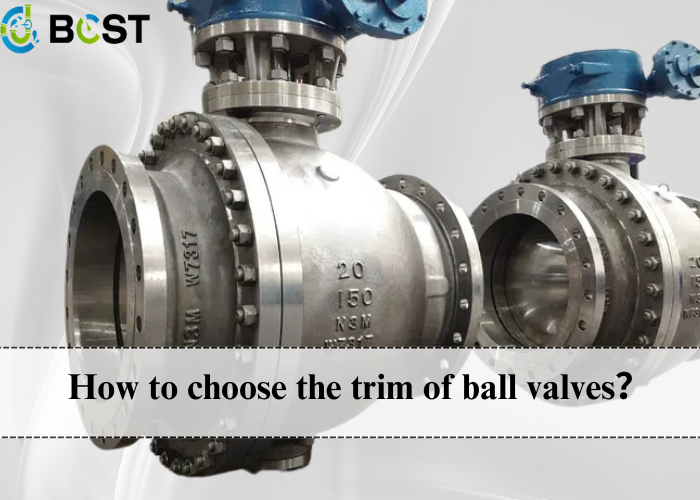
As a common fluid control device, ball valves are widely used in various industries due to their simple structure, good sealing and convenient operation.
In actual use, in order to meet the needs of different working conditions, it is necessary to reasonably select the valve trim of the ball valve. The valve trim mainly includes the valve core, valve seat, seal, embedded and bearing parts.
1. Seleccione el embellecedor de la válvula en función de las características del fluido
        1.1 Seleccionar los materiales del núcleo y del asiento de la válvula en función de la estabilidad del fluido.
    Cuando se manipulan medios, el núcleo y el asiento de la válvula de bola deben tener una mayor resistencia a la corrosión.
        1.1.1 Medios ácidos y alcalinos fuertes
    Use corrosion-resistant metal materials such as Hastelloy, Monel or nickel-based alloy to make the valve core and valve seat.
Weakly corrosive media: Stainless steel materials such as 304 and 316L stainless steel can be selected, which can not only meet the corrosion resistance requirements but also have higher mechanical strength.
1.1.2 Medios especiales en la industria química
    En medios que contienen flúor o soluciones de cloruro de alta concentración, se pueden seleccionar polímeros de politetrafluoroetileno (PTFE) y otros materiales mejorados como asientos de válvula para mejorar la resistencia a la corrosión.
        1.2. Seleccionar el material del embellecedor de la válvula en función de la temperatura del fluido
    La temperatura del medio afecta directamente a la selección de los materiales del núcleo y del asiento de la válvula.
        1.2.1 Medio de alta temperatura
    Adopta una estructura metálica de sellado duro, como el núcleo metálico de la válvula y el asiento metálico. Los materiales comúnmente utilizados incluyen aleación de cromo-molibdeno para válvulas, acero inoxidable, etc. Estos materiales pueden mantener un buen rendimiento a altas temperaturas.
        1.2.2 Medios a baja temperatura
    Such as liquid nitrogen, liquid oxygen, etc., it is recommended to use low temperature steel or special alloy materials to ensure that the valve does not crack under low temperature conditions.
Normal temperature medium: Under normal working conditions, standard stainless steel or carbon steel materials with higher grades can be selected.
1.3. Seleccione el embellecedor de la válvula en función del contenido de partículas del fluido
For media containing or slurry, the valve trim needs to have wear-resistant properties.Valve core material: It is recommended to choose cemented carbide or high-strength stainless steel. The high hardness and wear resistance of cemented carbide are suitable for granular media such as pipeline mortar and ore slurry.
Valve seat material: Enhanced PTFE or stainless steel metal valve seat is used to prevent particles from causing valve seat wear or sealing failure.
2.Seleccionar las juntas en función de los requisitos operativos
        2.1. Elección entre junta blanda y junta dura
    Las formas de sellado de las válvulas de bola se dividen principalmente en juntas blandas y juntas duras.
        2.1.1 Junta blanda (PTFE y otros materiales)
    Advantages: good sealing performance, suitable for low pressure and normal temperature conditions.
Application scenarios: food processing, medicine, pure water and other places requiring high cleanliness.
2.1.2 Junta dura (junta metal-metal)
Advantages: high temperature resistance, wear resistance, corrosion resistance, suitable for Samsung working conditions.Application scenarios: high temperature and high pressure environments such as petroleum and chemical industries.
2.2. Selección de atletas
The problem is to prevent leakage between the valve stem and the valve body.Normal temperature medium: Graphite or PTFE pins are used, which are wear-resistant and corrosion-resistant.
High temperature media: Adopts flexible handle with extremely high thermal stability and sealing performance.
Low temperature medium: It is recommended to choose special reset materials, such as low temperature graphite or special polymer materials, to prevent the reset from losing elasticity due to low temperature.
3. Seleccionar el asiento de la válvula en función de las condiciones de trabajo
    El asiento de la válvula es una parte importante de la válvula de bola que entra en contacto directo con el fluido y realiza la función de sellado. La selección del asiento de la válvula debe basarse en condiciones de trabajo específicas para garantizar su rendimiento y vida útil.
        3.1. Selección del material del asiento de la válvula y rendimiento de estanquidad
    La selección del material del asiento de la válvula debe basarse en las características del fluido, la temperatura, la presión y los requisitos de funcionamiento.
        3.1.1 Asiento de válvula metálico
    Features: The metal valve seat is made of wear-resistant and high-temperature resistant materials, can withstand extreme temperatures and pressures, and has good anti-aging ability.
Applicable working conditions: Suitable for high temperature and high pressure pipeline systems, such as steam, hot oil and certain chemical media.
Commonly used materials: stainless steel, carbide, etc.
3.1.2 Asiento de junta blanda
Features: Soft sealing valve seats are usually made of polytetrafluoroethylene (PTFE) or other polymer materials, which have excellent sealing performance, but have limited resistance to high temperature and high pressure.Applicable working conditions: Suitable for low temperature, normal temperature, medium and low pressure working environments, such as food processing, water treatment and pipelines.
Commonly used materials: PTFE, reinforced PTFE, PCTFE, etc.
3.1.3 Asiento de válvula de material compuesto
Features: The composite valve seat combines the advantages of metal and non-metal, which can withstand high temperature and provide good sealing performance.Applicable working conditions: Suitable for more complex working conditions, such as fluids with certain strength and high temperature and pressure in the petrochemical industry.
3.2. Diseño y selección del asiento de la válvula
        3.2.1 Asiento de junta simple
    Features: The valve seat provides sealing in only one direction, with simple structure and low cost.
Applicable working conditions: Suitable for systems with fixed medium flow direction, such as one-way pipelines.
3.2.2 Asiento de válvula de doble junta
Features: Double seal valve seat can achieve full sealing and is suitable for systems where the flow direction of the medium may change.Applicable working conditions: Oil, gas and other industries, especially in reversing pipelines or pipeline pipelines.
3.3. Resistencia al desgaste y a la corrosión
For substances containing fluid (such as slurry particles, mortar, etc.), it is recommended to select a metal valve seat with higher wear resistance, or to perform lymphoma treatment on the valve seat surface, such as using a carbide coating.In order to have anti-corrosion fluid, the valve seat material should have anti-corrosion effect, such as nickel-based alloy, Hastelloy and other materials.
4. Seleccione el embellecedor de la válvula en función del entorno de instalación
    La selección de los componentes internos de la válvula no sólo depende de las características del fluido, sino que también debe optimizarse en función de las condiciones específicas del entorno de la instalación.
        4.1. Pasos para instalar el espacio
    Compact design: In the case of installation space structure, such as underground pipelines or equipment, it is recommended to choose a compact valve internal design to reduce the installation occupation of the pipe gallery and space occupancy.
Integrated design: Some ball valves provide an integrated valve core and valve seat structure, which is more convenient to install and suitable for occasions with limited maintenance space.
4.2. Impacto de las condiciones ambientales en el interior de las válvulas
    Lorem ipsum dolor sit amet, consectetur adipiscing elit. Ut elit tellus, luctus nec ullamcorper mattis, pulvinar dapibus leo.
        4.2.1 Entorno exterior
    The valve internals are corrosion resistant, for example using stainless steel materials that require protective coatings, which can effectively protect against humidification, salt spray or acid rain monitoring.
In cold regions, valves need to use trim materials that are resistant to freeze cracking, such as cryogenic steel or reinforced polymers.
4.2.2 Entorno limpio
    En el procesamiento de alimentos, la fabricación de productos farmacéuticos y otros entornos que requieren un alto grado de limpieza, los embellecedores de las válvulas deben estar fabricados con materiales no tóxicos, resistentes a altas temperaturas y fáciles de limpiar, como acero inoxidable de calidad alimentaria o materiales con alto contenido en polímeros.
        4.3. Conveniencia del mantenimiento y la sustitución
    Where frequent maintenance or replacement of internal parts is required, the design of valve internal parts should be careful and sensible.
Specification design: allows for quick sensing and replacement of internals, reducing downtime.
Standardized components: Use common standard internal parts for purchase and replacement.
4.4. Requisitos especiales del entorno de trabajo
        4.4.1 Conmocionar al mundo
    En entornos de gran impacto, los embellecedores de las válvulas deben tener la misma resistencia al impacto, por ejemplo, utilizando diseños de vástago y asiento reforzados para evitar la degradación del rendimiento de la válvula debido a las vibraciones.
        4.4.2 Entorno de alta presión
    Para los sistemas de fluidos a alta presión, los embellecedores de válvulas deben tener una mayor solidez y resistencia a la presión. El uso de materiales compuestos bimetálicos o núcleos y asientos de válvula de carburo puede resistir eficazmente la presión.
        5. Resuma
    The selection of valve trim of ball valve directly affects its performance and service life. In practical applications, it is necessary to comprehensively consider factors such as fluid characteristics, temperature and pressure conditions, operating requirements and installation environment, and select appropriate valve core, valve seat, seal, and other internal materials and designs. Reasonable selection of valve trim can not only extend the service life of ball valve, but also effectively reduce costs and improve the operating efficiency of system maintenance. In engineering design and procurement, we should fully communicate with valve suppliers and select the most optimized valve solution based on actual working conditions.


 English
 Arabic
 Russian
 French
 Spanish