
Retrofitting for Profit: How Converting to Venturi Valves Slashes Carbon Taxes
Turn regulatory challenges into competitive advantage: A strategic investment for plant managers and ESG leaders.
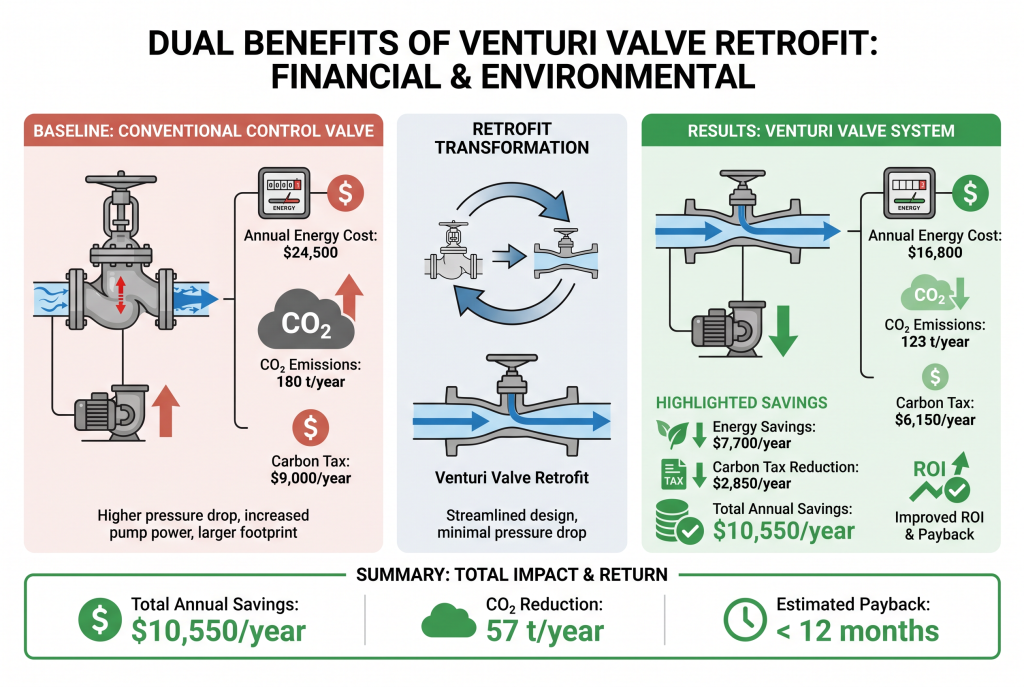
Facing escalating energy costs and an ever-tightening net of carbon emission regulations, industrial operations are under immense pressure to find sustainable solutions that also make economic sense. For many plant managers and corporate leaders, the focus often turns to large equipment like compressors and turbines. However, one of the most overlooked yet impactful areas for significant, quantifiable savings and carbon reduction lies within the ubiquitous control valve—specifically, the strategic choice to retrofit with Venturi valves. This isn’t just about efficiency; it’s about transforming operational liabilities into clear financial and environmental gains. For a deeper dive into the underlying technology, refer to The Ultimate Guide to Venturi Valves.
Economic & Environmental Imperative: The low permanent pressure loss of Venturi valves directly translates into reduced pumping power requirements, which in turn means lower electricity bills and a smaller carbon footprint. This article provides a compelling business case, offering a clear ROI perspective for plant managers, ESG directors, and senior project managers.
At BCST Valve, we specialize in delivering valves that are engineered for critical performance and long-term value. We understand that in today’s landscape, every percentage point of efficiency matters. This guide provides a detailed look at how retrofitting with Venturi valves addresses both the financial burden of carbon taxes and the growing demands for corporate environmental stewardship, presenting a significant competitive advantage. Many companies are already exploring the use of Venturi valves to address a wide range of industrial challenges, as detailed in our guide 10 High-Impact Applications for Venturi Valves.
The Looming Threat: High Energy Costs & Carbon Taxes
Industrial processes are inherently energy-intensive. Pumps and compressors, tasked with moving fluids and gases, are often among the largest consumers of electricity in a plant. Traditional control valves, like globe valves, are designed to create a significant pressure drop to control flow. While effective, this method dissipates energy, often contributing to a substantial portion of a system’s total pressure requirements and, consequently, its energy consumption.
Consider these drivers:
- Rising Electricity Prices: Global energy markets are volatile, pushing operational costs upwards.
- Carbon Pricing Mechanisms: Governments worldwide are implementing or expanding carbon taxes and cap-and-trade schemes. These put a direct price on greenhouse gas emissions, turning inefficient energy consumption into a double penalty—cost of electricity plus cost of carbon.
- ESG & Sustainability Mandates: Investors, consumers, and regulators demand better environmental performance. Companies are setting aggressive emissions reduction targets, with direct financial implications for failure to comply.
The Venturi Advantage: Lower Pressure Drop, Higher Savings
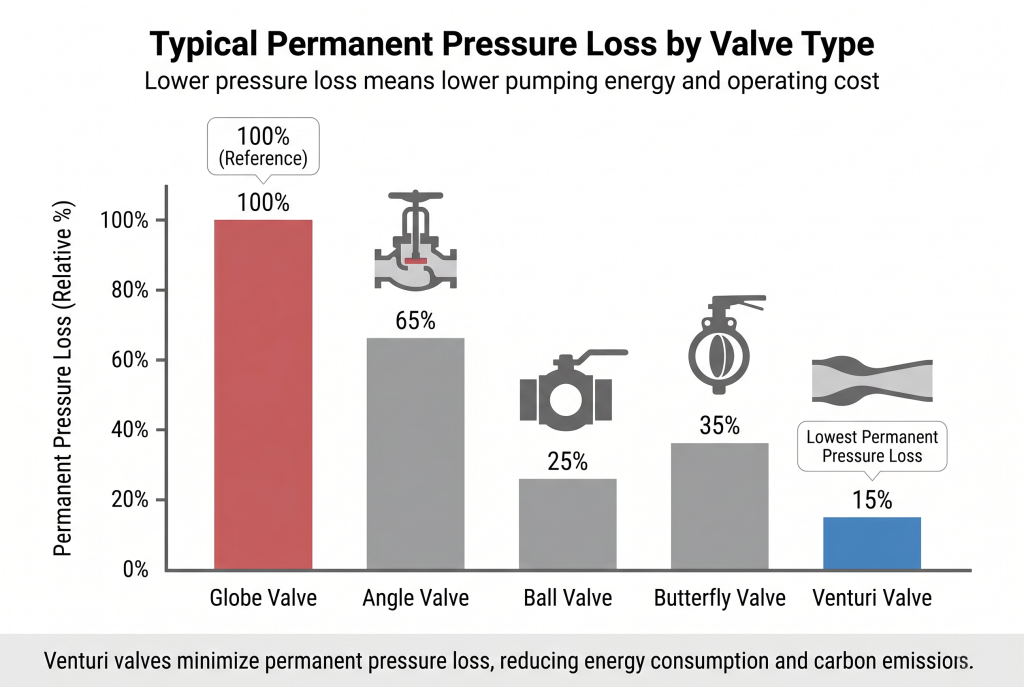
The core advantage of a Venturi valve lies in its unique geometric design. Unlike globe valves that introduce abrupt changes in flow direction and significant turbulence (causing high permanent pressure loss), a Venturi valve employs a smoothly converging inlet, a narrow throat, and a gradually diverging outlet. This design minimizes energy dissipation, leading to:
- Significantly Lower Permanent Pressure Loss: Venturi valves can achieve pressure recovery rates exceeding 90-95%, meaning less energy is permanently lost in the throttling process. (Conversely, globe valves might offer only 50-70% recovery).
- Reduced Pumping Power: Lower pressure loss across the valve means the pump has to work less to deliver the required flow rate and pressure downstream. This directly translates to reduced electricity consumption.
- Extended Equipment Life: Less strain on pumps and reduced turbulence can lead to longer operational life for associated equipment, further cutting maintenance and replacement costs.
This fundamental difference in energy efficiency is the engine behind substantial operational cost reductions and, critically, a measurable decrease in greenhouse gas emissions.
Calculating the ROI: A Sample Case Study
Let’s consider a common industrial scenario: a continuous pumping system in a chemical plant, where a traditional 6-inch globe valve is used to control flow. We calculate the potential savings by replacing it with a BCST Venturi valve of the same size.
Assumptions for this Scenario:
- Fluid: Water (SG ~ 1.0)
- Flow Rate (Q): 1000 GPM (227 m³/hr)
- Operating Hours: 8,000 hours/year (continuous operation)
- Electricity Cost: $0.12 / kWh
- Average Carbon Intensity of Electricity: 0.4 kg CO2 / kWh
- Carbon Tax Rate: $50 / metric ton CO2 (tCO2)
- Pump Efficiency: 75%
Valve Pressure Drop Comparison:
| Type de vanne | Typical ΔP (at operating flow) | Permanent Pressure Loss (approx. % of ΔP) |
|---|---|---|
| Standard Globe Valve | 15 psi (1.03 bar) | ~50% (7.5 psi / 0.52 bar) |
| BCST Venturi Valve | 15 psi (1.03 bar) | ~8% (1.2 psi / 0.08 bar) |
| Difference in Permanent Pressure Loss | 6.3 psi (0.44 bar) |
Calculation of Annual Savings:
- Energy Saved (Pumping Power):
- Power (kW) = (Q * ΔP * SG) / (1714 * Pump Eff.) (for GPM, psi, SG)
- Power Saved = (1000 GPM * 6.3 psi * 1.0) / (1714 * 0.75) ≈ 4.89 kW
- Annual Energy Savings = 4.89 kW * 8,000 hrs/year = 39,120 kWh/year
- Monetary Savings (Electricity Bill):
- Annual Electricity Savings = 39,120 kWh * $0.12/kWh = $4,694.40 / year
- Carbon Emissions Reduction:
- Annual CO2 Reduction = 39,120 kWh * 0.4 kg CO2/kWh = 15,648 kg CO2
- Annual CO2 Reduction (metric tons) = 15,648 kg / 1000 = 15.65 tCO2 / year
- Carbon Tax Savings:
- Annual Carbon Tax Savings = 15.65 tCO2 * $50/tCO2 = $782.50 / year
- Total Annual Direct Savings:
- Total = $4,694.40 (Electricity) + $782.50 (Carbon Tax) = $5,476.90 / year
Beyond Financial: ESG Benefits & Sustainable Operations
While the financial savings are a powerful motivator, the advantages of Venturi valve retrofits extend directly into your company’s Environmental, Social, and Governance (ESG) performance:
- Reduced Carbon Footprint: Directly contributes to Scope 2 emissions reductions (from purchased electricity), helping meet corporate sustainability goals.
- Enhanced Brand Reputation: Demonstrates a commitment to environmental responsibility, appealing to conscious investors, customers, and employees.
- Regulatory Compliance: Proactively manages and reduces exposure to current and future carbon taxes and climate regulations.
- Improved Resource Efficiency: Conserves energy as a finite resource, aligning with broader sustainable development objectives.
Why Choose BCST Valve for Your Retrofit Project?
- Engineered for ROI: Our Venturi valves are designed with precision fluid dynamics to maximize pressure recovery and minimize energy loss.
- Custom Solutions: We offer tailored Venturi valve designs to perfectly match your specific process conditions, ensuring optimal performance and maximum savings.
- Comprehensive Support: From initial site assessment and ROI calculation to installation guidance and long-term maintenance, our expert team is with you every step of the way.
- Proven Reliability: With decades of experience, BCST Valve delivers robust, durable valves that perform consistently in the most demanding industrial environments, reducing future maintenance costs.
Conclusion: A Smart Investment for a Sustainable Future
Retrofitting with energy-efficient Venturi valves represents much more than a simple equipment upgrade. It’s a strategic business decision that delivers a tangible return on investment through reduced energy bills and lower carbon tax liabilities. Simultaneously, it significantly bolsters your company’s ESG profile, demonstrating a commitment to sustainability that resonates with stakeholders across the board.
Don’t let inefficient control valves drain your profits and inflate your carbon footprint. BCST Valve is your partner in unlocking these vital savings and driving your operations toward a more profitable and sustainable future.
Ready to quantify your potential savings and slash your carbon footprint?


 English
 Arabic
 Russian
 French
 Spanish