
The Essential Guide to Ball Valve Grease: Lubrication vs. Sealing
Ball valves are ubiquitous in industrial processes, relied upon for their robust quarter-turn operation and excellent shut-off capabilities. To maintain their performance, especially in demanding environments, proper care is essential. When it comes to “ball valve grease,” many users often find themselves navigating a common confusion: Is it for lubrication or for creating a seal?
This comprehensive guide aims to clarify this critical distinction. We’ll explore the dual roles that grease-like substances play in ball valves—one primarily for reducing friction and extending operational life, and the other for establishing or restoring a bubble-tight seal. Understanding these nuances is fundamental for engineers, technicians, and anyone responsible for valve maintenance to ensure optimal valve performance, prevent leaks, and extend equipment lifespan.
Often, the need for grease becomes apparent when a valve is hard to turn or begins passing fluid. If a valve is exhibiting such symptoms, it’s crucial to understand the underlying problem to apply the correct solution. Learn more about when grease is the solution for a stiff or leaking valve.
Why Ball Valves Need Grease: The Fundamental Reasons
The operational environment and design of ball valves necessitate specialized compounds to ensure their long-term reliability. The primary reasons revolve around friction management and maintaining sealing integrity, particularly for specific valve types like metal-seated ball valves.
1. Reducing Operating Torque & Wear:
- The ball within a ball valve rotates against PTFE (Teflon), PEEK, or metal seats. While soft seats offer good low-friction characteristics, over time and with high cycle counts, friction can increase, requiring more torque to operate the valve and causing accelerated wear.
- For metal-seated ball valves, direct metal-on-metal contact is a reality when the valve is in transition. Lubricants help minimize friction and galling between these hardened surfaces.
- Proper lubrication keeps the valve easy to operate, reduces stress on actuators, and prevents premature wear of internal components.
2. Enhancing & Restoring Seal Performance:
- Ball valve seats, especially soft seats, can degrade, harden, or become damaged over time due to chemical attack, abrasion, or high-cycle operation.
- Fine particulate matter in the fluid can scratch seat surfaces, creating micro-leak paths.
- Specialized sealant compounds can fill these small imperfections, providing an emergency seal to stop external or internal leakage, buying time for proper maintenance or replacement.
Lubrication vs. Sealing: The Core Distinction
The key to successful ball valve maintenance lies in understanding that “grease” is often a catch-all term for two distinct categories of compounds with different primary objectives.
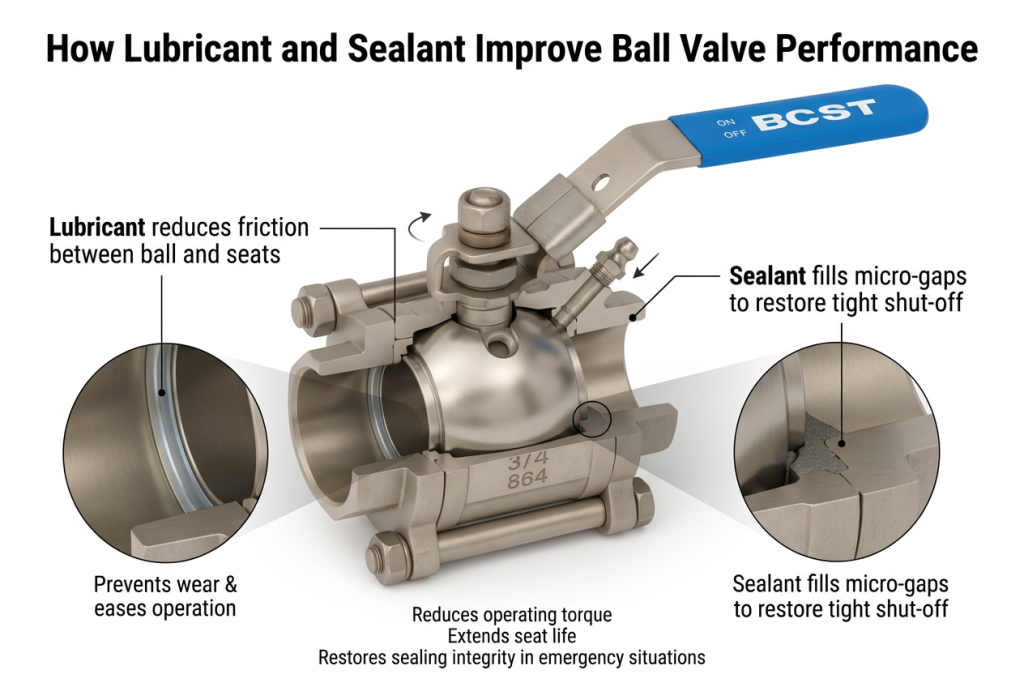
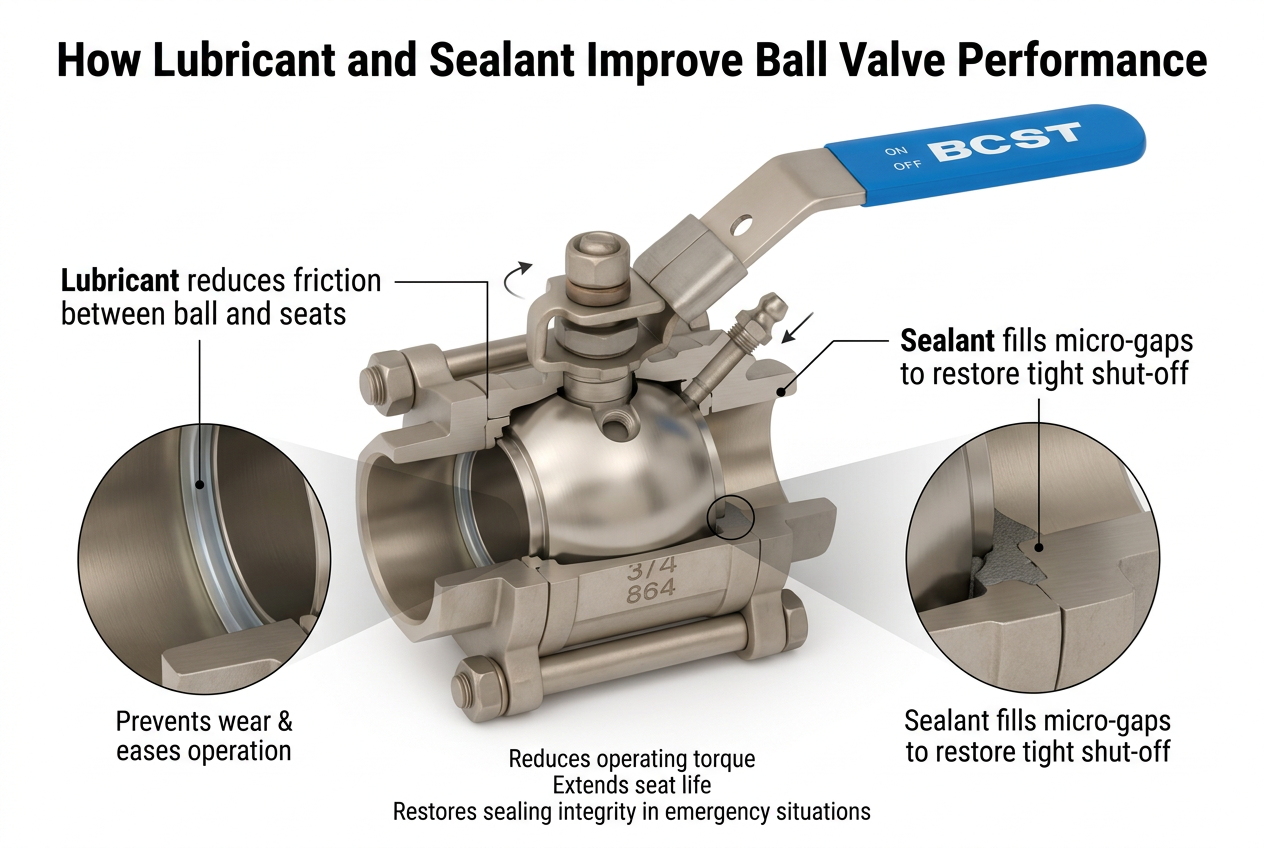
1. Lubricants (for smooth operation and reduced wear)
Lubricants are typically hydrocarbon-based or synthetic compounds designed to reduce friction between moving parts. Their main goal is longevity and ease of operation.
- Fonction : Forms a slick film between the ball and seats (or between stem and packing), allowing for smooth rotation and minimizing abrasive wear.
- Benefits: Reduces operating torque, extends the life of seats and stem packing, prevents galling in metal-seated valves.
- Application: Often injected into specialized ports (e.g., stem packing injection port, body injection port) to reach friction points.
- Effect on existing leaks: Minimal direct sealing capability. While it can temporarily improve a slight leak by filling small gaps, it’s not its primary purpose.
2. Sealants (for leak prevention and repair)
Sealants are compounds often containing fibrous or particulate fillers suspended in a grease base. They are designed to plug small leaks and restore sealing integrity.
- Fonction : The viscous, filler-laden material flows into small scratches, voids, and damaged areas on the seat surface and packing, physically blocking the leak path.
- Benefits: Stops internal (seat) or external (packing) leaks, allows for continued operation until a scheduled shutdown, avoids costly emergency repairs.
- Application: Injected under pressure directly into injection ports that lead to the seating or packing areas.
- Effect on operating torque: Can increase operating torque due to its higher viscosity and sometimes ‘sticky’ nature; some specialized sealant-lubricants exist to mitigate this.
Types of Ball Valve Grease/Sealant: Matching the Compound to the Application
Choosing the correct compound is paramount. The wrong type can do more harm than good, leading to chemical incompatibility, accelerated wear, or even complete valve failure. The substance you inject is critical and depends entirely on the service conditions. For a detailed breakdown, see our complete guide on how to choose the right ball valve grease for your application.
Common Base Chemistries:
- Hydrocarbon (Petroleum) Based: Economical, good for general-purpose lubrication. Not suitable for oxygen service or many chemical applications.
- Synthetic (e.g., Silicone, Perfluoropolyether – PFPE): Excellent chemical resistance, wider temperature range, often non-toxic. PFPE is the choice for oxygen and aggressive chemical service.
- Biodegradable: For environmentally sensitive applications.
Key Considerations for Selection:
- Media Compatibility: Crucial to avoid degradation of the compound or contamination of the process fluid.
- Temperature and Pressure: The grease/sealant must maintain its properties across the valve’s operating range.
- Viscosity & Consistency: Dictates flowability during injection and how well it stays in place.
- Food Grade/NSF Approval: Absolutely required for potable water, food, and pharmaceutical applications.
| Compound Type | Fonction principale | Typical Base | Meilleur pour |
|---|---|---|---|
| Valve Lubricant | Friction reduction, torque control | Hydrocarbon, Synthetic (Silicone) | General duty, improved opera-bility |
| Valve Sealant | Leak stopping/repair | Synthetic (PFPE), Petroleum (with fillers) | Emergency leak repair, critical isolation |
| Lubricant/Sealant Combo | Both (balanced properties) | Synthetic, advanced petroleum | Preventive maintenance, general service |
Application Methods: The Right Way to Grease a Ball Valve
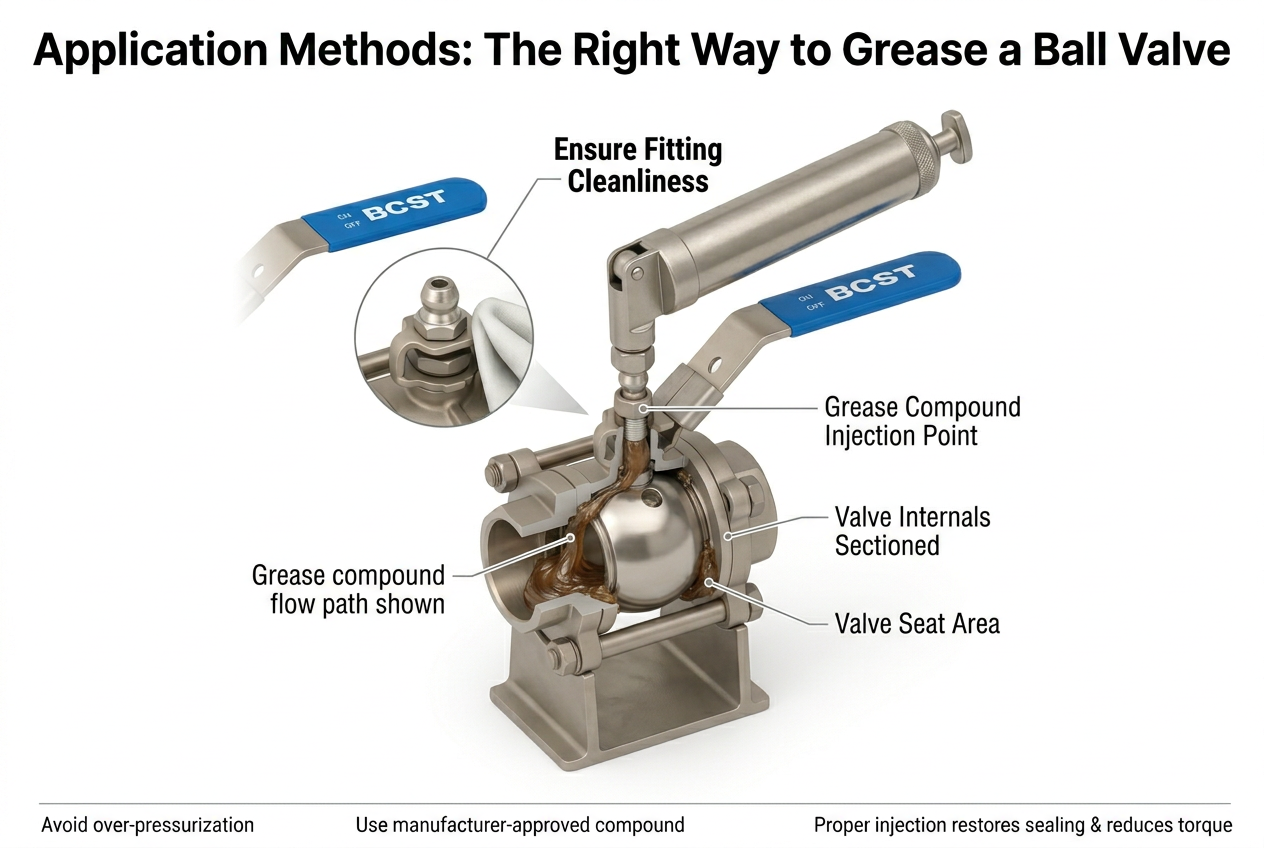
Ball valves designed for greasing typically feature designated injection fittings (often a Zerk or Giant Button head) on the body and/or stem. These fittings allow for the injection of the compound under pressure using a specialized grease gun. Proper injection is key to success. We’ve created a step-by-step guide on how to properly grease a ball valve to ensure you don’t over- or under-pressurize the valve.
General Steps for Injection:
- Safety First: Ensure the valve is depressurized, isolated, and in a safe state according to plant procedures. Always wear appropriate PPE.
- Clean the Fitting: Wipe the injection fitting clean to prevent contaminants from entering the valve.
- Attach Grease Gun: Securely attach the grease gun, loaded with the correct compound.
- Inject Slowly: Pump the grease gun slowly, listening and feeling for resistance. Rotate the valve open and closed during injection if required by the manufacturer’s instruction.
- Monitor Resistance: Stop injecting once the valve operates smoothly or the leak stops, or if you feel excessive back pressure, which could indicate over-pressurization.
- Clean Up: Remove the grease gun and clean any excess compound from the fitting.
Greasing Frequency and Best Practices
The frequency of greasing depends on several factors: valve type, service conditions (temperature, pressure, media abrasiveness), cycle frequency, and the specific grease/sealant used. Reactive greasing solves today’s problem, but a planned approach prevents future failures. Read our guide on developing a ball valve lubrication program for long-term reliability.
- Follow Manufacturer Guidelines: Always adhere to the valve manufacturer’s recommendations for grease type and injection frequency.
- Use Dedicated Equipment: Use a dedicated grease gun for each type of compound to avoid cross-contamination.
- Avoid Over-Greasing: Injecting too much grease can over-pressurize the valve cavity, potentially damaging seats, blocking the port, or in extreme cases, leading to valve body rupture or difficult operation.
- Document Everything: Keep records of which valves were greased, when, with what compound, and notes on observed performance or issues.
Conclusion
Understanding the difference between lubrication and sealing compounds, and their specific roles in ball valve maintenance, is fundamental to ensuring your valves operate reliably and safely. Lubricants proactively reduce friction and wear, extending the life of the valve, while sealants offer a critical reactive solution for stopping leaks and maintaining operational continuity.
By selecting the correct compound for your specific application and following proper injection techniques and maintenance schedules, you can significantly prolong the lifespan of your ball valves, reduce downtime, and enhance process safety.
Need expert advice on valve maintenance or sourcing quality ball valves?


 English
 Arabic
 Russian
 French
 Spanish