
Introduction
Soupapes de sécurité are critical components in various industrial systems, designed to protect equipment and personnel from overpressure conditions. By automatically releasing excess pressure, safety valves prevent catastrophic failures and maintain the integrity of systems across diverse applications. This article will explore the different types of safety valve structures, their working principles, and specific applications in various industries.
Understanding Safety Valves
Soupapes de sécurité are pressure-relief devices that automatically open to release excess pressure from a system, thereby preventing over pressure scenarios. They are essential in maintaining safe operating conditions in pressure vessels, boilers, pipelines, and other industrial equipment.

Principe de fonctionnement
Safety valves operate based on the balance of pressure forces acting on a disc or poppet. When the pressure inside a vessel exceeds the preset limit, the valve opens, allowing fluid (liquid or gas) to escape until the pressure drops back to a safe level. The valve then closes automatically, resealing the system.
Types of Safety Valve Structures
Soupapes de sécurité come in various designs and structures, each suited for specific applications. The most common types include:
1. Soupapes de sûreté à ressort
Structure
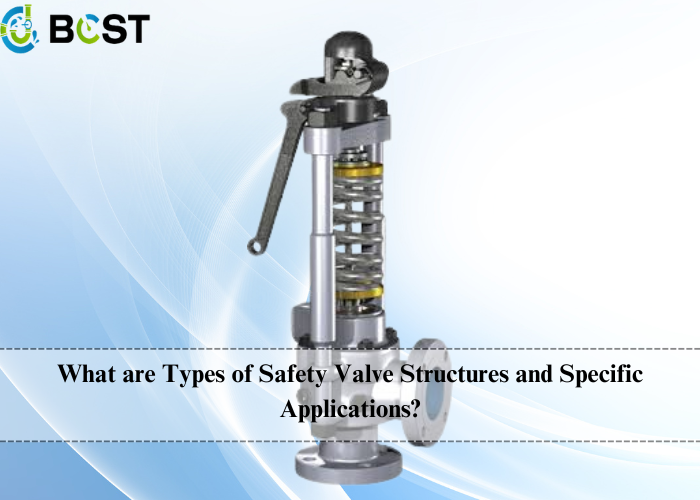
Spring-loaded safety valves consist of a valve body, a disc or poppet, and a spring mechanism. The spring is calibrated to hold the disc closed against the pressure until a specific threshold is reached.
Applications
Steam Boilers: In steam boilers, these valves protect against overpressure by releasing steam when pressure exceeds safe limits.
Gas Storage Tanks: Used to safeguard tanks containing gases under pressure, preventing explosions or leaks.
2. Soupapes de sûreté pilotées
Structure
Pilot-operated safety valves use a small pilot valve to control the larger main valve. The pilot valve opens at a set pressure, allowing fluid to control the opening of the main valve.
Applications
Chemical Processing: Ideal for systems where precise pressure control is required, such as in chemical reactors.
Power Generation: Used in power plants to manage steam and gas pressures effectively.
3. Direct-Acting Safety Valves
Structure
Direct-acting safety valves rely on a mechanical linkage between the valve disc and the pressure source. As pressure increases, the disc is pushed open directly.
Applications
Water Supply Systems: Commonly used in municipal water supply systems to protect against overpressure.
Hydraulic Systems: Essential for hydraulic equipment to prevent system failures due to excess pressure.
4. Balanced Safety Valves
Structure
Balanced safety valves are designed to minimize the effect of back pressure on the valve’s opening. They typically have a larger area on the underside of the disc to counteract the pressure acting on the top.
Applications
Oil and Gas Industry: Used in pipelines and tanks where back pressure fluctuations are common.
Refineries: Ideal for processes involving fluctuating pressures due to varying temperatures and fluid characteristics.
5. Rupture Disc Safety Devices
Structure
Rupture discs are not traditional valves but are designed to burst at a specific pressure, providing a one-time relief mechanism. Once the disc ruptures, it must be replaced.
Applications
High-Pressure Systems: Frequently used in systems that require fail-safe operation, such as in nuclear plants or high-pressure gas storage.
Pharmaceutical Industry: Employed in processes requiring sterile conditions, as they do not allow for fluid contamination.
6. Electronic Safety Valves
Structure
Electronic safety valves incorporate sensors and electronic controls to monitor pressure and operate the valve. They can provide more precise control than traditional mechanical valves.
Applications
Industrial Automation: Used in automated systems where precise pressure management is crucial.
Research Laboratories: Ideal for applications requiring detailed monitoring and control of pressure conditions.
Factors Influencing the Choice of Safety Valve
When selecting a safety valve for a specific application, several factors must be considered:
Type de fluide
The nature of the fluid (gas, liquid, corrosive, or non-corrosive) plays a significant role in valve selection. Materials must be compatible with the fluid to prevent corrosion and ensure safety.
Operating Pressure and Temperature
Understanding the maximum operating pressure and temperature of the system is essential. The safety valve must be rated for these conditions to function correctly.
Temps de réponse
The speed at which a safety valve reacts to pressure changes can be critical in preventing damage. Applications requiring rapid response may favor pilot-operated or electronic safety valves.
Installation Space
Physical dimensions and installation requirements may limit the choice of safety valve. Compact designs may be necessary in tight spaces.
Exigences en matière de maintenance
Some safety valves require more frequent maintenance than others. Choosing a valve with lower maintenance needs can reduce downtime and costs.
Conclusion
Safety valves are indispensable in protecting industrial systems from overpressure situations. Understanding the various types of safety valve structures and their specific applications allows engineers and operators to select the appropriate valve for their needs. By ensuring the safe operation of pressure vessels, boilers, and pipelines, safety valves play a crucial role in maintaining safety and efficiency across multiple industries. As technology advances, the integration of electronic and smart technologies into safety valves will continue to enhance their functionality and reliability, further ensuring the safety of industrial processes.


 English
 Arabic
 Russian
 French
 Spanish