
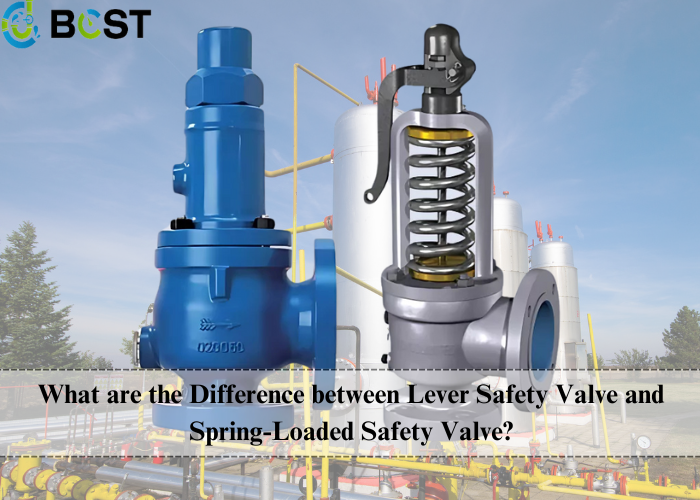
La soupape de sécurité est un dispositif de sécurité important pour les réservoirs sous pression, les pipelines et les équipements. Sa fonction est d'empêcher la pression dans le système de dépasser la valeur définie, afin de protéger l'équipement et la sécurité du personnel. Parmi les soupapes de sûreté à pression, on peut distinguer, selon leur structure, les soupapes de sûreté à levier et les soupapes de sûreté à ressort. Les différences entre les deux du point de vue de l'ingénierie, l'application de la scène et ses avantages et inconvénients sont examinés en détail ci-dessous.
I. Différences structurelles
Lever Soupape de sécurité
Lever Safety Valve is mainly composed of valve body, lever mechanism, spring and valve flap. Its core feature is to transfer the external force (such as the force of the weight or spring) to the valve flap through the lever mechanism to resist the medium pressure inside the system.1. Lever mechanism: the role of the lever is to increase the torque through the force arm, thereby reducing the force required to control the valve open.2. Hammer pressurization: the end of the lever is generally hung with a hammer, adjust the position of the hammer can change the opening pressure.
Spring-loaded pressure safety valve
Spring-loaded pressure safety valves rely on compressed springs to exert force directly, and their structure is relatively more compact, including the valve body, valve seat, spring and adjusting bolts. The spring force acts directly on the valve flap to balance the medium pressure, and the valve opens when the system pressure exceeds the set value.1. Spring loading: the set opening pressure is changed by adjusting the spring compression.2. Compact design: no levers and weights, simple structure and small size.
Ⅱ. La différence entre le principe de fonctionnement
Lever Soupape de sécurité
When working, the medium pressure in the system acts on the valve flap and tries to push open the valve. And the lever mechanism through the weight of the hammer produced by the torque and the media pressure to form a balance. When the medium pressure exceeds the set value, the force balance is destroyed, the valve flap rises, the valve opens and releases the overpressure medium.1. Adjustment mode: move the position of the hammer, change the lever force arm, adjust the opening pressure.2. Action characteristics: Because the lever mechanism has a certain inertia, its opening and closing may be slow.

Spring-loaded pressure safety valve
The medium pressure acts directly on the valve flap, and the elastic force of the spring provides the reaction force. When the pressure in the system exceeds the set value, the valve flap overcomes the spring force and is pushed open, and the medium is released. When the pressure drops below the set value, the spring force pushes the valve back to the seat and the valve closes.1. Adjustment mode: set the opening pressure by adjusting the bolt to change the pre-compression of the spring.2. Action characteristics: rapid response, sensitive opening and closing action.
Ⅲ. Comparaison des performances
Characteristics Lever Safety Valve Spring-type pressure safety valveStructural complexity Lever mechanism is more complex, high maintenance requirement Structural simplicity, easy maintenanceSpace occupied Lever and weight occupy more space Compact design, suitable for space-constrained occasionsCompact design, suitable for space-constrained applications Relatively slow actuation, suitable for systems with slow pressure changes Sensitive actuation, suitable for fast response requirementsPressure range Suitable for low to medium pressure applications (generally up to 2.5 MPa) Suitable for medium to high pressure applications (up to tens of MPa)Vibration resistance Highly affected by vibration, which may affect the stability of the lever and hammer Highly resistant to vibration, suitable for dynamic environmentsPressure setting adjustment Hammer position adjustable, low accuracy Spring preload adjustment, high setting accuracyService life More moving parts, wear may be faster Simple structure, longer service life
IV. Scénarios applicables
Application de la soupape de sécurité à levier
1. Low-pressure, large-diameter systems: such as steam boilers and industrial pipelines, which are suitable for lever-type structures due to their large-diameter requirements and stability requirements.2. Stable environment: occasions with less vibration are favorable for the stable work of lever and weight.3. Economic needs: In low-pressure environments, the manufacturing cost of lever-type valves may be lower.
Application de la soupape de sécurité à ressort
1. High-pressure, small-diameter systems: such as chemical plants and high-pressure steam boilers, their compact design and high-pressure adaptability are ideal.2. Dynamic environments: Piping systems with high vibration are more suitable for spring-loaded valves.3. Fast response requirements: such as the need to accurately control the overpressure release time of the spring-loaded structure is more superior.
Analyse des avantages et des inconvénients
Avantages et inconvénients de la soupape de sécurité à levier
1. Avantages :
1. Structure intuitive, fonctionnement simple.- Suitable for low pressure and high flow applications.
2. les inconvénients :
1. une précision de régulation plus faible. - Sensitive to vibration and tilt, more installation restrictions.
- Complex structure and high maintenance frequency.
Avantages et inconvénients de la soupape de sécurité à ressort
1.Avantages
1. Compact structure, occupies little space.2. Sensitive action, suitable for high-frequency overpressure release.3. High adjustment accuracy, wide range of applicable pressure.2. les inconvénients :
4. Manufacturing cost may be higher than rod structure.5. It may not be as effective as lever valve in high flow occasions.Ⅴ. Recommandations en matière de conception et de sélection
When selecting the type, it is necessary to consider the pressure range of the system, flow demand, space limitations and economic requirements. The following are specific recommendations:1. If the system is a low-pressure, high-flow occasions and environmental stability, you can prioritize the selection of rod pressure safety valve.2. If the system is a medium-high-pressure, low-flow occasion or the environment is complex (such as frequent vibration), it is recommended to choose spring-loaded pressure safety valves.3. For precise pressure control, the spring-loaded structure is more suitable due to its sensitivity and precision.4. If the system requires regular adjustment of opening pressure, the bolt adjustment of spring-loaded valve is more convenient.Conclusion
Les soupapes de sûreté à levier et les soupapes de sûreté à ressort ont leurs propres caractéristiques, qui doivent être sélectionnées en fonction des conditions de travail réelles dans les applications techniques. Les soupapes de sûreté à levier conviennent aux applications à basse pression en raison de leur simplicité et de leur intuitivité, tandis que les soupapes à ressort sont devenues le premier choix pour les applications à haute pression en raison de leur structure compacte et de leurs caractéristiques sensibles. Avec le développement de la technologie industrielle, le champ d'application des soupapes à ressort s'étend progressivement, mais la soupape à tige conserve un rôle irremplaçable dans des domaines spécifiques. La sélection et l'entretien appropriés des soupapes de sûreté améliorent efficacement la sécurité et l'économie du système.


 English
 Arabic
 Russian
 French
 Spanish