
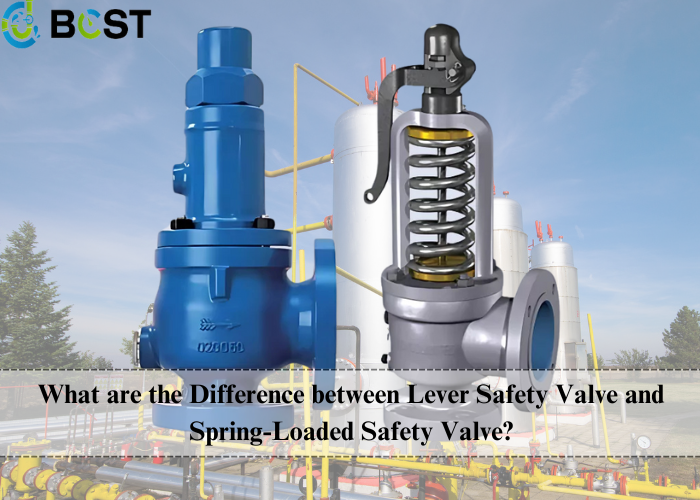
Pressure safety valve is an important safety device for pressure vessels, pipelines and equipment, its function is to prevent the pressure in the system from exceeding the set value, so as to protect the equipment and personnel safety. Among pressure safety valves, they can be categorized into Lever Safety Valve and Spring-Loaded Safety Valve according to their structure. The following is a detailed discussion of the differences between the two from the engineering point of view, the application of the scene and its advantages and disadvantages.
I. Structural differences
Lever Safety Valve
Lever Safety Valve is mainly composed of valve body, lever mechanism, spring and valve flap. Its core feature is to transfer the external force (such as the force of the weight or spring) to the valve flap through the lever mechanism to resist the medium pressure inside the system.1. Lever mechanism: the role of the lever is to increase the torque through the force arm, thereby reducing the force required to control the valve open.2. Hammer pressurization: the end of the lever is generally hung with a hammer, adjust the position of the hammer can change the opening pressure.
Spring-loaded pressure safety valve
Spring-loaded pressure safety valves rely on compressed springs to exert force directly, and their structure is relatively more compact, including the valve body, valve seat, spring and adjusting bolts. The spring force acts directly on the valve flap to balance the medium pressure, and the valve opens when the system pressure exceeds the set value.1. Spring loading: the set opening pressure is changed by adjusting the spring compression.2. Compact design: no levers and weights, simple structure and small size.
Ⅱ. The difference between the working principle
Lever Safety Valve
When working, the medium pressure in the system acts on the valve flap and tries to push open the valve. And the lever mechanism through the weight of the hammer produced by the torque and the media pressure to form a balance. When the medium pressure exceeds the set value, the force balance is destroyed, the valve flap rises, the valve opens and releases the overpressure medium.1. Adjustment mode: move the position of the hammer, change the lever force arm, adjust the opening pressure.2. Action characteristics: Because the lever mechanism has a certain inertia, its opening and closing may be slow.

Spring-loaded pressure safety valve
The medium pressure acts directly on the valve flap, and the elastic force of the spring provides the reaction force. When the pressure in the system exceeds the set value, the valve flap overcomes the spring force and is pushed open, and the medium is released. When the pressure drops below the set value, the spring force pushes the valve back to the seat and the valve closes.1. Adjustment mode: set the opening pressure by adjusting the bolt to change the pre-compression of the spring.2. Action characteristics: rapid response, sensitive opening and closing action.
Ⅲ. Performance Comparison
Characteristics Lever Safety Valve Spring-type pressure safety valveStructural complexity Lever mechanism is more complex, high maintenance requirement Structural simplicity, easy maintenanceSpace occupied Lever and weight occupy more space Compact design, suitable for space-constrained occasionsCompact design, suitable for space-constrained applications Relatively slow actuation, suitable for systems with slow pressure changes Sensitive actuation, suitable for fast response requirementsPressure range Suitable for low to medium pressure applications (generally up to 2.5 MPa) Suitable for medium to high pressure applications (up to tens of MPa)Vibration resistance Highly affected by vibration, which may affect the stability of the lever and hammer Highly resistant to vibration, suitable for dynamic environmentsPressure setting adjustment Hammer position adjustable, low accuracy Spring preload adjustment, high setting accuracyService life More moving parts, wear may be faster Simple structure, longer service life
IV. Applicable Scenarios
Application of lever pressure safety valve
1. Low-pressure, large-diameter systems: such as steam boilers and industrial pipelines, which are suitable for lever-type structures due to their large-diameter requirements and stability requirements.2. Stable environment: occasions with less vibration are favorable for the stable work of lever and weight.3. Economic needs: In low-pressure environments, the manufacturing cost of lever-type valves may be lower.
Application of spring-loaded pressure safety valve
1. High-pressure, small-diameter systems: such as chemical plants and high-pressure steam boilers, their compact design and high-pressure adaptability are ideal.2. Dynamic environments: Piping systems with high vibration are more suitable for spring-loaded valves.3. Fast response requirements: such as the need to accurately control the overpressure release time of the spring-loaded structure is more superior.
Advantages and disadvantages analysis
Advantages and disadvantages of lever pressure safety valve
1. Advantages:
1. Intuitive structure, simple operation.- Suitable for low pressure and high flow applications.
2.Disadvantages:
1. lower regulation accuracy. - Sensitive to vibration and tilt, more installation restrictions.
- Complex structure and high maintenance frequency.
Advantages and disadvantages of spring-loaded pressure safety valve
1.Advantages:
1. Compact structure, occupies little space.2. Sensitive action, suitable for high-frequency overpressure release.3. High adjustment accuracy, wide range of applicable pressure.2.Disadvantages:
4. Manufacturing cost may be higher than rod structure.5. It may not be as effective as lever valve in high flow occasions.Ⅴ. The design and selection recommendations
When selecting the type, it is necessary to consider the pressure range of the system, flow demand, space limitations and economic requirements. The following are specific recommendations:1. If the system is a low-pressure, high-flow occasions and environmental stability, you can prioritize the selection of rod pressure safety valve.2. If the system is a medium-high-pressure, low-flow occasion or the environment is complex (such as frequent vibration), it is recommended to choose spring-loaded pressure safety valves.3. For precise pressure control, the spring-loaded structure is more suitable due to its sensitivity and precision.4. If the system requires regular adjustment of opening pressure, the bolt adjustment of spring-loaded valve is more convenient.خاتمة
Lever Safety Valve and spring-loaded pressure safety valves have their own characteristics, which need to be reasonably selected according to the actual working conditions in engineering applications. Lever Safety Valves are suitable for low-pressure applications because of their simplicity and intuition, while spring-type valves have become the first choice for high-pressure applications due to their compact structure and sensitive characteristics. With the development of industrial technology, the scope of application of spring-loaded valves is gradually expanding, but the stem valve still has an irreplaceable role in specific areas. Proper selection and maintenance of safety valves will effectively improve the safety and economy of the system.


 English
 Arabic
 Russian
 French
 Spanish