
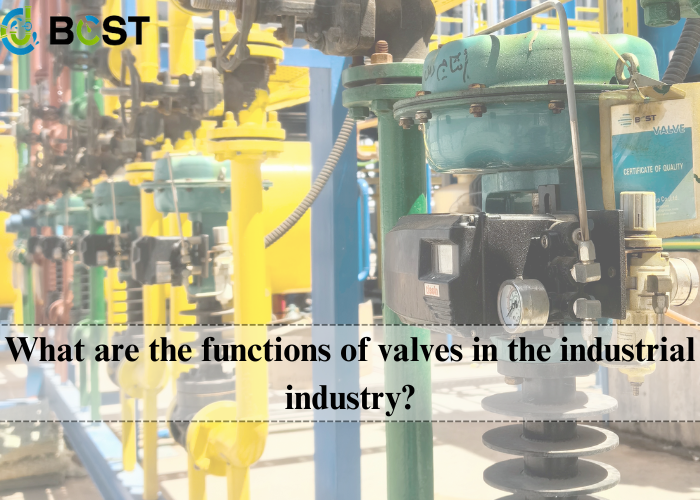
Vannes play an indispensable role in the industrial industry. As a primary device for controlling fluids (gas, liquid, or solid), valves are widely used in many fields, such as the chemical industry, petroleum, natural gas, electricity, pharmaceuticals, metallurgy, food processing, etc. They are used to control the flow, pressure, and direction of fluids and play a vital role in the safety and efficiency of the system. This article will explore the role, classification, application scenarios, and importance of soupapes in the industrial industry to modern industry.
1. The primary function of the valve
The primary function of a valve is to control and regulate the fluid in a pipeline or equipment. Specific functions include:
1.1 Starting and stopping the flow of fluids
The valve can start or stop fluid flow by fully opening or closing. This is one of its most basic functions and is widely used in the start-and-stop control of industrial equipment.
1.2 Regulate flow and pressure
Valves can control fluid flow and pressure by partially opening or closing them. This is particularly important in production processes to ensure the system remains in proper operating conditions.
1.3 Prevent backflow
The valve can prevent backflow and ensure fluid flows in the designed direction, avoiding system damage or process disturbance.
1.4 Dispensing fluid
Valves can change fluids’ flow direction and distribute them to different pipes or equipment, achieving multi-path fluid management.
1.5 Protecting equipment and systems
Some valves are designed to automatically close if pressure or temperature exceeds safe limits, protecting equipment and operators.
2. Types of valves and their applications in industry
According to different working principles, structures, and functions, valves can be divided into many types; each type has its unique role and applicable occasions.
2.1 Robinet à soupape

2.1.1 Principle and function
The globe valve moves the disc up and down by rotating the valve stem, thereby wholly closing or opening the pipeline. Its function is to control the fluid’s flow accurately while providing good sealing performance.
2.1.2 Application Scenario
Globe valves are widely used in industries that require frequent start-and-stop and precise flow adjustment, such as chemical plants, pharmaceutical plants, and power systems. In these industries, the flow and pressure of the fluid need to be strictly controlled to ensure the stability and efficiency of the production process.
2.2 Ball Valve

2.2.1 Principle and function
The ball valve controls fluid flow by rotating a ball with a hole. By rotating 90 degrees, the pipeline can be completely opened or closed. The ball valve operates fast and has good sealing performance.
2.2.2 Application Scenario
Ball valves are commonly used in the oil, gas, chemical, and water treatment industries. They are particularly suitable for situations that require rapid start and stop. In addition, ball valves perform well in diverting, mixing, and cutting off fluids in pipelines.
2.3 Gate Valve

2.3.1 Principle and function
The gate valve fully opens or closes the fluid by vertically moving the valve plate. Due to its structural characteristics, the gate valve has minimal flow resistance when fully opened and is suitable for systems that require lower fluid resistance.
2.3.2 Application Scenario
Gate valves are suitable for long-distance pipeline systems of water, oil, steam, and other media and are commonly found in water conservancy projects, petrochemicals, power stations, and other places. This type of valve is usually used when it is necessary to keep it open or closed for a long time.
2.4 Butterfly Valve

2.4.1 Principle and function
The butterfly valve controls the flow of fluid by rotating a disc. The disc’s rotation angle can adjust the amount of fluid passing through, making it suitable for flow control in large-diameter pipelines.
2.4.2 Application Scenario
Butterfly valves are widely used in air conditioning, ventilation, chemicals, food, and other industries. They are suitable for rapid start, stop, and considerable flow control, especially in low-pressure systems.
2.5 Safety Valve
2.5.1 Principle and function
The safety valve automatically opens when the system pressure exceeds the set value, releasing the excessive pressure and protecting the equipment and piping system from damage. When the pressure returns to a safe range, the valve automatically closes.
2.5.2 Application Scenario
Safety valves are mainly used in high-pressure systems such as boilers, pressure vessels, and petrochemical plants to ensure the system can automatically release pressure under abnormal circumstances to prevent explosions or other safety accidents.
2.6 Pressure Reducing Valve
2.6.1 Principle and function
The pressure-reducing valve reduces the pressure in the system by adjusting the flow area of the fluid to ensure that the downstream equipment operates within a safe pressure range.
2.6.2 Application Scenario
Pressure-reducing valves are widely used to stabilize system pressure in steam, gas, and liquid piping systems, such as water supply systems, air conditioning systems, boilers, and gas supply devices.
2.7 Check Valve

2.7.1 Principle and function
Check valves allow fluid to flow in one direction only, preventing the medium from flowing back, thus protecting system equipment.
2.7.2 Application Scenario
Check valves are commonly used in pumping systems, compressors, and various liquid or gas pipelines to prevent fluid backflow from damaging equipment or affecting the process.
3. The critical role of valves in the industrial industry
Valves not only play a control and regulation role in specific equipment and processes but also play a vital role in the safety, efficiency, and sustainability of the entire industrial system.
3.1 Improve system efficiency
Valve’s precise adjustment capability can ensure the system operates at its best. For example, in the petrochemical industry, valves control the temperature, pressure, and flow in the reactor to ensure the efficiency of chemical reactions and the quality of products.
3.2 Ensure production safety
Valves protect against high pressure, high temperature, and dangerous environments. Safety valves, explosion-proof valves, and check valves can automatically start when the system pressure or flow is abnormal, preventing accidents and ensuring the safety of operators and equipment.
3.3 Extend equipment life
Valves reduce equipment wear and corrosion through effective fluid control, thereby extending its service life. For example, pressure-reducing and check valves can prevent overpressure and backflow in the pipeline system, reducing equipment damage.
3.4 Adapt to changing process requirements.
With the continuous development of industrial technology, various new materials and process requirements continue to emerge, and the role of valves has become more diverse. Modern valves can cope with high pressure, high temperature, and corrosive media and adapt to special process requirements, such as ultra-low-temperature operation and sanitary requirements.
3.5 Reduce energy consumption
Valves can reduce energy waste in the system by precisely controlling the fluid. For example, a regulating valve can ensure that the system works optimally with minimal energy consumption, thereby reducing the energy cost of the entire industrial process.
3.6 Meet environmental protection requirements.
Modern industry has increasingly stringent environmental protection requirements, and the role of valves has also been reflected in environmental protection. Valves can control the discharge of harmful gases or liquids, ensure that they are processed and discharged within a safe range, and reduce environmental pollution.
4. Development trend of valve technology in the future
With the continuous advancement of industrial technology, valve technology is also developing. In the future, valves will make progress in the following directions:
4.1 Intelligence and automation
With the development of industrial automation, the application of intelligent valves is becoming increasingly extensive. By equipping them with sensors and automatic control systems, valves can achieve remote monitoring and automatic adjustment, greatly improving the efficiency and safety of industrial production.
4.2 New Materials Application
Valve materials in the future will be more diversified, such as composite materials and ceramic materials. These materials can cope with more extreme process conditions, such as ultra-high, ultra-low, and highly corrosive environments.
4.3 Energy-saving and environmentally friendly design
As energy and environmental issues become increasingly prominent, energy-saving and environmentally friendly valve design will become an important development direction. By optimizing the structure and materials, valves can further reduce energy loss and medium leakage, achieving higher efficiency and environmental standards.
4.4 Customized Solutions
Different industries and processes require different types of valves. In the future, valve design and production will pay more attention to customization and will be able to provide personalized solutions based on customers’ specific needs.
5. Conclusion
Valves play an irreplaceable role in the industrial industry. They are key equipment for controlling and regulating fluids and play an important role in the safety, efficiency, and environmental protection of the system. According to their characteristics, different types of valves are widely used in various industrial fields, thus ensuring the smooth progress of industrial production.
With the development of technology, valve applications will be more intelligent, energy-saving, and environmentally friendly in the future. Valve’s importance in industrial production will be further enhanced, providing more reliable and efficient support for the sustainable development of all walks of life.


 English
 Arabic
 Russian
 French
 Spanish