
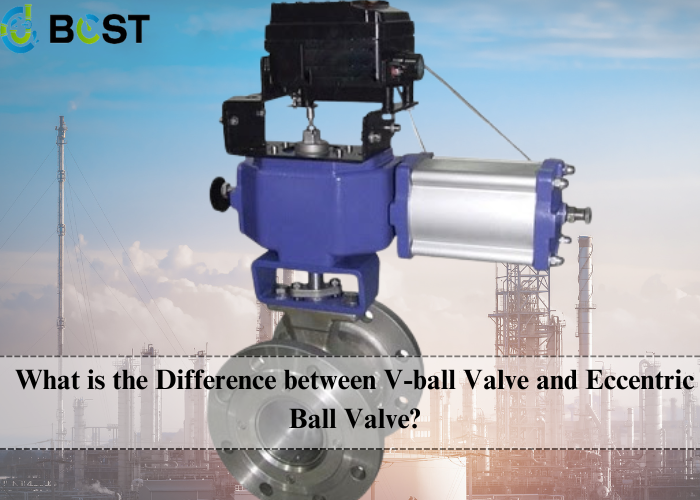
In modern industrial fluid control systems, robinets à boisseau sphérique are widely used for their excellent sealing performance, corrosion resistance and convenient operation. There are many types of ball valves with different functions, among which V-shaped ball valves and eccentric ball valves, as two special types, have their own unique structural design and application scenarios. This article will be from the perspective of engineering technology, around the two types of robinets à boisseau sphérique, structural features, operating principles, applicable conditions and technical advantages, in-depth analysis of the differences between the V-ball valve and eccentric ball valves, in order to help engineers in the actual application of reasonable choice of the right type of valve.

I. Caractéristiques structurelles
1. V-vanne à bille
V-ball valve design optimized on the basis of ordinary ball valves, its core component is a ball with a V-shaped notch. The V-shaped notch is usually located in the middle of the flow path of the ball, the valve body in the opening process, by rotating the ball to gradually release the fluid channel, so as to control the flow rate. v-notch design helps to form a flow adjustment curve, so that the fluid through the valve to achieve good linear control performance. This structure makes the V-shaped ball valve has obvious advantages in regulating flow and maintaining stability.
2. Eccentric Vannes à bille
The eccentric structure of eccentric ball valve is a certain offset between the ball and the seat of the eccentric ball valve, and the sealing surfaces of the ball and the seat are gradually contacted or disengaged during the opening and closing process through eccentric rotation. Eccentric design can reduce the friction between the ball and the valve seat, reduce the opening and closing torque, and extend the service life of the valve. The structural design makes the eccentric ball valve in the need for frequent operation of the working conditions is particularly good, and at the same time in high pressure, high temperature and other harsh environments have a strong adaptability.
Ⅱ. The working principle
1. The working principle of V-ball valve
V-ball valve in the process of rotation, through the ball with a V-shaped notch gradually release or close the flow path, so as to regulate the flow rate. v-notch angle is usually small, which makes the valve in a small degree of openness can be realized in a large fluid flow, suitable for the need for precise flow control occasions. v-ball valve adjustability, especially suitable for low pressure difference in the conditions of high-precision flow regulation. By adjusting the rotation angle of the ball, precise flow control can be obtained, and the flow curve is linear or equal percentage characteristics.
2. Principle of operation of eccentric ball valves
Eccentric ball valves utilize an eccentric structure to gradually move the ball closer to or away from the valve seat when opening and closing. When closing, the eccentric rotation of the ball makes the sealing surfaces come into contact with each other to achieve a tight seal. This working principle reduces the friction loss of the ball and the valve seat, avoids the wear and tear of the sealing surface in the process of high-frequency opening and closing. Eccentric ball valve in the open flow channel completely free, and because of the eccentric design reduces the opening and closing process of water hammer effect, suitable for the requirements of tight closing and low friction conditions.
Ⅲ. Performance Comparison
1. Adjustment performance
– V-ball valve: Due to its V-shaped notch design, V-ball valve has better flow regulation performance, and can meet the needs of high-precision flow control. Its flow adjustment curve is generally linear or equal percentage characteristics, especially suitable for occasions with large changes in flow, accurate and responsive regulation.
– Eccentric ball valves: the main function of eccentric ball valves lies in the rapid opening and closing and sealing performance, regulating performance is inferior to the V-ball valve. Its design is more inclined to the use in the fully open or fully closed state, so it is not suitable for working conditions that require fine flow regulation.
2. Sealing performance
– V-ball valve: V-ball valve in the valve seat set up a resilient structure, can to a certain extent to compensate for the wear and tear between the sealing surface, to achieve a better sealing effect. However, due to the frequent opening and closing operations in the adjustment process, the sealing surface is susceptible to wear and tear, resulting in reduced sealing performance in high-frequency operating conditions.
– Eccentric ball valves: Eccentric ball valves have significant advantages in sealing performance. Its eccentric structure design ensures that the ball in the closed state and the valve seat fit tightly, sealing performance is superior, especially for the requirements of high sealing and high-pressure working conditions.
3. Operating torque
– V-ball valve: due to the structural characteristics of the V-ball valve, its opening and closing torque is higher than ordinary ball valves, especially in the valve large opening degree when the operating torque is larger. Therefore, in the large V-ball valve usually need to configure electric or pneumatic actuator to reduce the operating difficulty.
– Eccentric ball valves: The eccentric structure of eccentric ball valves reduces the friction when opening and closing, and the operating torque is relatively small. For high-frequency operation, the low operating torque of eccentric ball valves makes them an ideal choice.
Ⅳ. Applicable working conditions
1. Applicable working conditions of V-globe valve
V-ball valves are suitable for working conditions that require precise flow regulation, such as chemical, pharmaceutical, food and other industries in the fluid handling system. Because of its V-shaped notch design, V-ball valve is particularly suitable for high viscosity, easy to deposit the media, such as slurry and granular fluid. Through flow adjustment, V-ball valves can meet the demand for high-precision and fast response control.
2. Eccentric Ball Valves
Eccentric ball valves are mainly used in applications with high requirements for sealing performance and opening and closing frequency, such as high temperature and high pressure piping systems for steam, gas, oil and corrosive media. The design of eccentric ball valve reduces the dead space and scale accumulation in the flow path, so it performs well in the working conditions with scaling tendency. It is suitable for oil and gas, metallurgy, electric power and other industrial systems that require high durability and high sealing.
V. Technical Advantages and Shortcomings
1. V-ball valve
– Advantage: excellent regulating performance, applicable to a wide range of media, especially in the medium and low-pressure systems with stable performance. Can realize high-precision flow control, suitable for a variety of complex working conditions.
– Shortcomings: large operating torque, sealing performance in high-frequency operation declines, and there is a risk of abrasion for media with large particles or high hardness.
2. Eccentric ball valves
– Advantages: superior sealing performance, small opening and closing torque, adapt to frequent operation conditions, long service life.
– Inadequate: general regulation performance, mainly used for switching control, and viscous fluid or high precision flow regulation is not applicable to the demand.
Ⅵ. How to choose V-ball valve and eccentric ball valve
In practice, the choice of V ball valves or eccentric ball valves need to consider the specific needs of the working conditions, such as flow control accuracy, media characteristics, operating frequency, temperature and pressure conditions. For the need for accurate flow regulation of low pressure, liquid conditions, can give priority to the choice of V-ball valve; and for frequent opening and closing, high pressure, gas or steam conditions, eccentric ball valve is a better choice. In addition, the selection should also be combined with the valve’s installation conditions, economy and maintenance costs for comprehensive consideration to ensure that the valve in the system for stable and reliable operation.
Ⅶ. Summarize
In summary, V-ball valves and eccentric ball valves in the structure, performance, applicable conditions, etc. There are significant differences between the V-ball valves with V-shaped notch design in the flow regulation, suitable for precise control occasions; eccentric ball valves with its excellent sealing performance and low operating torque, in the high-pressure, high-temperature and frequent opening and closing of the working conditions outstanding. Correct selection and rational use of V-shaped ball valves and eccentric ball valves can not only improve the efficiency of the fluid control system, but also extend the service life of the valve and reduce maintenance costs.


 English
 Arabic
 Russian
 French
 Spanish