
In industrial piping systems, valve selection is crucial, and different valves play different roles in fluid control. Ball and globe valves are standard, each with unique performance and applicable occasions. This article will deeply explore the working principles, characteristics, appropriate conditions, and selection principles of ball valves and globe valves in practical applications to help engineers and technicians make wise choices in actual work.
1. Applicable conditions of ball valve
1.1. Quickly cut off the fluid
Vannes à bille are ideal for quick opening and closing, such as water flow control in fire protection systems requiring a fast response to avoid accidents.
1.2. High flow rate applications
Due to their low fluid resistance, ball valves are suitable for applications with significant flow rates, such as large pipeline systems in the petroleum, chemical, and other industries.
1.3. Frequent Operations
When frequent opening and closing is required, the ball valve is simple and convenient to operate, which can effectively improve work efficiency.
1.4. Low and high-temperature fluids
Vannes à bille are available in various materials and are suitable for handling low- and high-temperature fluids such as liquid nitrogen, hot water, steam, etc.
2. Applicable conditions of the globe valve
Robinets à soupape are more appropriate in certain situations, including:
2.1. Flow regulation
Le robinet à soupape‘s valve disc design allows for fine flow control in situations where precise flow regulation is required. This is suitable for processes that require precise flow control, such as water treatment and chemical production.
2.2. High temperature and high-pressure conditions
The globe valve can maintain good sealing performance under high temperatures and pressure and is suitable for high-energy environments such as boilers and pressure vessels.
2.3. It doesn’t take up much space
Le robinet à soupape‘s vertical lifting design makes installing in specific environments with limited space more convenient.
3. Complex medium characteristics
Le robinet à soupape is suitable for complex fluid media, such as liquids containing particles or corrosive liquids, because its valve disc design can better cope with the wear of these media on the valve.
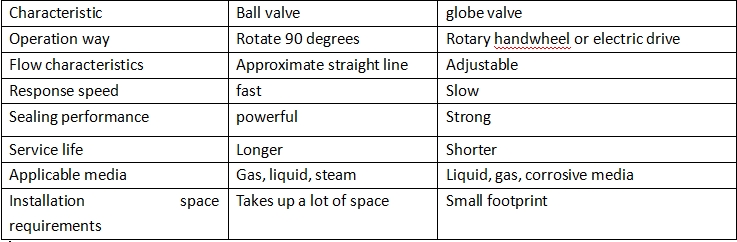
4. Comparison between ball valve and globe valve
To help with the selection, here are some comparisons of ball valves vs. robinets à soupape:
5. Selection principles in practical applications
5.1. Select according to fluid properties
When selecting a valve, the fluid’s properties, including its temperature, pressure, corrosiveness, etc., should be considered first. For example, a globe valve may be more appropriate for high-temperature, corrosive liquids, while a ball valve is more ideal for high-flow, fast-cut requirements.
5.2. Select according to the operating frequency
If frequent opening and closing operations are required, ball valves are more popular due to their simple operation; when fine flow adjustment is needed, globe valves are more suitable.
5.3. Consider installation space
Due to its small footprint, the globe valve better meets the installation requirements in an environment with limited space, while the ball valve is more convenient to install in large piping systems.
5.4. Maintenance and cost factors
The maintenance of ball valves is relatively simple, while the maintenance cost of globe valves is high due to their complex structure. Choosing the correct valve to reduce operating costs is also an important consideration for those with limited budgets.
6. Conclusion
Ball and globe soupapes have unique advantages and applicable conditions in industrial piping systems. According to the specific fluid properties, operating requirements, installation space, and maintenance costs, the rational selection of the appropriate valve type is the key to ensuring the safe and efficient operation of the fluid control system.
In practical applications, understanding the performance characteristics of various valves and their applicability under different conditions will help make more informed decisions and improve the overall efficiency and reliability of the project. Valves will play a more significant role in industrial production through reasonable selection and application.


 English
 Arabic
 Russian
 French
 Spanish