
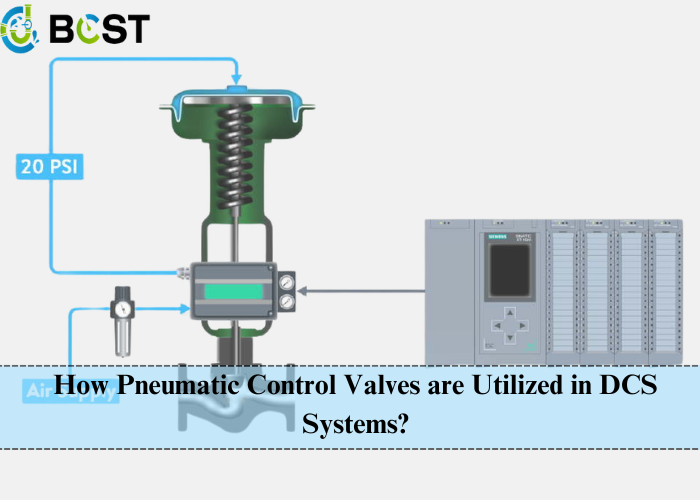
Pneumatic control valves, serving as crucial actuators in industrial process control, are extensively applied in automation control systems, particularly in Distributed Control Systems (DCS). This article delves into the working principles, composition, and characteristics of pneumatic control valves, along with their application methods, technical advantages, and challenges within DCS systems. Furthermore, through practical engineering cases, we explore how to achieve efficient integration between pneumatic control valves and DCS systems.
I. Basic Principles and Composition of Pneumatic Control Valves
A pneumatic control valve is a regulating device powered by compressed air, utilizing a pneumatic actuator to drive valve movement. It primarily consists of three parts: the valve body, actuator, and positioner.
1. Corps de vanne
The valve body is the core component of a pneumatic control valve, determining the flow control as fluid passes through. Common valve body types include ball valves, butterfly valves, and globe valves. The internal flow path design of the valve body influences fluid flow characteristics, with the relationship between valve opening and flow typically categorized as linear, equal percentage, and quick-opening.
2. Actuator
The actuator converts control signals into mechanical displacement, enabling the valve to open or close. Pneumatic actuators operate in either direct-acting or reverse-acting modes. Direct-acting increases valve opening with increasing air pressure, while reverse-acting decreases valve opening. Common actuator types include diaphragm, piston, and spring-return.
3. Positioner
The positioner is a vital component for precise control, comparing control signals from the DCS system with feedback signals from the pneumatic actuator to adjust air supply pressure, thereby achieving precise valve position control. Smart positioners can also monitor valve status and provide diagnostic functions.
II. Basic Concepts and Functions of DCS Systems
DCS systems are distributed automation control systems used for complex industrial process control. Their main feature is decentralizing control functions into Field Control Units (FCU) while enabling centralized monitoring and management through a central operator station.
Basic functions of DCS systems include:
- Process Monitoring and Data Acquisition: Real-time acquisition of data from field instruments and control devices, transmitting it to operator stations.
- Automatic Control and Optimization: Automatically adjusting actuators like control valves based on process requirements for closed-loop control.
- Alarm and Fault Diagnosis: When anomalies occur, DCS systems issue alarms and help locate issues.
- Historical Data Storage and Analysis: DCS systems store long-term process data for subsequent analysis and optimization.

III. Application of Pneumatic Control Valves in DCS Systems
In modern industrial automation control systems, pneumatic control valves, through tight integration with DCS systems, enable precise regulation of process parameters such as flow, pressure, temperature, and liquid level. Specific applications include:
1. Control Signal Transmission and Execution
In DCS systems, control valves typically receive analog signals (e.g., 4-20mA) or digital signals (e.g., HART protocol) from controllers. These signals are converted into valve opening commands by the positioner, which also adjusts the pneumatic actuator’s action based on valve position feedback to ensure accurate valve positioning.
2. Closed-Loop Control and Valve Action
Pneumatic control valves are crucial in process control loops. DCS systems regulate material flow, temperature, or pressure by controlling valve opening. In closed-loop control, process variables (e.g., flow, temperature) are fed back to the DCS system, which automatically adjusts valve opening based on deviation signals (differences between setpoints and actual values) to maintain process parameters within set ranges.
3. Communication Between Smart Positioners and DCS
Modern pneumatic control valves often come with smart positioners capable of bidirectional communication with DCS systems via industrial buses like HART, Profibus, or Foundation Fieldbus. Smart positioners provide additional diagnostic information, such as valve status and actuator health, helping operators detect potential faults early for preventive maintenance.
4. Safety Interlocks and Emergency Shutdowns
In processes, pneumatic control valves can work with interlock control strategies in DCS systems. Upon detecting abnormalities or emergencies, the DCS system can trigger rapid valve closure or opening through interlock logic, ensuring safe process operation.
IV. Technical Advantages of Integrating Pneumatic Control Valves with DCS Systems
1. High-Performance Control
Vannes de contrôle pneumatiques respond quickly, ideal for frequent startups/shutdowns and precise regulation. Tight integration with DCS systems enables closed-loop control, rapidly responding to process parameter changes to ensure process stability and efficiency.
2. Reliability and Safety
Pneumatic control valves have simple structures and low failure rates. Especially during electrical system outages or failures, pneumatic systems can ensure safe valve closure via spring-return mechanisms. Additionally, valve positioners with self-diagnostic functions communicate with DCS systems to provide valve health status information, aiding in predictive maintenance and reducing unplanned shutdowns.
3. Entretien facile
Pneumatic control valves have simple structures and are easy to maintain. Remote monitoring and intelligent diagnostics via DCS systems allow operators to monitor valve status in real-time, significantly reducing on-site inspections and maintenance costs. Smart positioners also offer online calibration, enabling precision calibration without disassembly.
4. Flexible Control Strategies
DCS systems offer powerful control algorithms and optimization functions, allowing flexible adjustment of pneumatic control valve control strategies based on process needs, such as feedforward control and fuzzy control. This flexibility broadens the application of pneumatic control valves in complex processes.
V. Challenges in Integrating Pneumatic Control Valves with DCS Systems
1. Signal Compatibility and Standardization Issues
Despite modern smart positioners supporting multiple communication protocols, differences in signal transmission and communication protocols may exist among devices from different manufacturers and models. During DCS system integration, ensuring signal compatibility and protocol consistency among devices is crucial for seamless connectivity.
2. Actuator Lag and Non-Linear Characteristics
Pneumatic control valve actuators exhibit some lag and non-linear characteristics, potentially reducing control accuracy, especially at low openings or high pressure differences. Therefore, in DCS systems, suitable control algorithms (e.g., PID regulation, feedforward compensation) are needed to mitigate these effects and ensure system control accuracy.
3. Complexity in Maintenance and Management
With increasing smart positioner functionality, maintaining and managing pneumatic control valves becomes more complex. Operators need technical skills to identify and address positioner diagnostic feedback, promptly adjusting or replacing equipment. Additionally, interfaces and communications between vannes de contrôle pneumatiques and DCS systems require regular inspections and maintenance to ensure system stability.
VI. Practical Application Case Analysis
Taking steam pipeline flow control in a chemical enterprise as an example, vannes de contrôle pneumatiques integrated with a DCS system achieve automatic steam flow control. The enterprise faced significant pressure fluctuations in its steam pipelines, making traditional manual valves unable to adjust flow in real-time, leading to high energy waste during production.
During the retrofit, the enterprise introduced pneumatic control valves and a DCS control system, installing pneumatic control valves with smart positioners to automatically control steam pipeline flow and pressure. The DCS system adjusts the opening of the pneumatic control valve in real-time based on feedback signals from flow sensors, ensuring steam flow fluctuates within set ranges. After the retrofit, steam pipeline flow fluctuations significantly decreased, reducing production energy consumption by about 15%.
VII. Conclusion
The application of vannes de contrôle pneumatiques in DCS systems provides efficient and reliable process control means for industrial automation. Through seamless integration with DCS systems, pneumatic control valves not only achieve high-precision process parameter control but also provide rich diagnostic information via smart positioners, enhancing system stability and safety. Despite integration



 English
 Arabic
 Russian
 French
 Spanish