
High Pressure Angle Valve For Severe Service & Cavitation Control
Hardened stainless steel trim and erosion‑resistant design for boiler feedwater, let‑down stations, and pump recirculation systems
- Iso 9001 certified
- Fast Global Delivery

Our Core Products
A high pressure angle valve is a specialized control valve with an angled body design (typically 90°) that naturally handles extreme pressure drops, cavitation, and flashing better than straight‑pattern globe valves. The angled flow path directs high‑velocity fluids away from the valve seat and downstream piping, reducing erosion and extending service life. Unlike standard globe valves that suffer from vibration and trim damage under high differential pressure, angle valves allow the fluid to discharge directly into a larger pipe or vessel, minimizing turbulence and noise.
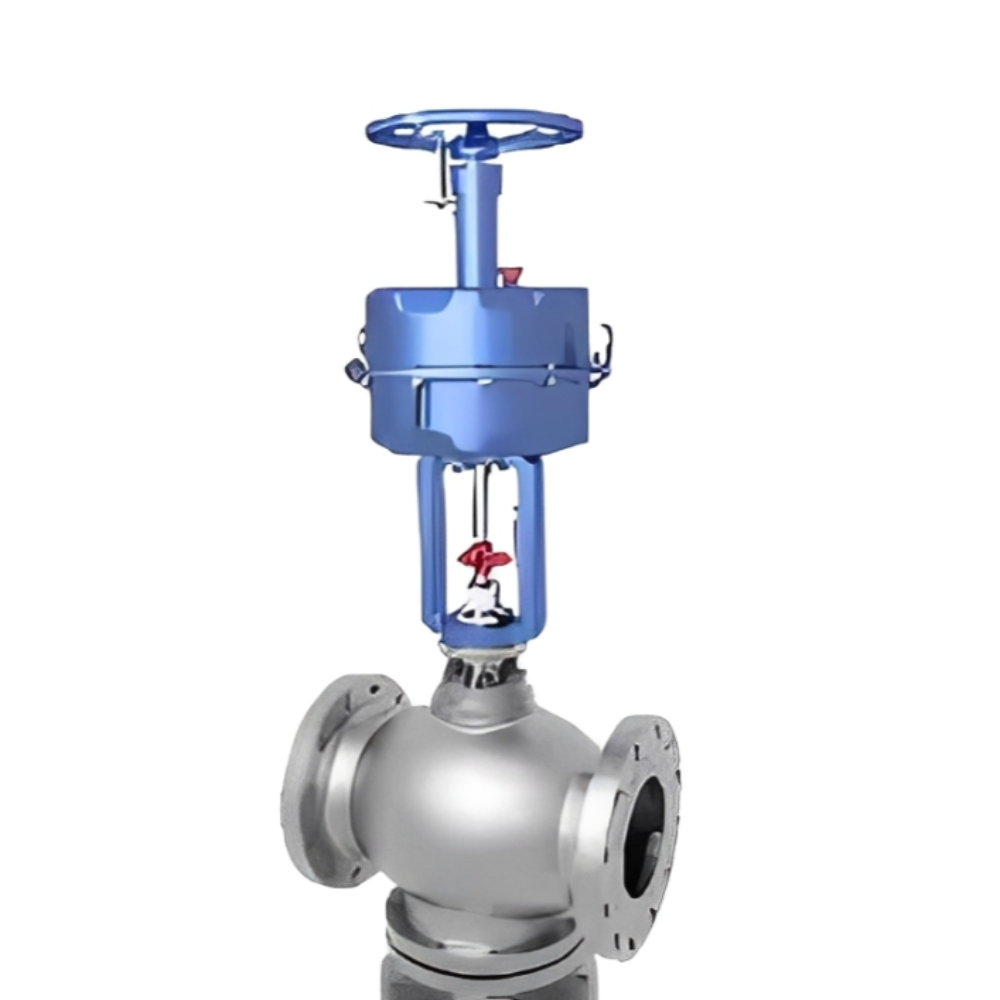
High Pressure Angle Globe Valve
Pressure Seal Bonnet Technology for Extreme High Pressure Throttling
High pressure angle globe valves feature a 90-degree angled body design that directs high-velocity flow away from the valve seat and downstream piping, significantly reducing erosion and extending service life in severe pressure drop applications. Unlike straight-pattern globe valves, the angle configuration allows the fluid to discharge directly into a larger pipe or vessel, minimizing turbulence, vibration, and cavitation damage. These valves utilize pressure seal bonnet construction for Class 1500 and above, where higher internal pressure increases the sealing force between the bonnet and body, eliminating leak paths that bolted bonnets may develop under extreme conditions. The angle body also provides excellent self-draining capabilities and reduces the number of pipe elbows required, lowering installation costs and pressure losses. High pressure angle globe valves excel in boiler feedwater recirculation, pump minimum flow protection, high-pressure steam let-down stations, and any severe service where standard globe valves would fail due to erosion or cavitation.
Key Features
- 90° angled body design for natural erosion resistance
- Hardened stainless steel or Stellite-faced trim
- Pressure seal bonnet for Class 1500–2500 (per ASME B16.34)
- OS&Y (Outside Screw and Yoke) construction
- Self-draining capability for vertical installations
Applications typiques
- Boiler feedwater pump recirculation systems
- High-pressure steam let-down stations
- Chemical injection lines with high differential pressure
- Power generation severe service throttling
- Offshore platform high-pressure process control
High Pressure Angle Check Valve
Spring-Loaded Silent Closure for High Pressure Non-Return Service
A high pressure angle check valve is a non-return valve designed with an angled body configuration that allows flow to change direction by 90 degrees while preventing reverse flow. Unlike traditional swing check valves that rely solely on gravity and backflow for closure, high pressure angle check valves incorporate spring-loaded discs that close silently and immediately as forward flow velocity approaches zero before reverse flow can begin. This rapid closure eliminates water hammer and pressure surges that can damage pumps, pipes, and fittings in high-pressure systems. The angled body reduces pressure drop compared to straight-pattern check valves by eliminating one pipe elbow, and the compact design saves valuable space in piping layouts. These valves conform to API 594 standards and are available in wafer, lug, or flanged configurations for Class 600 to 2500 service, with trim options including 316 stainless steel, Monel, and Hastelloy for aggressive media.
Key Features
- Spring-loaded silent closure (non-slam design)
- Eliminates water hammer and pressure surges
- 90° angled body reduces piping elbows
- Available in wafer, lug, or flanged connections
- Stainless steel, Monel, or Hastelloy trim options
Applications typiques
- High-pressure pump discharge protection
- Compressor discharge lines
- Offshore and subsea pipeline systems
- Hydraulic power unit return lines
- Refinery high-pressure process lines

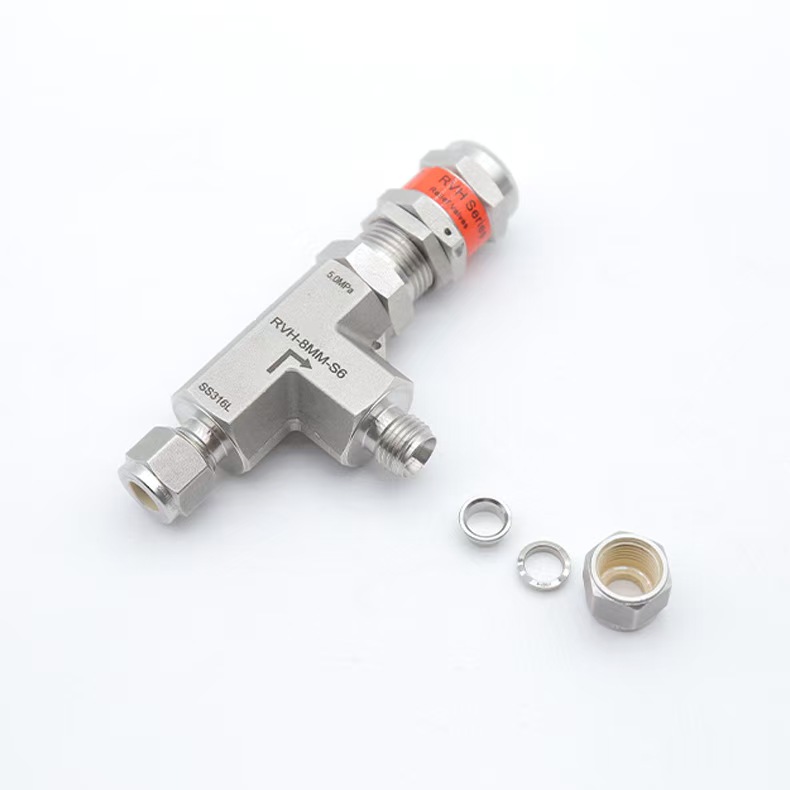
High Pressure Angle Relief Valve
ASME & API Certified Overpressure Protection
A high pressure angle relief valve is a spring-loaded pressure safety valve designed with a 90-degree angle body that discharges overpressure fluid directly into a vent or flare header, preventing damage to equipment, piping, and personnel. When system pressure exceeds the setpoint, the spring force is overcome, and the disc lifts off the seat, allowing fluid to escape through the angled outlet. The angle body configuration reduces discharge piping complexity and minimizes backpressure effects on valve operation. These valves are certified to ASME Section VIII (for unfired pressure vessels) and API 526, ensuring reliable overpressure protection for steam, gas, and liquid services. They feature full nozzle design, high lift capacity (full lift within 10% overpressure), and are available with conventional, balanced bellows, or pilot-operated configurations. Set pressures range from 0.4 bar to 414 bar, with temperature ratings up to 538°C depending on material selection.
Key Features
- ASME Section VIII and API 526 certified
- Full lift within 10% over set pressure
- Angle body directs discharge to vent or flare
- Conventional, balanced bellows, or pilot-operated configurations
- Soft seat or metal-to-metal seating options
Applications typiques
- High-pressure boiler and steam drum protection
- Chemical reactor overpressure relief
- Hydraulic system pressure protection
- Natural gas transmission line safety
- Offshore production platform pressure relief
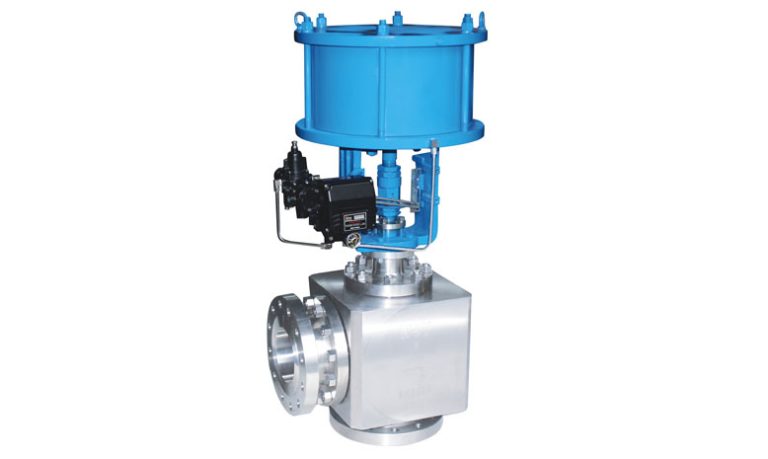
High Pressure Angle Control Valve
Multi-Stage Anti-Cavitation Trim for Severe Service Control
A high pressure angle control valve is an actuated valve specifically engineered for extreme pressure drop applications where cavitation, flashing, and erosion would destroy standard globe valves within weeks. The angle body configuration naturally directs high-velocity fluid away from the valve seat, while multi-stage anti-cavitation trims (2, 3, 4, 5, or 6 stages) reduce fluid pressure incrementally, preventing the formation of damaging vapor bubbles. Each stage absorbs a portion of the total pressure drop, keeping local pressure above the fluid’s vapor pressure until it exits the valve. These valves are available with pneumatic or electric actuation and can handle pressure drops up to 4200 psi (290 bar) in liquid, gas, and steam services. They meet IEC 60534 standards for control valve sizing and ANSI/FCI 70-2 for shut-off leakage classifications (Class IV, V, or VI). Advanced trim designs include tortuous path, stacked disc, and drilled cage configurations for optimal cavitation control.
Key Features
- Multi-stage anti-cavitation trim (2 to 6 stages)
- Pressure drops up to 290 bar (4200 psi)
- Angle body reduces erosion and seat damage
- Options d'actionnement pneumatique ou électrique
- Hardened stainless steel or Stellite trim
Applications typiques
- Boiler feedwater pump recirculation control
- High-pressure let-down stations
- Wellhead flow control in oil & gas production
- Chemical reactor pressure reduction
- Power plant steam conditioning
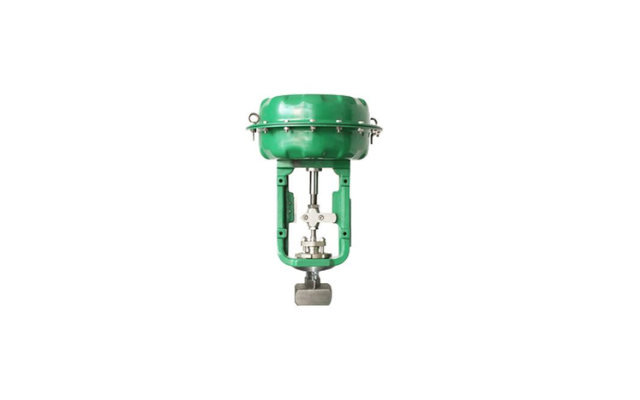
High Pressure Angle Needle Valve
Precision Metering for Instrumentation and High Pressure Sampling
A high pressure angle needle valve is a precision flow control device with a needle-shaped plunger that provides fine, incremental adjustment of flow rate in high-pressure systems. The angle body configuration (90° between inlet and outlet) allows the valve to function as both a flow regulator and an elbow fitting, simplifying piping layouts and reducing connection points. Unlike standard needle valves, the angle design protects the stem and packing from direct impingement of high-velocity flow, significantly extending packing life and preventing external leakage. The non-rotating stem tip design eliminates galling and seat damage during operation, while the blow-out proof bonnet ensures safe operation even under extreme pressure. These valves are manufactured from 316/316L stainless steel as standard, with Monel, Inconel, and Hastelloy options for corrosive or high-temperature service. Pressure ratings range from 6000 psi to 20,000 psi, with temperature capabilities from cryogenic (-200°C) to high-temperature (650°C).
Key Features
- Needle-shaped plunger for precise flow metering
- Non-rotating stem tip prevents seat galling
- Blow-out proof bonnet for operator safety
- PTFE or graphite packing options
Applications typiques
- Instrumentation pressure taps and gauge isolation
- High-pressure sampling systems
- Hydraulic control circuits
- Chemical injection metering
- Laboratory and test bench flow control
What Is A High Pressure Angle Valve?
A high pressure angle valve is a specialized flow control device with an inlet and outlet oriented at 90 degrees, designed to handle extreme pressure drops, cavitation, and erosive media that would quickly destroy standard globe valves. The angled body directs high-velocity flow away from the valve seat and downstream piping, reducing erosion, vibration, and noise. These valves are essential for boiler feedwater recirculation, pump minimum flow protection, let-down stations, and high-pressure chemical injection systems where reliability and long service life are critical.
Handles Extreme Pressure Drops
Cavitation & Flashing Control
Joint de pression Bonnet
Trusted for Material Handling Across All Industries
Our high pressure angle valves are trusted across diverse industries for their durability, erosion resistance, and reliable performance under extreme pressure drops.

Traitement chimique
Controlling high-pressure, high-temperature, and corrosive media. Our valves are widely used in ammonia, urea, and polyethylene plants for precise regulation. They also excel in severe petrochemical applications like hydrocracking, reforming, and coking, where standard valves quickly fail

Pétrole et gaz
Managing high pressure drops with erosive and corrosive fluids. Use our angle choke valves at wellheads for oil & gas processing, water/gas injection, and gas lift systems. The rugged design and multi-stage trim provide high energy dissipation for dirty, corrosive, and high-pressure services
Traitement de l'eau
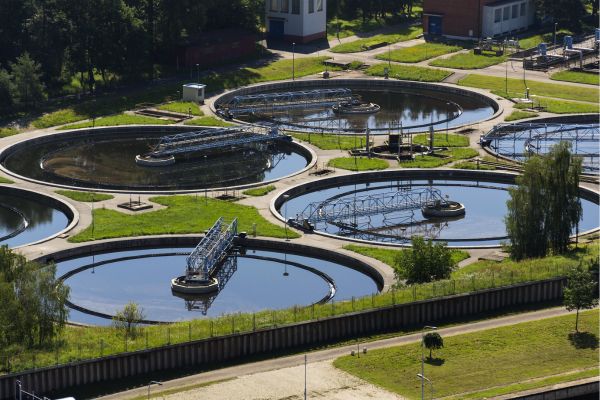
Protecting high-pressure pumping systems from cavitation. Our angle control and blowdown valves manage slurry solutions and maintain minimum flow through high-pressure pumps in desalination and water treatment facilities. The 90° angled design is ideal for self-draining applications and handling “dirty” water with particulate matter.

Production d'électricité
Optimizing boiler and turbine systems under high pressure. BCST angle valves are essential for boiler feedwater pump recirculation, high-pressure steam bypass around turbines, and let-down stations. Their multi-stage anti-cavitation trim handles extreme differential pressures, preventing pump damage and ensuring efficient energy production

Pulp & Paper
Ensuring reliable operation in harsh, steam-driven processes. BCST angle safety and pressure-reducing valves are used in pulp production and paper-making for steam system stabilization. Their compact design and corrosion-resistant materials handle high pressures and aggressive chemicals, ensuring uninterrupted plant operation.

Mining & Minerals
Withstanding extreme erosion and high differential pressures. Our valves are used in slurry transport, hydro-metallurgy, and black water let-down services. The hardened trim and multi-stage pressure reduction handle solid-laden and corrosive fluids, providing long-term durability in the most abrasive mining environments.
Vous êtes prêt à trouver la solution de robinetterie idéale pour votre projet ?
Contactez notre équipe d'experts dès aujourd'hui pour discuter des exigences de votre projet et découvrir comment BCST peut fournir des solutions fiables et efficaces adaptées à vos besoins.
Certified Performance: BCST High Pressure Angle Valve Quality Control
In critical applications across oil and gas, chemical, and power generation, an industrial on-off valve must meet stringent safety and quality standards. As your trusted manufacturer, BCST holds key international certifications, including ISO 9001, CE, and SIL (Safety Integrity Level), to ensure our products meet global requirements for hazardous and demanding environments. This commitment to certified quality, direct from our factory, provides the assurance you need for safe and compliant operations..

Conception
- Calcul du logiciel technique
- Réunion de l'équipe technique
- Confirmation du dessin CAO

Inspection des matières premières
- Analyse chimique
- Propriété mécanique
- dimension Contrôles
- Contrôles visuels
- Examen de non-destruction

Usinage
- Usinage CNC
- Contrôles visuels
- Contrôles dimensionnels
- Test de pénétration des liquides

Test de la partie spartiate
- Contrôles visuels
- Pénétration des liquides
- Test
- Essai de dureté
- Rodage
- Contrôles dimensionnels

Assemblée
- Installation
- Calibrage

Test hydrostatique
- Essai de carapace
- Test d'étanchéité
- Essai d'étanchéité
- Test à l'air
- Test de fonctionnement

Traitement des perspectives
- Polissage de surface
- Peinture
- Inspection visuelle
- Contrôles d'épaisseur

Emballage
- Marquage
- Boîte en bois exportée
High Pressure Angle Valves: Globe, Check, Relief, Control, or Needle? How to Choose for Severe Service
You need a high pressure valve that can survive extreme pressure drops, cavitation, and erosion, but the options – globe, check, relief, control, or needle – can be confusing. The wrong choice leads to premature failure, unsafe operation, or costly downtime. Here’s exactly when to pick each type, backed by ASME, API, and IEC standards.
✅ For throttling & tight shut-off under high ΔP → High Pressure Angle Globe Valve. ✅ For non-slam backflow prevention in high-pressure lines → High Pressure Angle Check Valve. ✅ For overpressure protection (ASME certified) → High Pressure Angle Relief Valve. ✅ For severe service control with cavitation elimination → High Pressure Angle Control Valve (multi-stage trim). ✅ For precise metering & instrumentation sampling → High Pressure Angle Needle Valve.

Figure 1: Five high pressure angle valve configurations – each engineered for a specific severe service role.
💡 Real-world lesson: A power plant once used standard globe valves on boiler feedwater recirculation. Within three months, cavitation had destroyed the trim, forcing an unplanned outage. We replaced them with high pressure angle control valves featuring multi-stage anti-cavitation trim. The valves have run for five years with no internal damage. The lesson: never underestimate the destructive power of high ΔP – angle valves with proper trim are non-negotiable for severe service.
What You Really Need to Know Before Choosing
High pressure angle valves are not ordinary valves. Focus on four critical factors: Pressure rating (Class 600–2500 per ASME B16.34), fluid phase (liquid/gas/steam), presence of cavitation or flashinget function (throttling, isolation, non-return, or overpressure relief). The angled body (90°) naturally handles erosion better than straight pattern valves. Below we break down the five specialized types.
1. High Pressure Angle Globe Valve1. High Pressure Angle Globe Valve: Throttling & Tight Shut-Off Under Extreme ΔP
Comment ça marche
A high pressure angle globe valve combines a 90° body with a pressure seal bonnet (for Class 1500–2500). The angled flow path directs high-velocity fluid away from the seat, reducing erosion. The plug moves linearly against a seat, providing excellent shut-off (ANSI Class IV–VI). Pressure seal bonnets tighten as internal pressure increases, eliminating leaks at extreme pressures (up to 414 bar / 6000 psi).
When I Recommend It
- Boiler feedwater pump recirculation – protects pumps from low-flow damage.
- High-pressure steam let-down stations – reduces steam pressure from 250 bar to 10 bar.
- Chemical injection lines – handles high differential pressures without erosion.
- Offshore high-pressure process control – compact design saves space.
Where It Falls Short
Angle globe valves are larger and heavier than standard globe valves. They are not ideal for very dirty or slurry services where solids can accumulate in the body. For extreme cavitation, add a multi-stage trim (see angle control valve).
2. High Pressure Angle Check Valve2. High Pressure Angle Check Valve: Non-Slam Backflow Prevention
Comment ça marche
A spring-loaded disc closes instantly when forward flow stops, before reverse flow can occur. The 90° angle body reduces water hammer by eliminating the need for a separate elbow. Designed per API 594, these valves handle Class 600–2500 with materials from carbon steel to Inconel.
When You Want This One
- High-pressure pump discharge – prevents reverse flow when pump stops.
- Compressor discharge lines – protects against sudden backflow.
- Offshore pipelines – compact, corrosion-resistant materials.
- Hydraulic power units – silent closure eliminates pressure spikes.
The Trade-Off
Higher pressure drop than swing checks due to spring. Not suitable for very low flow velocities where spring may not fully open the disc.
⚠️ Critical: Never use a standard swing check valve in high-pressure pulsating service – water hammer can destroy piping. Always specify a spring-loaded angle check valve per API 594 for severe duty.
3. High Pressure Angle Relief Valve3. High Pressure Angle Relief Valve: ASME Section VIII Overpressure Protection
Comment ça marche
A spring-loaded disc lifts when system pressure exceeds setpoint, discharging fluid through the 90° outlet directly to a flare or vent. Certified to ASME Section VIII and API 526, these valves achieve full lift within 10% overpressure. Available in conventional, balanced bellows (for variable backpressure), and pilot-operated designs.
When You Absolutely Need This Valve
- High-pressure boilers and pressure vessels – mandatory for code compliance.
- Chemical reactor overpressure protection – handles corrosive media with Hastelloy trim.
- Natural gas transmission lines – high set pressures up to 414 bar.
- Hydraulic systems – compact angle design fits tight spaces.
One Limitation
Angle relief valves require proper discharge piping to avoid backpressure. For closed systems, use a balanced bellows or pilot-operated design. Never cap or restrict the outlet.
4. High Pressure Angle Control Valve4. High Pressure Angle Control Valve: Multi-Stage Anti-Cavitation for Severe Service
Comment ça marche
This valve combines an angle body with a multi-stage trim (2–6 stages) that reduces pressure incrementally, keeping fluid pressure above vapor pressure to prevent cavitation. The trim uses tortuous paths or stacked discs to dissipate energy. Pneumatic or electric actuation provides precise modulation. Designed per IEC 60534, it handles pressure drops up to 290 bar (4200 psi).
When You Reach for This One
- Boiler feedwater pump minimum flow recirculation – prevents cavitation at low flow.
- High-pressure let-down stations – reduces pressure from 200 bar to 10 bar in liquids.
- Wellhead choke service – handles sand-laden crude with hardened trim.
- Steam conditioning (desuperheating + pressure reduction) – angle body handles two-phase flow.
Where It Falls Short
More expensive than standard globe valves. Requires careful sizing to avoid trim clogging in dirty service – specify self-flushing designs.
5. High Pressure Angle Needle Valve5. High Pressure Angle Needle Valve: Precision Metering & Instrumentation Isolation
Comment ça marche
A needle-shaped plunger provides fine, linear flow adjustment. The 90° angle body protects the stem packing from direct flow impingement, preventing leaks. Non-rotating stem tip eliminates galling. Built to 316 stainless steel, rated up to 20,000 psi (1379 bar) per ASME B16.34.
When This Is the Right Choice
- Instrument pressure taps and gauge isolation – safe isolation of high-pressure sensors.
- High-pressure sampling systems – precise flow control for lab analysis.
- Hydraulic control circuits – fine metering of hydraulic fluid.
- Chemical injection metering pumps – bleed and calibration lines.
Limitation
Very low flow capacity (Cv < 2.0). Not for mainline flow control. Use only for instrumentation, sampling, or bypass lines.
COMPARISON TABLEQuick Comparison Table: High Pressure Angle Valves
| Fonctionnalité | Angle Globe | Angle Check | Angle Relief | Angle Control | Angle Needle |
|---|---|---|---|---|---|
| Fonction principale | Throttling & shut-off | Non-slam backflow prevention | Overpressure relief | Severe service modulation | Precision metering |
| Pression nominale | Class 600–2500 | Class 600–2500 | Up to 414 bar | Up to 290 bar ΔP | Up to 1379 bar |
| Leakage Class | Class IV–VI | Zero (check function) | Bubble-tight at setpoint | Class IV–V | Class IV |
| Actionnement | Manual / pneumatic / electric | Automatic (spring-loaded) | Spring or pilot | Pneumatic / electric | Manual (handle or knob) |
| Best Industries | Power, chemical, oil & gas | Pumping stations, compressors | Refineries, boilers, pressure vessels | Severe service (cavitation, flashing) | Instrumentation, hydraulics, sampling |
Making the Right Choice – A Practical Decision Framework
✅ Need throttling and tight shut-off under high differential pressure? → High Pressure Angle Globe Valve (pressure seal bonnet).
✅ Need to prevent reverse flow without water hammer in a high-pressure line? → High Pressure Angle Check Valve (spring-loaded, API 594).
✅ Require ASME-certified overpressure protection for a pressure vessel or boiler? → High Pressure Angle Relief Valve.
✅ Facing severe cavitation, flashing, or extreme pressure drops that destroy standard valves? → High Pressure Angle Control Valve with multi-stage anti-cavitation trim.
✅ Need precise flow metering or high-pressure instrument isolation? → High Pressure Angle Needle Valve (316 SS, up to 20,000 psi).
Match the valve to your real problem: pressure rating, fluid corrosiveness, cavitation potential, and function. I’ve seen plants destroy standard globe valves in weeks because they ignored the angle body advantage. Don’t be that person. Always verify ASME B16.34 pressure-temperature ratings and specify hardened trim for erosive services.
Pro tip: For high-pressure let-down stations, always calculate the required Cv and check for cavitation using the valve manufacturer’s sizing software (per IEC 60534-2). When in doubt, consult a valve application engineer – the extra hour of analysis prevents catastrophic failures and months of downtime.
Questions fréquemment posées
What is the main advantage of an angle valve over a straight globe valve?
The 90° angled body directs high‑velocity flow away from the seat and downstream piping, significantly reducing erosion, cavitation, and vibration. It also eliminates the need for a separate pipe elbow, lowering installation costs and pressure drop.
When should I use a pressure seal bonnet on a high pressure angle valve?
For ASME Class 1500 and above (above 2500 psi), a pressure seal bonnet is required. It uses the internal pressure to tighten the seal, eliminating leaks that bolted bonnets may develop under extreme pressure and temperature cycling.
How do I prevent cavitation in a high pressure liquid let‑down station?
Use a high pressure angle control valve with multi‑stage anti‑cavitation trim (2 to 6 stages). Each stage reduces pressure incrementally, keeping fluid pressure above its vapor pressure. This eliminates cavitation and protects the valve from erosion damage.
What is the difference between a spring‑loaded angle check valve and a swing check?
A spring‑loaded angle check valve closes instantly as forward flow stops, preventing water hammer. Swing checks rely on gravity and reverse flow, which can cause slamming and pressure surges. For high‑pressure applications, always specify spring‑loaded per API 594.
What certifications should a high pressure angle relief valve have?
ASME Section VIII (for unfired pressure vessels) or ASME Section I (for steam boilers), and API 526. These certifications ensure the valve has been capacity‑certified by the National Board and will reliably relieve overpressure.
Prenez contact avec nous
Tell us your specs; our engineer will reply within 24 hours.
 English
 Arabic
 Russian
 French
 Spanish