
You need a reliable valve for flow control in your system. The wrong choice can lead to operational issues, leaks, and costly downtime, impacting project timelines and plant safety.
The primary butterfly valve function is to control the flow of a fluid through a pipe. It uses a rotating disc mounted on a central stem to start, stop, or regulate flow, making it suitable for both isolation and throttling services in various industrial systems.
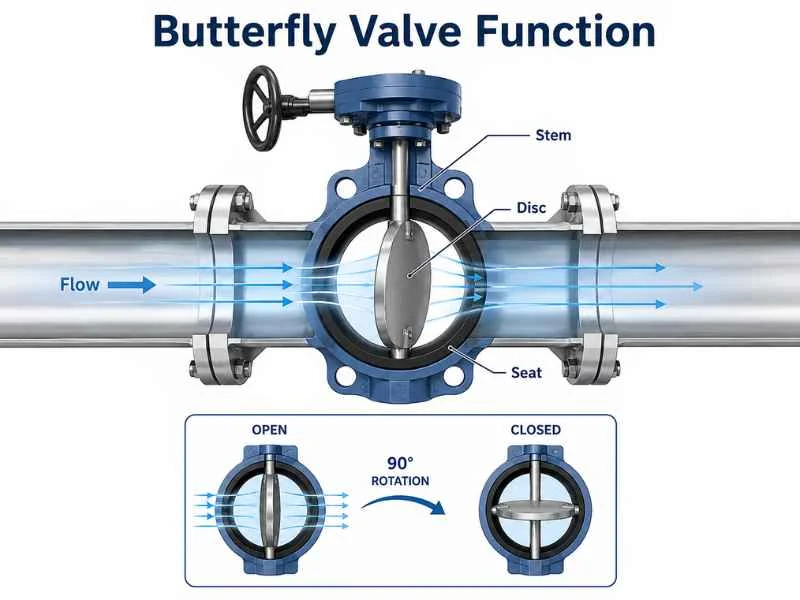
Understanding this core function is just the beginning. A valve’s specific design, materials, and actuator ultimately determine how well it performs in your application. Exploring these details will help you ensure system safety, reliability, and efficiency. This article dives into the key functional aspects of butterfly valves.
The Dual Role: On-Off Isolation and Throttling
A butterfly valve is not a one-function component. Its design allows it to perform different roles, making it a versatile and economical choice for many system designers.
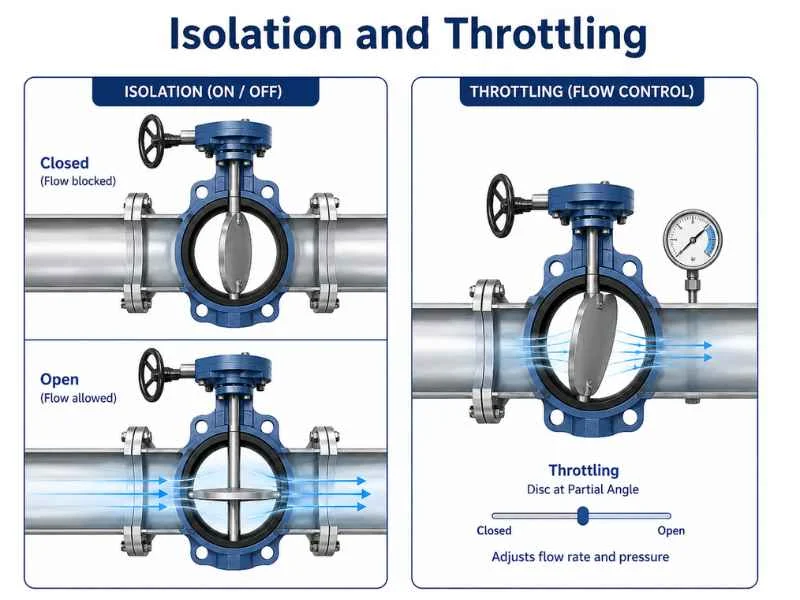
A butterfly valve functions in two main ways: as an on-off butterfly valve to completely stop flow, and as a throttling valve to regulate the flow rate. The valve’s suitability for each role depends on its design, especially the disc and seat, and your process needs.
Function as an On-Off Isolation Valve
The most common function of a butterfly valve is for isolation. In this role, the valve is either fully open to allow unrestricted flow or fully closed to stop it. The valve achieves this with a quarter-turn (90-degree) rotation of the disc. This quick action is a significant advantage in emergency shutdown (ESD) systems or where rapid operation is required. When closed, the edge of the disc presses against a flexible or metallic seat, creating a seal. API Standard 609 covers double-flanged, lug, wafer-type, and butt-welding-end butterfly valves used in industrial piping systems.
For general services like water distribution or HVAC, a resilient-seated butterfly valve provides a “bubble-tight” shutoff. The soft seat, often made of EPDM or NBR, deforms around the disc to prevent any leakage. This makes them highly effective and cost-efficient for applications where a complete seal is necessary but pressures and temperatures are moderate. The simplicity and speed of this on-off function are key reasons for the valve’s widespread use.
Function in Throttling and Flow Regulation
Butterfly valves can also function as control devices to regulate, or throttle, the flow rate. By positioning the disc at an angle between fully open (0 degrees) and fully closed (90 degrees), you can control the volume of fluid passing through the valve. This is useful for adjusting process conditions, such as maintaining a specific flow rate or pressure in a pipeline.
However, not all butterfly valves are ideal for throttling. Standard concentric butterfly valves can be used for throttling but are generally not recommended for extended periods, especially in high-pressure drop situations. The flow can create high dynamic torque on the disc, making it unstable and potentially causing wear. For more precise and stable flow control, high-performance or triple offset butterfly valves are superior. Their design is better suited to handle the forces and potential for cavitation that can occur during throttling. When throttling, the best control range is typically between 20% and 80% open.
How Design Affects Butterfly Valve Function
Not all butterfly valves perform the same functions equally well. The specific design—concentric, double offset, or triple offset—directly impacts its capabilities and suitability for your application.
A valve’s function is defined by its internal geometry. Concentric designs are best for general-purpose on/off service. In contrast, double and triple offset designs provide superior performance in high-pressure, high-temperature, and critical throttling applications, ensuring better sealing and a longer service life.
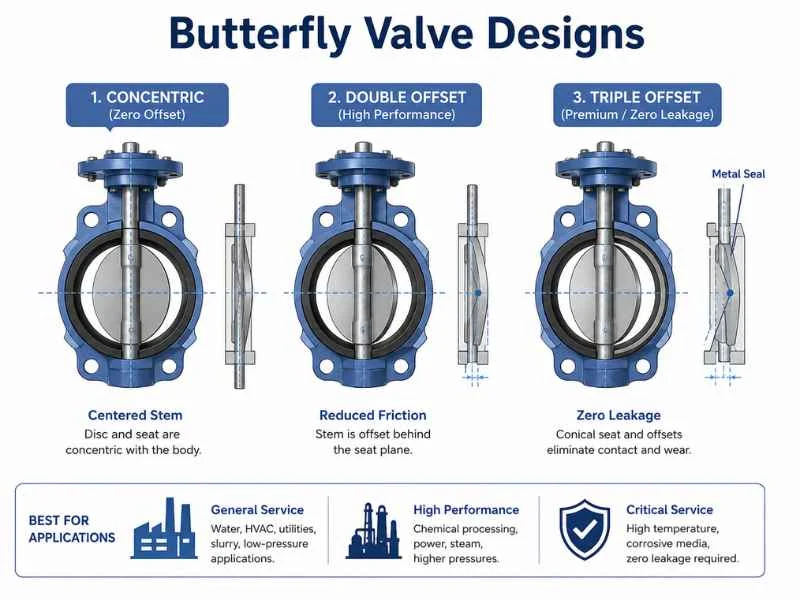
The fundamental butterfly valve working principle remains the same—a rotating disc controls flow. However, subtle changes in the disc and stem geometry dramatically alter the valve’s performance characteristics. Understanding these differences is crucial for selecting a valve that functions reliably in your specific process.
Concentric Butterfly Valves
In a concentric design, the stem is centered in the pipeline, and it also passes through the centerline of the disc. This is the simplest design. The sealing function relies entirely on the disc compressing the soft, resilient seat. This design, often found in a rubber-lined butterfly valve, is excellent for providing tight shutoff in low-pressure, low-temperature applications.
Because the disc is in constant contact with the seat during rotation, friction can cause wear over time. This makes them less suitable for frequent cycling or throttling applications where the disc is constantly moving against the seat. Their primary function is reliable, cost-effective on-off isolation in utility lines, water treatment, and food and beverage industries.
Offset Butterfly Valves (High-Performance)
Offset designs were created to improve the function and lifespan of butterfly valves in more demanding services.
- Double décalage : This design has two offsets. First, the stem is offset from the centerline of the disc. Second, the stem is offset from the centerline of the pipe. This geometry causes the disc to swing away from the seat as it opens, creating a cam-like action. This action minimizes contact between the disc and seat until the final few degrees of closing, significantly reducing friction and wear. This makes double offset valves excellent for both throttling and high-cycle on-off applications. They can handle higher pressures and temperatures than concentric designs.
- Triple décalage : The triple offset valve (TOV) adds a third offset: the seat cone axis is offset from the stem centerline. This creates a cone-in-cone seating design that completely eliminates rubbing between the disc and the metal seat during operation. The seal is created by a wedging action at the last moment of closure. This friction-free design allows for bubble-tight shutoff in critical services, including high temperatures, high pressures, and cryogenic applications. Its primary function is zero-leakage isolation in demanding environments like oil and gas, refining, and chemical processing.
| Conception des vannes | Fonction principale | Pressure/Temp Range | Mécanisme de scellement | Typical Application |
|---|---|---|---|---|
| Concentrique | On/Off Isolation | Low | Disc Compresses Soft Seat | Water, HVAC, Food & Bev |
| Double Offset | On/Off & Throttling | Medium to High | Cam-Action, Reduced Friction | Chemical, Power, Oil & Gas |
| Triple Offset | Critical On/Off Isolation | High to Very High | Fricton-Free, Cone-in-Cone | Severe Service, Cryogenics |
Factors Influencing Performance and Reliability
Specifying the correct design is only the first step. To ensure a vanne papillon functions reliably throughout its service life, you must consider several critical operating factors that directly impact performance.
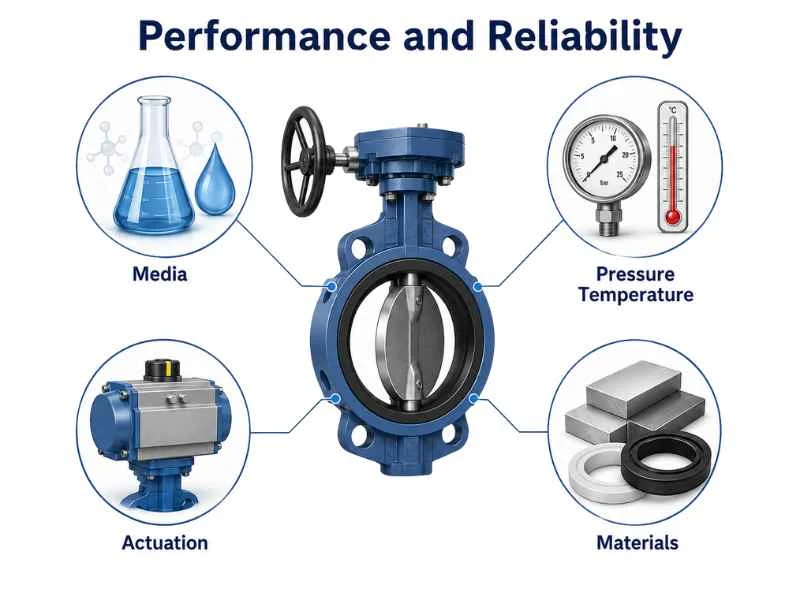
To guarantee proper butterfly valve function, you must evaluate the fluid media, pressure, and temperature. These factors dictate the selection of the correct body, disc, and seat materials, preventing premature failure and ensuring system safety.
Media Compatibility
The fluid flowing through the valve is a primary consideration. The materials of the body, disc, and especially the seat must be chemically compatible with the process media to prevent corrosion, degradation, and premature failure. For example, an EPDM seat functions perfectly in water applications but will fail quickly in hydrocarbon service, where a Buna-N (NBR) or Viton (FKM) seat would be required. For highly corrosive chemicals, a PTFE-lined or PFA-lined disc and body may be necessary. Always consult a reputable chemical compatibility chart and consider all fluid components, including trace chemicals and potential contaminants.
Pressure and Temperature Limits
Every valve has a specific pressure-temperature (P-T) rating. This rating defines the safe operating envelope for the valve. The maximum allowable working pressure decreases as the operating temperature increases. Operating a valve outside its P-T curve can lead to seat failure, stem leakage, or even catastrophic failure of the valve body. It is essential to check the manufacturer’s data sheet for the specific P-T curve of the valve you are considering. This ensures the valve will function safely and reliably under your project’s worst-case operating and design conditions.
Actuation and Control
The actuator is the engine that drives the valve’s function. Whether manual (lever or gear) or automated (vanne papillon pneumatique or electric), the actuator must be correctly sized to provide enough torque to open and close the disc against process pressures and friction. The required torque can vary significantly depending on the valve type, size, and application. For a simple on-off function, a basic actuator is sufficient. For throttling, a pneumatic actuator paired with a smart positioner is needed to precisely control the disc’s position. An undersized actuator will fail to operate the valve reliably, compromising control and safety.
FAQ
1. What Is the Main Butterfly Valve Function?
The main butterfly valve function is to start, stop, or regulate fluid flow in a pipeline. A circular disc rotates around a stem, allowing the valve to move quickly between open, partially open, and closed positions.
2. What is the use of a butterfly valve?
Dernière réflexion
The butterfly valve offers a versatile function, serving as both an isolation and a control device. However, its performance hinges on matching the design—concentric for general use, offset for demanding services—and materials to your specific process conditions. This alignment is crucial for ensuring safety, reliability, and long-term operational success.
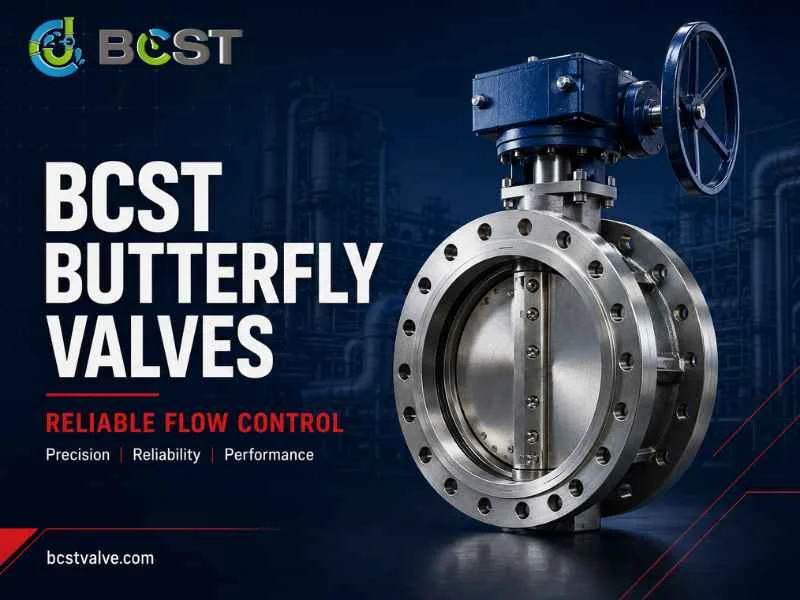
For expert support in selecting a vanne papillon that meets your project’s exact functional requirements, contact the BCST engineering team today.


 English
 Arabic
 Russian
 French
 Spanish