
Slide Gate Valve vs. Knife Gate Valve: Which One Do You Actually Need?
In industrial processes, especially those dealing with challenging media, choosing the right valve can make all the difference in efficiency, safety, and longevity. Two common valve types, the slide gate valve و صمام بوابة السكين, often cause confusion due to their similar-sounding names and sliding disc mechanisms. While both are designed for specialized flow control, they are engineered for distinctly different applications and types of media.
At BCST Valve, with decades of experience in manufacturing industrial valves, we frequently encounter projects where this distinction is critical. Incorrect selection can lead to frequent breakdowns, material leakage, and compromised operational integrity. This guide will clarify the core differences between these two workhorse valves, helping you determine which one truly meets your process requirements.
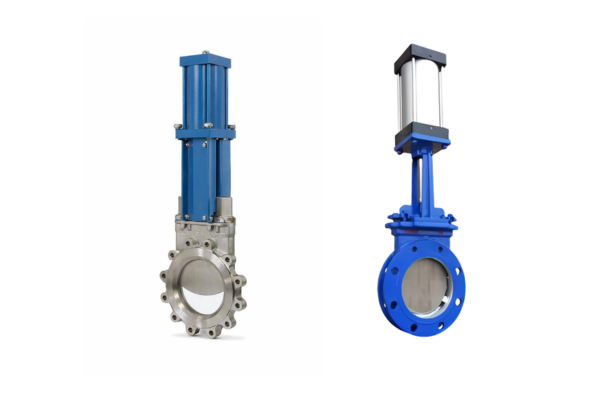
Understanding the Slide Gate Valve: Precision for Dry Bulk
ال slide gate valve is expertly designed for controlling the gravity flow of dry bulk solid materials. Think powders, pellets, granules, and other free-flowing to moderately abrasive solids. Its primary function is to provide a positive shut-off or controlled feed from silos, hoppers, and conveyors.
Key Characteristics & Design:
- Flat Gate: Features a flat, rectangular or square blade that slides into a close-fitting body. This design seals precisely against fine particles.
- Sealing System: Relies on internal seals and gaskets (often polymeric or elastomer) that compress against the gate to create a dust-tight seal. Some designs, like the parallel slide gate valve, offer enhanced sealing.
- توافق المواد: Best suited for materials that are free-flowing, non-abrasive to moderately abrasive, and do not tend to pack or stick.
- Actuation: Can be operated manually (manual slide gate valve), or automated using pneumatic (pneumatic single piston slide gate valves) or electric actuators for remote control.
For a comprehensive understanding, explore our Ultimate Guide to Slide Gate Valves for Dry Bulk Handling.
Understanding the Knife Gate Valve: Cutting Through Tough Media
In contrast, the صمام بوابة السكين is built to manage challenging slurries, viscous liquids, corrosive or abrasive fluids, and highly concentrated media containing suspended solids or fibers (like pulp and paper stock). Its design allows it to cut through and push aside stubborn materials that would jam a standard valve.
Key Characteristics & Design:
- Sharp-Edged Gate: Features a thin, tapered blade (the “knife”) with a sharpened edge. This enables the gate to cut through thick, fibrous, or granular material upon closure.
- Sealing System: Often relies on a metal-to-metal seal or an elastomer seat that the blade shears into. The sealing is generally less tight than a slide gate, with some leakage acceptable in many applications. Some designs incorporate packing glands to minimize stem leakage.
- توافق المواد: Ideal for slurries, pulp, wastewater, highly viscous fluids, and bulk solids that are abrasive, sticky, or contain large particles/fibers.
- Full Bore Design: Many knife gate valves are full bore, meaning the internal bore matches the pipe diameter, minimizing pressure drop and preventing material buildup.
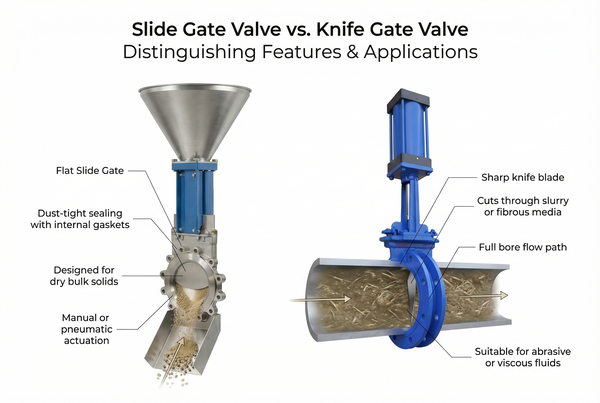
Side-by-Side Comparison: Understanding the Differences
To summarize, here’s a direct comparison illustrating the key distinctions:
| ميزة | Slide Gate Valve | صمام بوابة السكين |
|---|---|---|
| Primary Media | Dry bulk solids (powders, granules, pellets) | Slurries, viscous liquids, abrasive fluids, pulp, high-solids media |
| Gate Design | Flat, rectangular/square blade | Thin, sharp-edged blade |
| Sealing Mechanism | Perimeter seals/gaskets, compression sealing | Shearing action into seat, metal-to-metal or resilient seat |
| Shut-off Quality | Typically dust-tight, excellent for dry solids | Good for slurries, some leakage often permissible (depending on seal type) |
| Primary Action | Block/unblock gravity flow | Cut through/shear difficult media |
| Common Applications | Food & pharma, cement, plastics, mining (fine aggregates) | Pulp & paper, wastewater treatment, power generation, heavy mining |
Which One Do You Actually Need? Making the Right Choice
Selecting between a slide gate valve و صمام بوابة السكين boils down to a thorough analysis of your application:
- Choose a Slide Gate Valve if:
- Your media is dry, free-flowing, or granular (e.g., powders, pellets, grains).
- You require a dust-tight, positive shut-off to prevent leakage of fine particles.
- The material is non-abrasive to moderately abrasive.
- Applications include batching, diverting, or controlling gravity-fed materials from hoppers or silos.
- You need options like a manual slide gate valve for infrequent use or a pneumatic single piston slide gate valve for automation in dry bulk lines.
- Choose a Knife Gate Valve if:
- Your media is a slurry, highly viscous, contains high concentrations of suspended solids, or is fibrous (e.g., wastewater, pulp, coal ash, heavy mining slurries).
- You need the valve to cut through the media as it closes to prevent jamming.
- Some minor seat leakage is acceptable, as the primary goal is often to isolate flow rather than achieve a perfect seal against fine dry particles.
- The media is highly abrasive or corrosive, requiring robust metal-to-metal sealing or specialized resilient seats.
- Minimal pressure drop is critical due to the full bore design often found in these valves.
Conclusion: Precision in Valve Selection
While both the slide gate valve و صمام بوابة السكين employ a sliding mechanism, their fundamental purpose, design, and suitability for different media set them apart. The slide gate excels in managing dry bulk solids, offering precise, dust-tight control, while the knife gate is the champion of slurries and challenging, high-solids media.
Making the correct choice is paramount for operational efficiency, reducing maintenance costs, and ensuring the longevity of your system. At BCST Valve, we specialize in providing tailored valve solutions for a wide range of industrial applications. Our experts are ready to assist you in selecting the ideal valve to perfectly match your specific process needs.
Still unsure which valve is right for you?


 English
 Arabic
 Russian
 French
 Spanish