
What is Pressure Safety Valve?
In any pressurized system, overpressure is a silent and constant threat. A safety relief valve (SRV) is your primary, and often last, line of defense. Understanding its function, types, and what happens when it fails is essential for protecting your people and your plant.
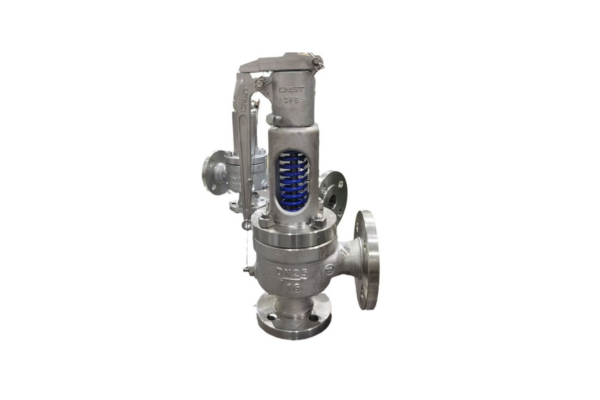
At What PSI Does a Safety Relief Valve Open?
A safety relief valve is designed to open automatically at a precise, pre-determined “set pressure.” This is the point where the system pressure overcomes the resisting force of the valve’s internal spring.
Set Pressure, Overpressure, and Blowdown
The “pop” of a safety relief valve is governed by three key terms defined by codes like ASME:
- Set Pressure: The pressure at which the valve begins to audibly “pop.” This is stamped on the valve and set at or below the vessel’s Maximum Allowable Working Pressure (MAWP).
- Overpressure: The additional pressure required for the valve to lift fully open. For gases, this is typically limited to 10% of the set pressure (e.g., a 100 PSI valve is fully open at 110 PSI).
- Blowdown: The difference between the set pressure and the lower reseating pressure. This prevents “chattering.” For a 100 PSI valve, the blowdown is typically 7%, so it would reseat at 93 PSI.
Where Is the Safety Relief Valve Usually Located?
Placing this critical device in the wrong location can render it ineffective. The SRV must always be installed on the vapor or gas space of a vessel or a high point in a piping system, as close as possible to the equipment it protects.

Prime Locations for Protection
| Location | سبب |
|---|---|
| Top of a Steam Boiler/Vessel | To directly relieve compressible vapor from the gas space. |
| Blocked Liquid Piping | To protect against immense pressure buildup from thermal expansion. |
| Positive Displacement Pump Discharge | To prevent overpressure from a blocked outlet. |
What Are the Common Safety Relief Valve Types?
The main types—conventional, balanced bellows, and pilot-operated—are chosen based on the amount of backpressure (pressure at the valve’s outlet) in the system.
Conventional vs. Balanced vs. Pilot-Operated
| نوع الصمام | How it Handles Backpressure | Best Application |
|---|---|---|
| التقليدية | Set pressure is directly affected by backpressure. | Low, constant backpressure (<10% of set psi). |
| Balanced Bellows | Set pressure is immune to backpressure. | High or variable backpressure (e.g., flare headers). |
| Pilot-Operated | System pressure holds it closed; unaffected by backpressure. | High-pressure, large-scale systems needing max capacity. |
What Happens If a Relief Valve Fails?
SRV failure typically occurs in two ways: it fails to open, allowing catastrophic pressure buildup, or it fails to reseat, causing a continuous leak.
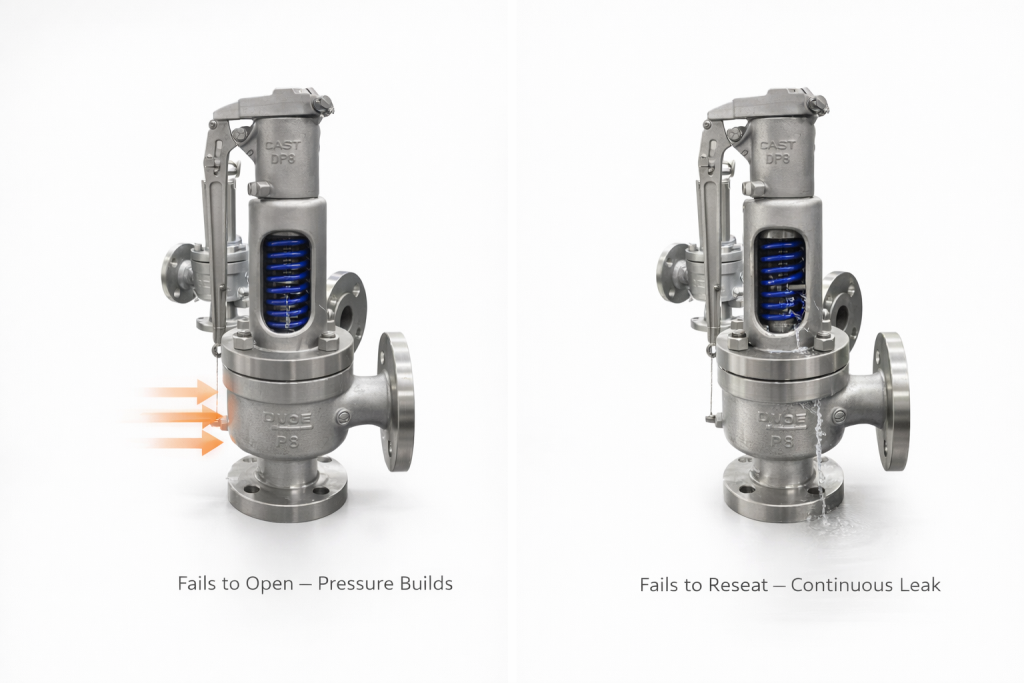
The Two Faces of Failure
- Failure to Open (Seized Shut): This is the most dangerous mode, leading to vessel rupture. It is caused by corrosion, process buildup, or improper installation.
- Failure to Reseat (Leaking): A more common failure causing product loss and environmental hazards. It is often caused by seat damage from debris, valve chatter, or improper manual testing.
خاتمة
The safety relief valve is more than just hardware; it is a critical safety system. Understanding its core functions—set pressure, location, types, and failure modes—is essential. By giving this vital device the attention it deserves through proper selection, installation, and maintenance, you ensure it will be ready to perform its life-saving function when you need it most.


 English
 Arabic
 Russian
 French
 Spanish