
What Are Tri-Clamp Ball Valves? A Guide to Aseptic Flow Control
In biopharma and food production, a single contaminated valve can cost millions. Discover how BCST’s tri-clamp ball valves eliminate contamination risks while cutting maintenance costs.
Tri-clamp ball valves provide aseptic flow control with 100% cleanable surfaces, featuring quick-clamp connections for easy dismantling. BCST’s ultra-sanitary designs exceed 3A, EHEDG, and ASME BPE standards with electropolished 10Ra finishes and zero dead-leg construction.
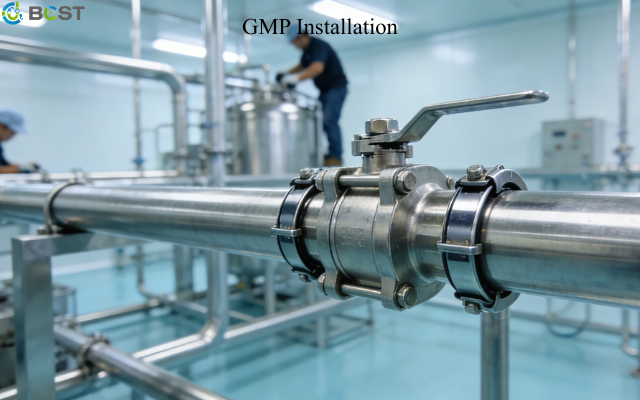
Standard sanitary valves often hide dangerous imperfections. BCST’s aerospace manufacturing background brings unprecedented quality to hygienic valves.
Why Top Biotech Firms Choose BCST Tri-Clamp Ball Valves
A recent FDA audit revealed 43% of contamination events originate from valve dead-legs. BCST solves this with revolutionary full-flow-path technology.
BCST’s Patented Features include:
- Integral diaphragm stem seal (eliminates threads)
- Single-piece body construction (no crevices)
- Laser-etched markings (no flaking)
- Mirror-finished 5-10Ra surfaces (beyond 3A standards)
- CCI/SIP validation documentation
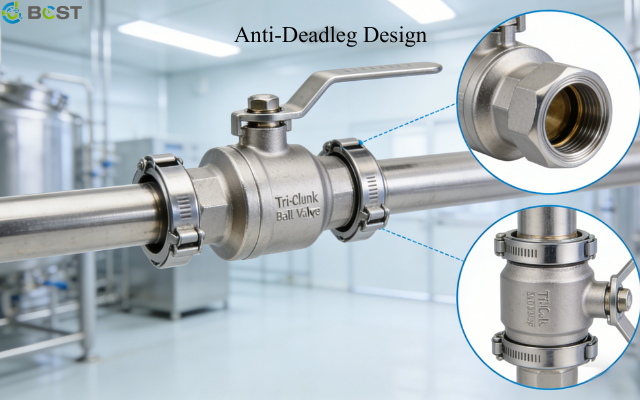
Engineering Behind the Hygiene: Materials Comparison
| المكوّن | Premium Grade (BCST) | Industrial Grade | Pharma Grade (BCST Elite) |
|---|---|---|---|
| جسم | 316L SS (ASTM A270) | 304 SS | 316L VMQ Sch40 |
| Surface | 15μin Ra electropolish | 32μin Ra | 5μin Ra EP+Passivation |
| Seals | USP Class VI PTFE | Standard PTFE | FFKM per ISO 10993 |
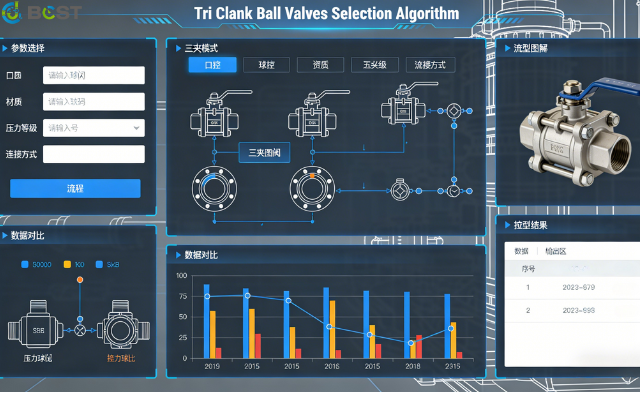
Complete Selection Guide for Hygienic Applications
Choosing the wrong valve caused a $18M product recall last year. Use this expert framework to ensure perfect selection.
Five Critical Selection Factors:
- Connection Type (Tri-Clamp 3A vs DIN vs RJT)
- Material Grade (316L / 904L / Hastelloy)
- Surface Finish (10Ra / 15Ra / 20Ra)
- Certification Package (3A / EHEDG / CE)
- Process Validation Support (CCI / SIP / DQ)
Application-Specific Solutions
- Bioprocessing: Steam-in-place capable, USP Class VI compliant, double-sealed stem.
- Dairy/Food: FDA 21 CFR compliant, self-draining orientation, 3-A Symbol Authorization.
- UltraPure Water: Electropolished to 5Ra, zero extractables, <1ppb metallic ions.
Maintenance Best Practices
| Activity | Frequency | طريقة |
|---|---|---|
| Gasket Replacement | 12 CIP cycles | 3A-compliant EPDM |
| Surface Inspection | Quarterly | Borescope |
| Full Validation | Annual | IQ/OQ/PQ |
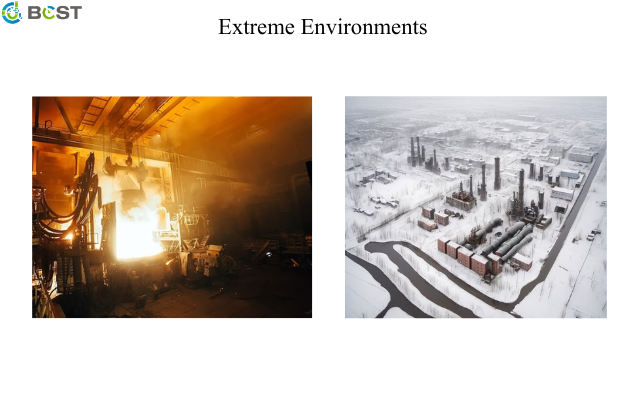
Specialized Options for Extreme Conditions
Specialized Configurations Include:
- Cryogenic (-196°C) versions with extended stems
- ATEX-approved for solvent handling
- High-purity versions with orbital welds
- Combichem-resistant linings
Cutting-Edge Enhancements
- Smart Valve Technology: Integrated sensors, RFID tracking, and predictive maintenance alerts.
- Cleanroom Integration: VHP-compatible materials and isolator-compatible actuators.
- Validation Services: Full IQ/OQ/PQ and Continued Process Verification (CPV) support.
Conclusion: Uncompromising Hygiene, Measurable ROI
BCST tri-clamp ball valves represent the convergence of aerospace precision, pharmaceutical validation, and industrial durability. They deliver uncompromising hygiene with measurable ROI through:
- Elimination of contamination risks
- Reduction in validation costs
- Extension of maintenance cycles
- Compliance with evolving global standards


 English
 Arabic
 Russian
 French
 Spanish