
How Can You Make Your Safety Valve Truly Safe?
You’re responsible for protecting a multi-million dollar facility from overpressure. It’s not just a valve; it’s the last line of defense, and getting it wrong is not an option. The safety of your entire system rests on five critical design factors: sealing performance, set pressure configuration, noise management, operational loads, and proper sizing.
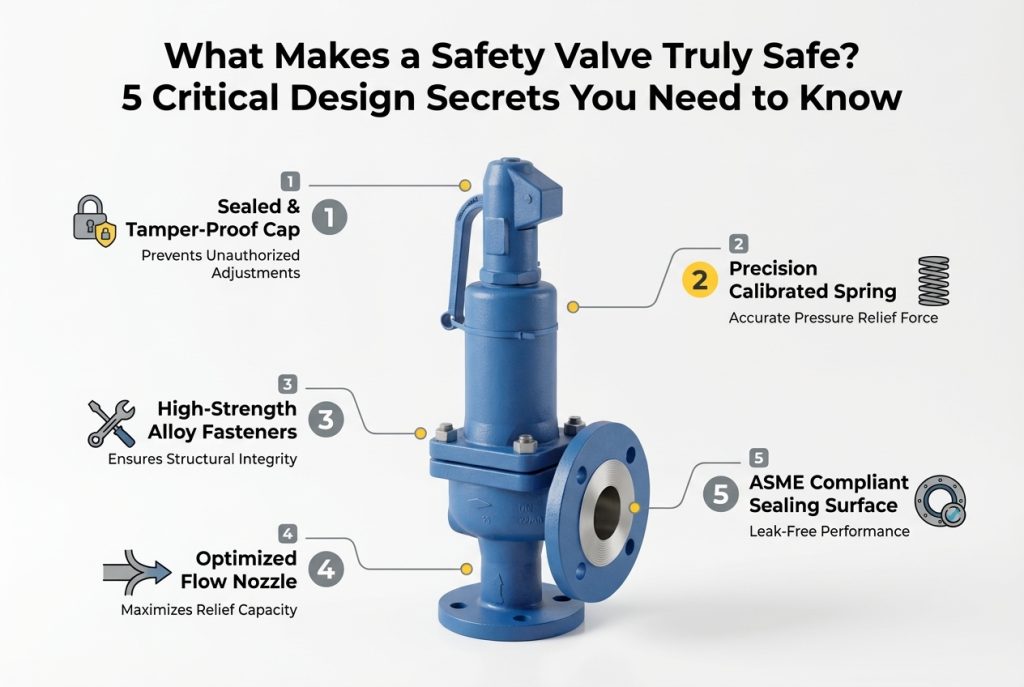
1. Why Does Even a Small Leak from a Safety Valve Matter So Much?
A leak from a safety valve means lost product, fugitive emissions, and progressive damage to the valve’s seat. The right sealing performance is the foundation of the valve’s reliability, efficiency, and long-term integrity.
Metal Seats vs. Soft Seats
| ميزة | Metal-to-Metal Seat | Soft Seat (e.g., O-Ring) |
|---|---|---|
| Sealing Tightness | Good (Meets API 527) | Excellent (Often bubble-tight) |
| نطاق درجة الحرارة | Very Wide | Limited |
| Best Application | High-pressure steam, corrosives | Clean gas, fugitive emission control |
2. Is a Valve’s Set Pressure Really What You Think It Is?
The pressure at which a safety valve opens on a test bench is the Cold Differential Test Pressure (CDTP). This must be adjusted for in-service conditions like temperature and backpressure, which can significantly alter when the valve actually opens.
From the Test Bench to the Real World
- Temperature Correction: A hot spring loses stiffness, causing the valve to open at a lower pressure. The CDTP must be set slightly *higher* to compensate for this.
- Backpressure Correction: Backpressure at the outlet of a conventional valve adds to the spring force, causing it to open at a higher pressure. A balanced bellows design is used to negate this effect.
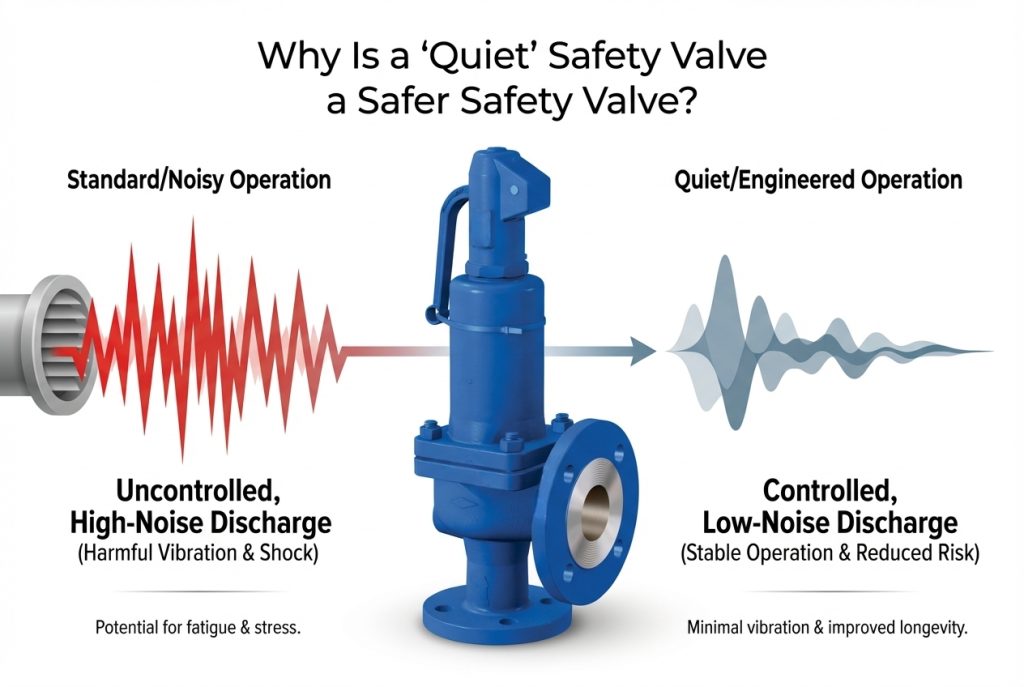
3. Why is a “Quiet” Safety Valve a Safer Safety Valve?
The roar of a discharging safety valve is a serious hazard. Engineers must predict sound levels and design mitigation like silencers to protect personnel and prevent damage from Acoustic-Induced Vibration (AIV), which can cause piping to crack from fatigue.
4. How Can a Safety Valve Break the Piping It’s Connected To?
When a safety valve discharges, it generates powerful operational loads (reaction forces). The system designer must calculate these forces and ensure the piping is strong enough and properly braced to withstand them without failing.
Bracing for Impact
Piping stress engineers use formulas from standards like API 520 to calculate these forces and design the system with thicker pipe walls or additional structural supports. Ignoring these loads can lead to cracked pipes or torn supports.
5. Is “Bigger” Always Better When Sizing a Safety Valve?
No. Oversizing a safety valve is dangerous. It can lead to “chattering”—where the valve rapidly opens and closes because it relieves pressure too quickly. This cycling can cause severe damage to the valve’s seat and disc.
The Sizing Balancing Act
Proper sizing is a precise calculation based on the worst-case scenario. It involves complex formulas considering flow rate, gas properties, pressure, temperature, and specific valve coefficients (Kd, Kb). Sizing is a balance between being safe and being stable.
Conclusion: A System of Safety
A safety valve is a sophisticated, life-saving device. By understanding these five critical factors—sealing, set pressure, noise, loads, and sizing—you can ensure your facility’s last line of defense is truly reliable, robust, and ready to perform its critical duty when it matters most.


 English
 Arabic
 Russian
 French
 Spanish