
Field Guide to Troubleshooting Zone Control Valve Failures
Zone control valves are workhorses in modern hydronic HVAC systems, enabling individualized temperature control and significant energy savings. However, like any electro-mechanical component, they can develop issues that compromise system performance and homeowner comfort. When a zone isn’t heating or cooling as expected, the zone valve is often a primary suspect. Research conducted by Control Engineering stated that troubleshooting a zone control valve, whether for HVAC, irrigation, or industrial liquid zones,reveals that these components are highly prone to specific mechanical and electrical failures. Academic and industrial engineering data indicate that over 30% of control valves in operation have performance issues that can be detected through simple diagnostic tests.
This comprehensive troubleshooting guide from BCST Valve is designed for HVAC technicians to efficiently diagnose and resolve common zone control valve failures. Building on our detailed articles like How a Zone Valve Works: Actuators, End Switches, and Schematics, we’ll walk you through systematic diagnostic steps, common failure modes, and practical solutions to get your hydronic systems back on track.

Safety First: Essential Precautions Before You Begin
Always prioritize safety when working with electrical and plumbing systems:
- Disconnect Power: Turn off power to the entire HVAC system at the main breaker or fuse panel. Use a multimeter to verify zero voltage before touching any wires.
- Hot Surfaces/Fluids: Hydronic systems can contain very hot water. Allow surfaces to cool or take appropriate precautions.
- Lockout/Tagout: For commercial or larger residential systems, follow proper lockout/tagout procedures.
- Personal Protective Equipment (PPE): Wear insulated gloves, safety glasses, and appropriate clothing.
Understanding Common Zone Valve Malfunctions
Zone valve failures typically manifest in a few key ways:
- Zone Not Heating/Cooling (Valve Not Opening): The thermostat calls for conditioning, but the zone valve remains closed, preventing fluid flow.
- Zone Always Heating/Cooling (Valve Not Closing): The thermostat is satisfied, but the zone valve is stuck open, leading to continuous, unwanted conditioning.
- Boiler/Pump Not Firing (End Switch Failure): The zone valve opens correctly, but the boiler or circulating pump doesn’t receive the signal to activate.
- Humming or Buzzing Sound: The actuator is receiving power but failing to operate the valve fully.
- Leaking Valve: Visible water drips or puddles around the valve body or stem.
Systematic Troubleshooting Steps
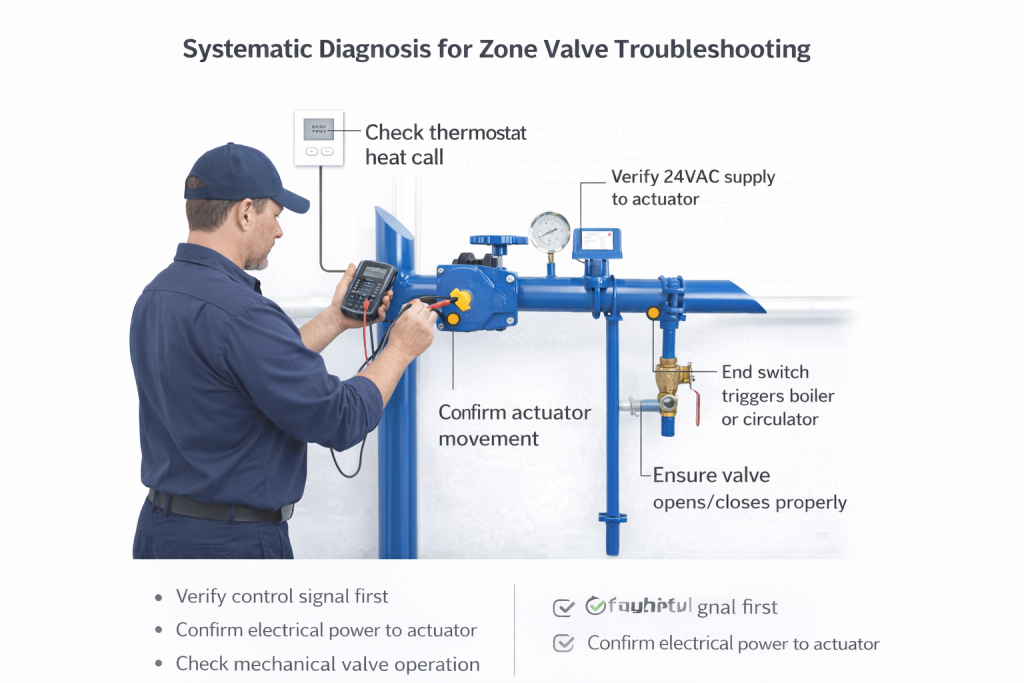
Follow these steps to systematically diagnose the problem zone control valve:
Step 1: Verify Thermostat Operation
- Set Thermostat: Ensure the thermostat for the problematic zone is set significantly above (for heating) or below (for cooling) the ambient temperature.
- Check for Call Signal: Use a multimeter to check for 24VAC across the ‘R’ and ‘W’ (or corresponding cooling terminals) on the thermostat sub-base/wiring block when calling for conditioning.
- Check for Power to Actuator: With power on, check for 24VAC at the zone valve actuator’s power terminals (consult wiring diagram for specific terminals, often Red/Yellow or ‘1’/’2′ wires). No voltage here indicates a thermostat or wiring issue, not the valve. Refer to How to Wire a Zone Control Valve: A Technician’s Guide for correct connections.
Step 2: Inspect the Zone Valve Actuator
The actuator is the brain and muscle of the valve. With 24VAC confirmed at the actuator:
- Listen and Observe: Does the actuator hum, buzz, or show any signs of movement? Thermal actuators might take 1-2 minutes to open. Motorized actuators are usually faster.
- Manual Override (if applicable): Many actuators have a manual override lever. Try moving it to see if the valve stem moves freely. If it does, the mechanical valve body might be fine, indicating a bad actuator. *Do not force a stuck valve.*
- Actuator Not Moving or Humming: Likely a failed actuator if power is present but no action.
- Humming but Not Moving: Could be a jammed gear train in a motorized actuator or a sticky valve stem.
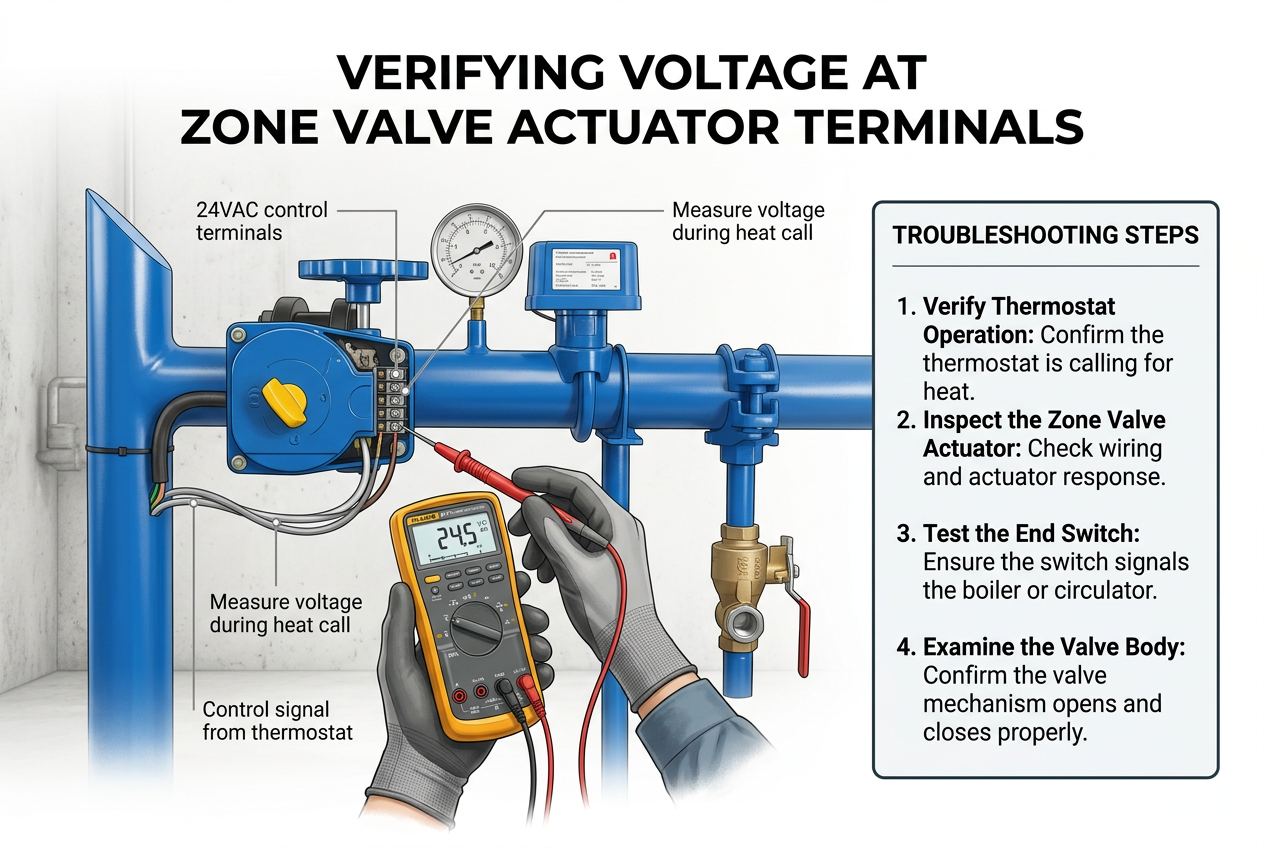
Step 3: Test the End Switch
The end switch signals the boiler/pump. This is crucial if the valve opens but the heat source doesn’t engage:
- With the Thermostat Calling: Allow the actuator to fully open the valve.
- Check End Switch Terminals: Use a multimeter to check for continuity across the end switch terminals (often two Orange wires, or ‘3’/’4′). When the valve is fully open, the end switch should close, showing continuity across these terminals.
- Check Voltage at Boiler/Pump: If the end switch shows continuity, check for 24VAC at the boiler control’s ‘T’ terminals or the circulator relay’s control terminals. No voltage there indicates a wiring break between the end switch and the boiler/pump.
- End Switch Not Closing: If the end switch doesn’t show continuity when the valve is open, the switch itself is bad, or the actuator isn’t fully stroking the valve. This usually necessitates actuator replacement.
Step 4: Examine the Valve Body
If the actuator and end switch appear to be functioning, the issue might be mechanical within the valve body itself:
- Stuck Stem/Ball: The valve stem or internal ball can get seized due to mineral deposits, corrosion, or debris. This often accompanies a humming actuator or restricted manual override.
- Valve Not Fully Closing: If a zone is always heating/cooling even when the thermostat is satisfied, the valve may not be fully seating due to debris, worn seals, or a bent stem.
- Leaking:
- Around the Stem: Often a worn O-ring or packing gland. Some older valves might allow repacking; most modern valves require replacement.
- From Body Joints: Gasket failure between parts of the valve body (less common with one-piece bodies).
- Pinholes/Cracks: Very rare, but indicates extreme corrosion or manufacturing defect, requiring full valve replacement.
Common Scenarios and Solutions
| Symptom | Likely Cause | Troubleshooting Steps / Solution |
|---|---|---|
| Zone not heating/cooling | No power to actuator, failed actuator, stuck valve body, failed end switch. | Check thermostat call, verify 24VAC to actuator. If voltage present, diagnose actuator. If actuator works, check end switch. If mechanical, replace valve body. |
| Zone always hot/cold | Stuck open valve body, failed actuator (stuck open), constant power to actuator, shorted thermostat/wiring. | Disconnect power to actuator; if valve remains open, it’s mechanically stuck. Check for constant 24VAC at actuator; if present when thermostat isn’t calling, troubleshoot wiring/thermostat. |
| Boiler/Pump not activating | Failed end switch, open circuit from end switch to boiler/pump, main boiler/pump control issue. | Confirm actuator opens valve. Test continuity of end switch when valve is open. Trace wiring from end switch to boiler/pump control. |
| Valve leaking | Worn stem seals/O-rings, cracked valve body, loose connections. | For minor stem leaks, some valves can be tightened or repacked (consult manufacturer). Often full valve replacement is required. Check piping connections. |
| Humming/Buzzing actuator | Stuck valve stem/ball, failing gears in motorized actuator, worn motor. | Attempt manual override (if possible). Cycling valve several times might dislodge minor debris. If persistent, replace actuator or entire valve. |
Prevention and Maintenance Tips
Proactive measures can significantly extend the life of zone control valves:
- System Flushing: Periodically flush hydronic systems to remove sediment and debris that can foul valve seats.
- معالجة المياه: Use appropriate water treatment chemicals to prevent corrosion and scale buildup.
- Proper Installation: Ensure valves are installed correctly, adhering to flow direction and maintaining proper piping supports to avoid strain.
- Verify Transformer Sizing: Ensure the 24VAC transformer is adequately sized for the total load of all connected zone valves and controls. An undersized transformer can lead to erratic operation and premature component failure.
Conclusion: Restoring Zone Control with Confidence
Effective troubleshooting of zone control valves is a core competency for any hydronic HVAC technician. By systematically evaluating thermostat calls, actuator functionality, end switch operation, and the mechanical integrity of the valve body, you can quickly pinpoint issues and restore essential zone control. While some issues may require replacing the entire valve, often only the actuator needs to be swapped out—a much simpler and cost-effective repair.
BCST Valve provides robust, reliable zone control valves engineered for longevity and ease of service. When diagnostics point to a component replacement, trust BCST to deliver dependable solutions that stand the test of time, helping you maintain efficient and comfortable hydronic systems for your clients.
Diagnosed a faulty valve? Find a reliable replacement!


 English
 Arabic
 Russian
 French
 Spanish