
Applications for Spring-Loaded Ball Valves
Spring-loaded ball valves are engineered for superior sealing performance and reliability, particularly in applications where standard valve designs fall short. The “spring-loaded” mechanism most often refers to the internal seats, which are energized by compression springs to maintain constant contact with the ball, ensuring a tight seal even when line pressure is insufficient. In other contexts, it can refer to external spring-return actuators that provide critical fail-safe capabilities.
If you’re looking for a deeper dive into the fundamental principles, our comprehensive guide, “How Spring-Loaded Ball Valves Work: A Complete Guide to Mechanisms & Designs,” provides a thorough explanation. Here, we’ll focus on the specific industrial applications where these advanced features deliver indispensable benefits.
From maintaining perfect seals in challenging low-pressure environments to ensuring critical isolation in pipelines, spring-loaded ball valves offer robust solutions. Let’s explore the top four scenarios where they are absolutely essential.
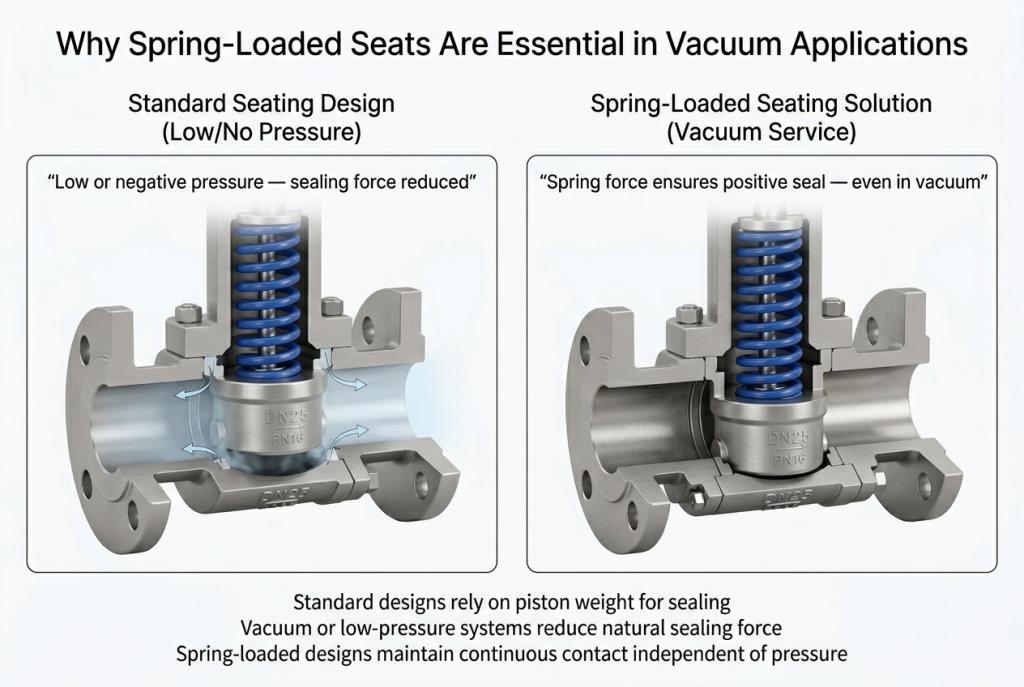
1. Low-Pressure Gas & Vacuum Service
The Challenge: In typical floating ball valves, line pressure is essential for pushing the ball into the downstream seat to create a positive seal. In low-pressure gas systems, vacuum lines, or during hydrostatic testing where differential pressure is minimal or negative, this natural sealing mechanism is compromised. This can lead to leakage, process contamination, or an inability to maintain vacuum.

The Spring-Loaded Solution:
Spring-loaded seats are explicitly designed to overcome this challenge. The compression springs continuously push the seats against the ball, providing the necessary sealing force irrespective of line pressure. This means:
- Consistent Sealing: Achieves a bubble-tight seal even at the lowest operating pressures or under full vacuum.
- Process Integrity: Prevents atmospheric air ingress into vacuum systems or unintended leakage of low-pressure gases.
- Reliable Testing: Ensures successful hydrostatic and pneumatic tests without false indications of leakage.
2. High-Temperature & Thermal Cycling Processes
The Challenge: Operations involving superheated steam, hot gasses, or processes with wide temperature swings (thermal cycling) pose significant challenges for valve seals. Standard soft seats can degrade, harden, or experience differential thermal expansion, leading to loss of contact with the ball, material degradation, and ultimately, leakage.
The Spring-Loaded Solution:
Spring-loaded seats effectively counteract these thermal effects. When combined with appropriate seat materials (like PEEK, metal seats with hard coatings), the springs continuously self-adjust to maintain a tight seal:
- Compensation for Thermal Expansion/Contraction: The springs absorb slight movements caused by differential thermal expansion between the ball and seats, ensuring constant contact and preventing leakage.
- Extended Seal Life: By constantly exerting force, the springs help the seats conform to the ball, even as materials may slightly deform or wear due to high temperatures, thereby extending the service life of the seal.
- Reduced Fugitive Emissions: A consistent seal minimizes leakage pathways, crucial for environmental compliance and safety in high-temperature hazardous fluid services.
3. Abrasive/Erosive Slurries & Dirty Gas (with Metal Seats)
The Challenge: Process media containing suspended solids, catalysts, or other abrasive particles—common in mining, power generation (ash slurry), and chemical processing—can rapidly erode soft seats, valve balls, and even hardened metal surfaces. This leads to premature seat wear, loss of shut-off capability, and frequent valve replacement. Dirty gas applications can also cause similar particulate wear.
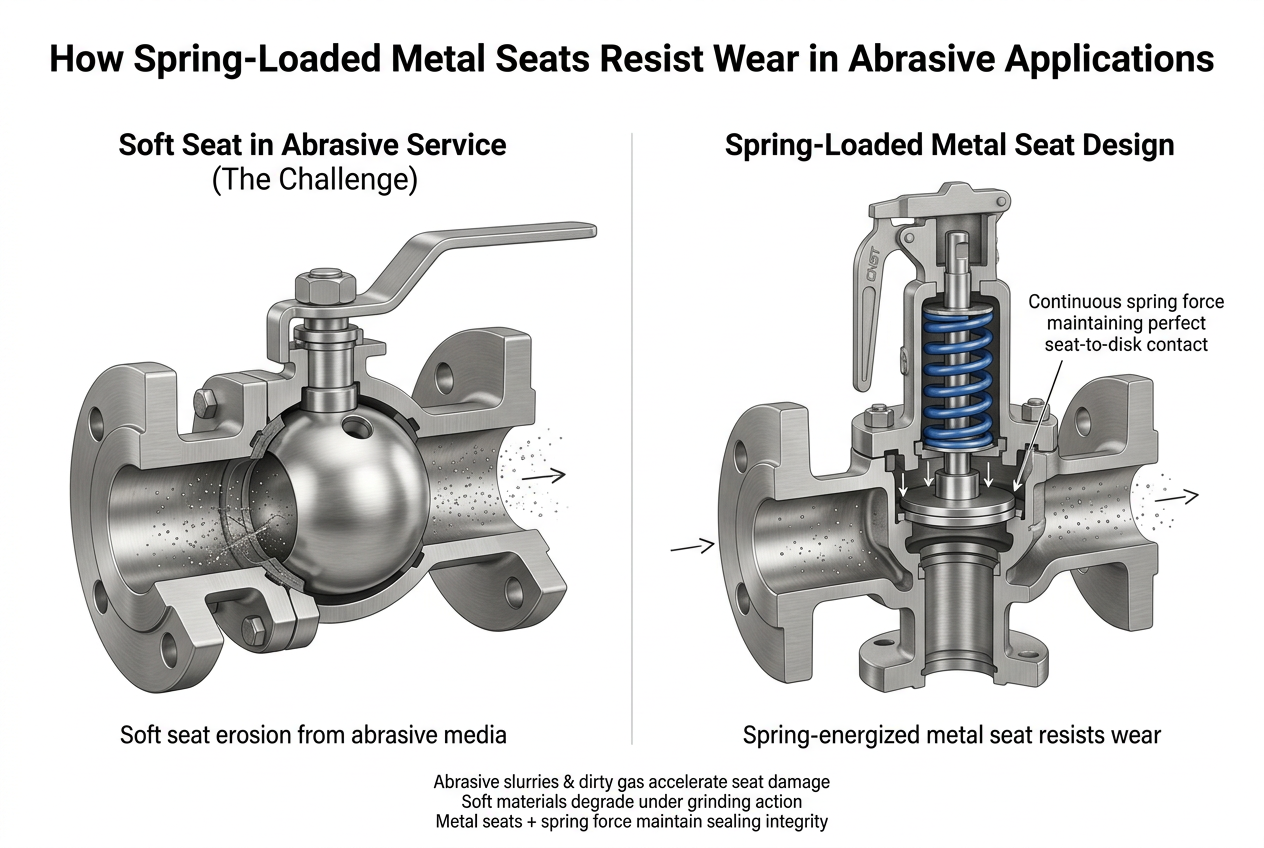
The Spring-Loaded Metal Seat Solution:
When combined with robust metal seats (often hard-coated with Tungsten Carbide, Chrome Carbide, or ceramics), spring-loading provides an outstanding solution for abrasive services:
- Enhanced Wear Resistance: The hard-faced metal seats themselves are designed to resist erosion and abrasion. The spring force helps maintain a tight, consistent contact, which is critical in preventing localized erosion that can start from minute gaps.
- Self-Cleaning Action: The continuous spring pressure aids in pushing away minor particulate build-up from the sealing surfaces as the valve operates, minimizing the risk of grinding and damage.
- Longer Service Life: This combination significantly extends the operational lifespan of the valve in the most punishing applications, dramatically reducing maintenance frequency and costs. If your existing valves show signs of rapid wear, refer to our article on 5 Critical Signs You Need to Upgrade to a PBV Severe Service Valve.
4. Critical Pipeline Isolation & Metering Skids (Trunnion-Mounted, DBB)
The Challenge: In large diameter pipelines, natural gas transmission, and metering skids, the need for positive, verifiable isolation is paramount for safety and measurement accuracy. Standard valves may not provide the redundancy required, and achieving true “zero leakage” can be difficult, especially without line pressure assisting the seal.
The Spring-Loaded Trunnion & DBB Solution:
Spring-loaded seats are a foundational feature of trunnion-mounted ball valves and are essential for achieving Double Block and Bleed (DBB) capabilities, which are often mandated by standards like API 6D.
- Positive Isolation (DBB): Both upstream and downstream seats are individually energized by springs (and/or line pressure) against the fixed ball, creating two independent seals. The cavity between them can then be bled, providing verifiable zero leakage for maintenance or safety protocols.
- Lower Operating Torque: Since the springs push the seats towards the fixed ball (rather than the ball floating into the seat as the primary seal), the operating torque is significantly reduced, allowing for easier manual operation or smaller, more efficient actuators.
- API 6D Compliance: Spring-loaded seats are crucial for trunnion designs to meet demanding pipeline standards for sealing integrity and DBB functionality.
- Fail-Safe Automation (with Actuators): When paired with spring-return actuators, these valves provide an additional layer of safety, automatically moving to a safe open or closed position upon power or signal failure, vital for emergency shutdown systems in pipelines.
خاتمة
Spring-loaded ball valves, primarily those incorporating spring-energized seats, are far more than just “standard” valves. They represent a significant advancement in fluid control technology, offering enhanced sealing, reliability, and safety in challenging industrial environments.
Whether you’re dealing with sensitive low-pressure gases, highly corrosive media, extreme temperatures, or critical pipeline isolation, recognizing these key applications will guide you towards selecting the optimal valve for long-term performance and reduced operational costs.
Ready to deploy the trusted performance of spring-loaded ball valves in your application?


 English
 Arabic
 Russian
 French
 Spanish