
Spring-Return Actuator or Spring-Loaded Valve: What’s the Difference?
In the world of industrial valves, precision in terminology is crucial. The phrase “spring-loaded” often causes confusion because it can refer to two entirely different features of a valve system: either the internal seating mechanism of the valve itself or the external automation device mounted on top of it. Both involve springs, but their functions, locations, and impacts on valve performance and safety are distinct.
This guide systematically breaks down the differences between an internal spring-loaded valve (referring to its seats) and a valve equipped with an external spring-return actuator. Understanding this distinction is fundamental for proper valve specification, operation, and maintenance. For a more comprehensive overview of both concepts, refer to our pillar article: “How Spring-Loaded Ball Valves Work: A Complete Guide to Mechanisms & Designs.”
Let’s clarify these two critical concepts to ensure you’re speaking the right language and making the right choices for your applications.
What is a “Spring-Loaded Valve” (referring to Internal Seats)?
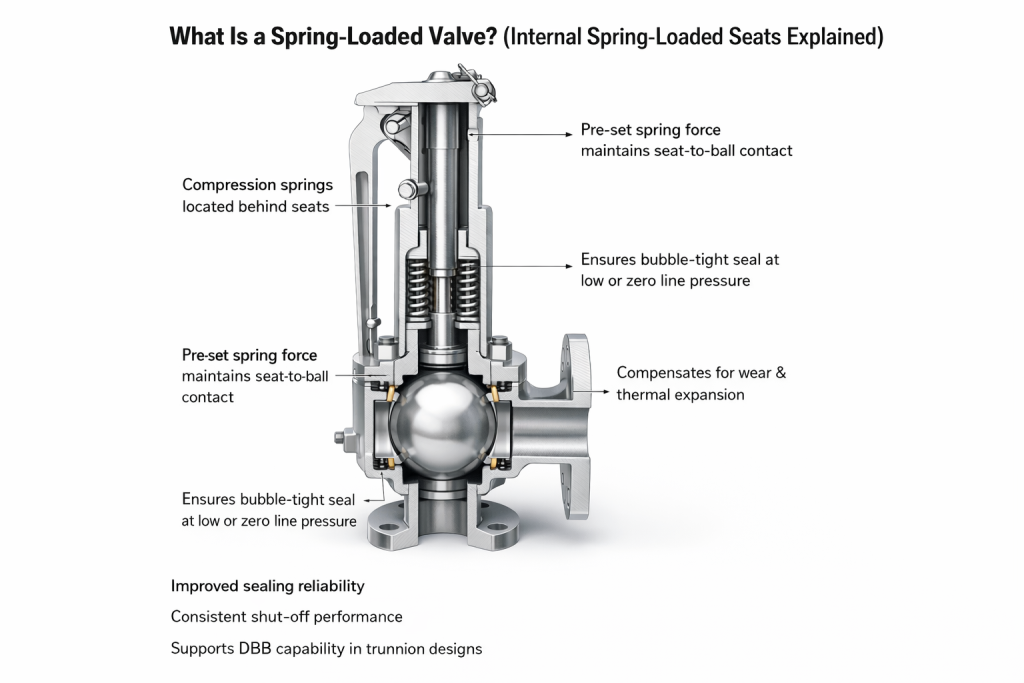
When engineers refer to a “spring-loaded valve” in terms of its internal design, they are almost always talking about spring-loaded seats. This is a design feature within the valve body itself, directly impacting its ability to seal against flow.
Mechanism & Purpose:
- Location: Springs are located directly behind the valve seats, inside the valve body.
- الوظيفة: These compression springs exert a constant, pre-set force that pushes the seats against the ball, regardless of line pressure.
- Primary Purpose: To ensure a positive, bubble-tight seal at low line pressures, in vacuum service, or during start-up conditions where process pressure alone is insufficient to energize the seal. They also compensate for seat wear and thermal expansion/contraction, extending the valve’s reliable sealing life.
- Impact on Valve Operation: Improves sealing reliability and consistency, especially crucial for trunnion-mounted ball valves needing Double Block and Bleed (DBB) capability.

This internal mechanism directly contributes to the valve’s sealing class and is a fundamental design choice for specific applications, such as those discussed in “The Top 4 Applications for Spring-Loaded Ball Valves.”
What is a “Spring-Return Actuator”?
In contrast, a “spring-return actuator” is an external device mounted on top of the valve, responsible for automating its operation. The spring in this context is for fail-safe functionality, not directly for the fluid seal across the ball.
Mechanism & Purpose:
- Location: External to the valve body, mounted on the valve stem or bonnet.
- الوظيفة: Uses an external power source (e.g., compressed air for pneumatic, electrical for electric) to move the valve in one direction, while a powerful internal spring provides the force for the return stroke.
- Primary Purpose: To provide fail-safe operation. In the event of a power or signal failure (e.g., loss of compressed air or electricity), the stored energy in the spring automatically drives the valve to a predetermined safe position (either fully open or fully closed).
- Impact on Valve Operation: Crucial for emergency shutdown systems (ESD), safety instrumented systems (SIS), and any application where the valve’s position must be guaranteed in case of system failure.

This is a safety and automation feature, entirely separate from the valve’s inherent sealing capabilities, though often chosen in tandem with high-performance valve bodies.
Key Differences at a Glance
To summarize, here’s a direct comparison of the fundamental characteristics of spring-loaded seats versus spring-return actuators:
| ميزة | Spring-Loaded Seats (Internal Valve Design) | Spring-Return Actuator (External Mount) |
|---|---|---|
| Location | Inside the valve body, behind the seats. | External to the valve, mounted on the stem connection. |
| الوظيفة الأساسية | Enhances the valve’s sealing capability. | Automates valve movement for fail-safe scenarios. |
| Purpose of Spring | Applies continuous force to seats for tight shut-off. | Returns valve to a safe position upon power/signal loss. |
| Impact on Valve | Directly affects leak integrity, performance at low pressure/vacuum. | Dictates automated valve behavior during system failure. |
| Typically Found In | High-performance ball valves, trunnion ball valves. | Automated valve systems requiring specified fail-action. |
Why This Distinction Matters
Mistaking one “spring-loaded” concept for the other can lead to serious consequences:
- Safety Hazards: Specifying a valve without a spring-return actuator (when one is needed) could lead to an uncontrolled process in an emergency.
- Performance Issues: Choosing a valve without spring-loaded seats for low-pressure or vacuum service could result in chronic leakage.
- Costly Errors: Incorrect specifications can lead to expensive repairs, replacements, or system downtime.
- الامتثال التنظيمي: Many industry standards and safety regulations explicitly require fail-safe (spring-return) actuation for critical services.
خاتمة
While both “spring-loaded seats” and “spring-return actuators” are vital components in modern valve technology, they serve fundamentally different purposes. The former enhances the inherent sealing capability of the valve, ensuring robust shut-off regardless of pressure conditions. The latter provides a critical safety mechanism, automating the valve’s position in the event of system failure.
Knowing this distinction empowers you to make informed decisions, ensuring the safety, reliability, and efficiency of your fluid control systems. At BCST Valve, we are committed to providing the right solutions and the expertise to guide your choices.
Confidently specify your next valve with expert guidance.


 English
 Arabic
 Russian
 French
 Spanish