
Seacock vs. Ball Valve: Which Is Right for Your Thru-Hull? A Critical Safety Guide
For boat owners and marine professionals, the choice of valve for through-hull fittings—especially those below the waterline—is not merely a design preference; it’s a critical safety decision. The terms “marine ball valve” and “seacock” are often used interchangeably, leading to dangerous misconceptions that can ultimately jeopardize a vessel’s integrity and safety. While both components control fluid flow, their construction, intended application, and ability to withstand the harsh marine environment differ profoundly. According to a study, for a thru‑hull below the waterline, a true marine seacock that is purpose‑designed, robustly mounted, and serviceable is usually the safer and standards‑compliant choice, while a standalone ball valve on a thru‑hull is only acceptable if it is specifically designed and installed as an integrated seacock assembly.
At BCST Valve, we believe that informed choices are safe choices. This guide will clarify the vital distinctions between marine ball valves and true seacocks, explain why one is unequivocally mandated for below-waterline thru-hulls, and help you select the appropriate component to protect your vessel against potential flooding. For a broader understanding of all marine valves, consult our foundational resource: The Complete Guide to Marine Ball Valves & Seacocks.
Understanding the Marine Ball Valve (Standard Type)
A standard marine ball valve operates on the same quarter-turn principle as industrial ball valves, using a rotating ball with a bore to open or close the flow path. The “marine grade” designation typically indicates that its materials (e.g., specific bronzes, 316 stainless steel, or certain polymers) are chosen for corrosion resistance in saltwater environments.
- Purpose: To stop or start fluid flow.
- التصميم: Inline, relatively compact, with female NPT (National Pipe Thread) ends for threading into pipe systems.
- Appropriate Use: Excellent for isolating components in a system *above* the waterline, such as engine room manifold shutoffs, washdown pumps, or tank vents, where structural support is provided by the surrounding piping system.
- Key Limitation: A standard threaded ball valve is generally *not* designed to withstand significant side loads or impact stresses at its connection point without independent structural support.
The True Seacock: Engineered for Through-Hull Integrity
أ seacock is a robust, purpose-built fitting specifically designed for ultimate integrity at a hull penetration. It’s more than just a valve; it’s an integrated system engineered to prevent catastrophic failure in the event of external forces. While many modern seacocks utilize a ball valve mechanism internally, their external design and mounting are fundamentally different and critically stronger.
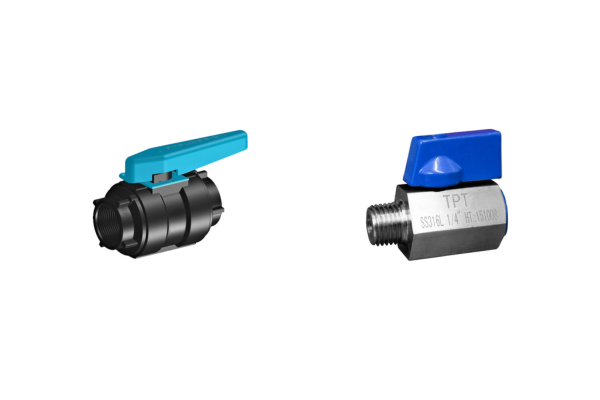
Defining Characteristics of a Seacock:
- Integrated Design: A true seacock is designed to mount securely to the hull. This can be a flanged base with multiple bolts passing through the hull (or a robust backing block), or a heavy-duty housing that encapsulates a strong threaded through-hull fitting with backing nut.
- Structural Strength: It’s engineered to absorb and distribute loads from attached hoses, impacts, or vibration without compromising the hull penetration.
- ABYC/UL Compliance: Seacocks designed for below-waterline use must meet stringent standards like ABYC H-27 and UL 1121, which specify minimum strength and secure mounting requirements. This differs significantly from general “marine grade” ball valve specifications.
The Critical Safety Distinction: The Leverage Effect
The primary reason a standard threaded ball valve is unsuitable for below-waterline through-hulls without additional support is the “leverage effect.”
- Weak Point: When a simple ball valve is threaded directly onto a through-hull fitting, the threaded connection between the valve and the through-hull becomes a critical weak point.
- Lever Arm: The weight and movement of an attached hose, or an impact from inside or outside the hull, can create a significant lever arm. This leverage concentrates stress on the threads or the valve body itself.
- Catastrophic Failure: Under sufficient load, the threads can strip, the valve body can crack, or the internal stem can shear off, leading to an immediate, uncontrolled ingress of seawater. This is a common and extremely dangerous failure mode.
When to Choose Which for Your Vessel
Choose a Seacock When:
- Any Below-Waterline Through-Hull: This is non-negotiable for critical safety. This includes engine raw water intakes, head intakes/discharges, washdown intakes, bilge pump discharges, and transducer fittings.
- Required by Standards: If your vessel is subject to ABYC, ISO, or other national marine safety standards, seacocks are mandatory for hull penetrations.
- Peace of Mind: Even if unsure, opting for a properly installed seacock offers the highest level of security against hull breach.
Choose a Marine Ball Valve When:
- Above-Waterline Applications: For domestic fresh water systems, fuel tank vents (often above waterline), cockpit drains, or other discharge lines that are always above the waterline.
- Within an Internally Supported System: When the valve is part of an engine’s internal plumbing, a fuel system on deck, or any piping network where the valve itself isn’t the primary structural support at a hull penetration.
- Cost and Space: For less critical applications, a well-chosen marine ball valve can be more cost-effective and compact.
Installation Considerations: Ensuring Proper Support
Proper installation is as crucial as selecting the right valve. For any thru-hull fitting below the waterline, whether with a flanged seacock or a heavy-duty threaded type, always use a robust backing plate.
- Thru-Hull Fitting: Should be adequately sized and made of appropriate marine-grade material (e.g., bronze for fiberglass hulls).
- Backing Block: A substantial block of marine plywood (epoxied and sealed) or high-density plastic (e.g., Starboard) helps distribute loads and provides a rigid surface for bolting the seacock.
- Sealant: Marine-grade sealant (e.g., 3M 4200 or 5200) should be used liberally between the thru-hull flange, hull, backing block, and seacock base to ensure watertight integrity.
- Hose Clamps: Always double-clamp hoses on barb fittings with marine-grade stainless steel clamps.
Conclusion: Prioritizing Safety Below the Waterline
The distinction between a marine ball valve and a seacock is not academic; it’s fundamental to boat safety. For any thru-hull penetration below the waterline, the only correct choice is a properly installed seacock that meets ABYC and UL standards. A standard marine ball valve, while suitable for many applications above the waterline, simply does not offer the structural integrity required to prevent catastrophic failure at the hull.
By making the correct choice, you are investing in the safety of your vessel and everyone onboard. BCST Valve is a trusted provider of high-quality marine ball valves and ABYC-compliant seacocks, engineered to deliver unparalleled reliability and peace of mind on the water.
Ensure your boat’s safety with the right thru-hull components.


 English
 Arabic
 Russian
 French
 Spanish