
What Defines a Safety Valve?
أ صمام الأمان is a pressure relief device designed to protect vessels and systems containing compressible fluids—primarily gases and vapors. Its defining characteristic is a rapid, full-opening “pop action.”

When system pressure reaches the set point, a safety valve snaps fully open almost instantaneously, discharging maximum flow immediately. This is achieved through a unique disk-and-seat design that uses a “huddling chamber” to amplify the opening force.
The Mechanics of Pop Action
- Initial Lift: The disk lifts slightly as pressure nears the set point.
- Huddling Chamber Effect: Media enters a chamber under the disk, creating a much larger surface area for pressure to act upon.
- Rapid Full Opening: This amplified force causes the valve to snap to its full open position in milliseconds.
- Blowdown: The valve stays fully open until pressure drops significantly below the set point (the blowdown value), at which point it closes sharply.
What Defines a Relief Valve?
A relief valve is designed for incompressible fluids—liquids like water or oil. The key distinction is that relief valves open proportionally to overpressure. As pressure rises, the valve opens gradually wider, creating a modulating effect.

Proportional Opening Characteristics
- Gradual opening starting at the set pressure.
- Discharge capacity increases as overpressure increases.
- Smooth modulation for stable pressure control.
- Reseats as soon as pressure falls below the set point.
Functional Differences: Safety Valve vs. Relief Valve
The choice between a safety valve and a relief valve is dictated by the service media and mandated by codes like the ASME Boiler and Pressure Vessel Code (BPVC).

| ميزة | صمام الأمان | Relief Valve |
|---|---|---|
| Primary Media | Compressible (Gas, Vapor, Steam) | Incompressible (Liquids) |
| Opening Action | Rapid “Pop Action” (Full Open) | Proportional / Modulating |
| ASME Code | Section I (Boilers), Section VIII | Section VIII |
| Typical Application | Steam Boilers, Air Receivers | Hydraulic Systems, Pump Protection |
Selecting the Right Device: A Decision Framework
Follow this framework to ensure you select the correct pressure protection device for your application:
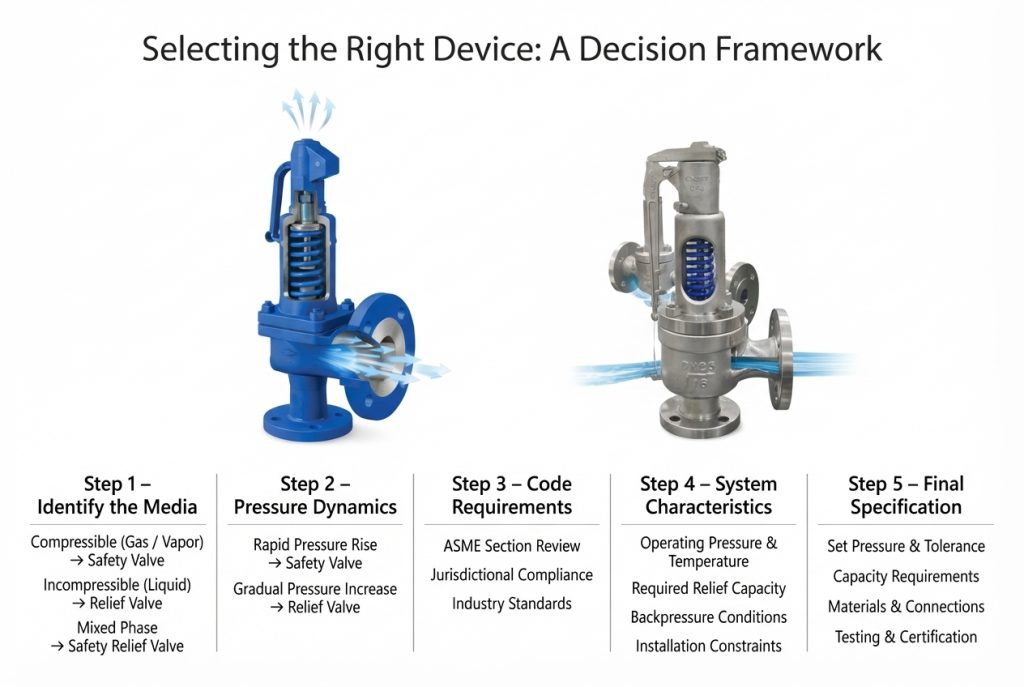
- Step 1: Identify the Media. Is it compressible (gas, steam) or incompressible (liquid)?
- Step 2: Analyze Pressure Dynamics. Is the potential for pressure rise rapid or gradual?
- Step 3: Review Code Requirements. Check applicable ASME, API, and local jurisdictional codes.
- Step 4: Evaluate System Characteristics. Consider operating pressure, temperature, required capacity, and backpressure.
- Step 5: Specify All Requirements. Define set pressure, tolerance, blowdown (for safety valves), materials, and certifications.
Conclusion: Precision Matters for Safety
The difference between a safety valve and a relief valve is not semantic; it’s a critical distinction in engineering design and system safety. A safety valve offers rapid, full-capacity relief for gases, while a relief valve provides stable, modulating control for liquids.
Understanding these differences is essential for proper device selection, regulatory compliance, and most importantly, the protection of personnel and equipment. The valve you choose is the last line of defense protecting your facility.


 English
 Arabic
 Russian
 French
 Spanish