
A Practical Engineer’s Guide to Butterfly Valve Components
Specifying the wrong valve components can lead to system failures. Understanding each part ensures your صمامات الفراشة operate safely and reliably, preventing costly downtime.
The primary butterfly valve components are the body, disc, stem, and seat. These parts work together inside the valve to control fluid flow, with the actuator providing the force for operation. Each part plays a critical role in performance.
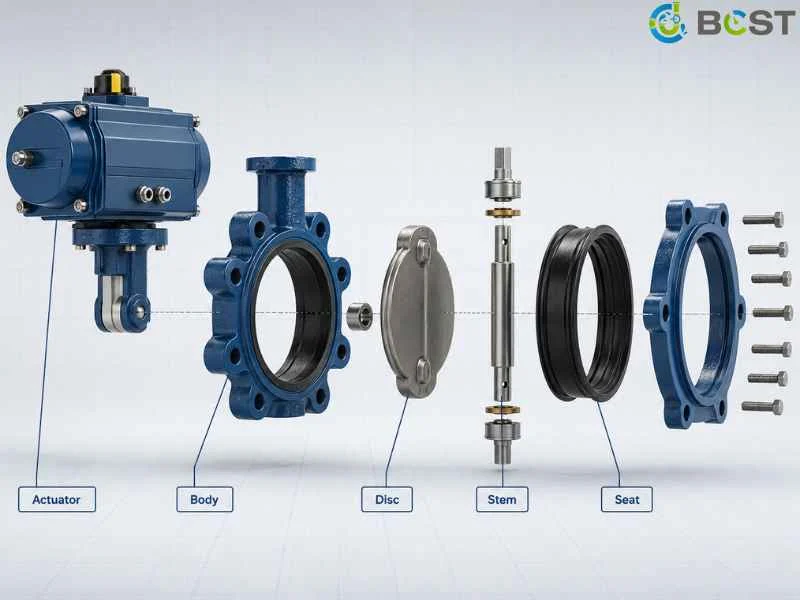
A detailed look at each component is essential for any project engineer. This knowledge helps you move beyond a basic spec sheet and choose a valve that offers long-term reliability and safety for your specific application. This guide breaks down what you need to know.
Understanding the Core Butterfly Valve Components
The four main parts must work in harmony to control your process. A weakness or failure in just one part can compromise the entire valve’s function and your plant’s safety.
A complete butterfly valve component assembly consists of the body, disc, stem, and seat. The body is the main pressure-containing structure, the disc rotates to control flow, the stem connects the disc to the actuator, and the seat provides the seal.
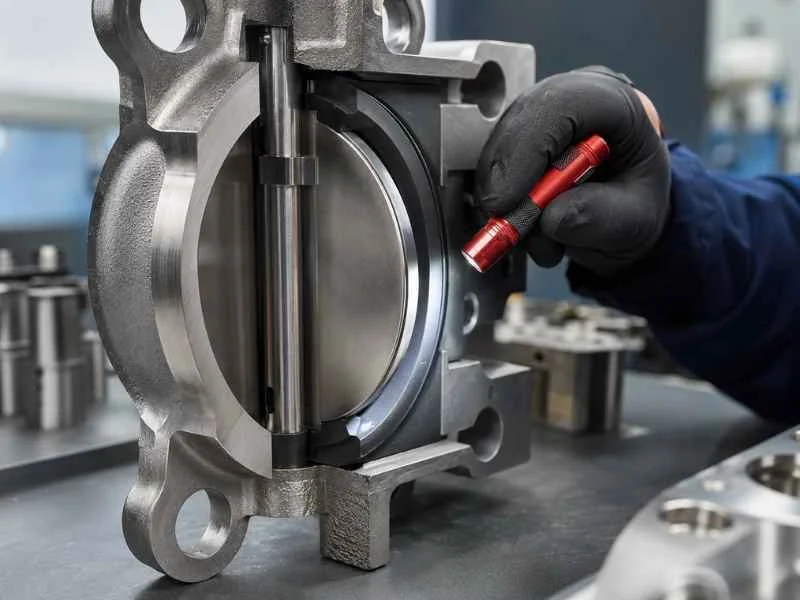
Body, Disc, Stem, and Seat Explained
Each core component has a specific function and design considerations that impact the valve’s overall performance.
- جسم الصمام: The body is the valve’s framework. It houses all internal parts and connects to the pipeline. Its main job is to withstand the line pressure and external stresses. Body designs vary to suit different installation needs. Wafer-style bodies are thin and fit between two pipe flanges, held by long bolts. Lug-style bodies have threaded “lugs” that allow the valve to be bolted directly to each pipe flange, which is useful for dead-end service. Double-flanged bodies have their own flanges and are bolted independently to each pipe flange, common in larger sizes.
- قرص الصمام: The disc is the part that opens and closes the flow path. It rotates 90 degrees inside the valve body. In the closed position, the disc edge presses against the seat to stop the flow. In the open position, it is parallel to the flow, creating minimal obstruction. Disc design greatly affects performance. A standard concentric disc is centered in the valve bore. High-performance butterfly valves use double or triple offset designs, where the disc and stem are moved off-center. This reduces seat wear and operating torque, extending the valve’s life, especially in demanding applications.
- Valve Stem: The stem is the shaft that connects the disc to the actuator or handle. It transfers the rotational force to open or close the valve. Stems can be a single piece running through the disc or a two-piece design where two separate stubs connect to the disc. A two-piece stem can increase the flow capacity (Cv) because its reduced profile creates less obstruction. The connection between the stem and disc is critical for reliability; common designs include square drives or pins.
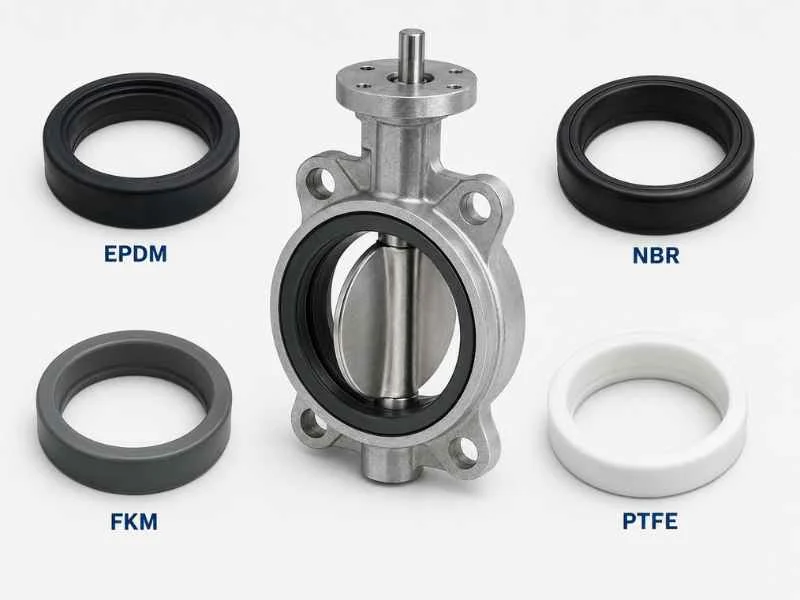
- Valve Seat: The seat is arguably the most critical component for shutoff performance. It is a ring of material, either soft (like rubber or PTFE) or metal, that lines the inside of the valve body. When the valve closes, the disc edge seals against the seat to prevent leakage. The seat material must be compatible with the process fluid and temperature. The design also matters; seats can be bonded to the body or be replaceable, which affects maintenance procedures and costs.
Selecting the Right Materials for Key Components
Choosing incorrect materials is a common and costly mistake. It can lead to rapid corrosion, chemical attack, premature failure, and significant safety risks within your facility.
Material selection for butterfly valve components is driven by the process fluid, its concentration, temperature, and pressure. While bodies are often cast iron or steel, the disc and seat materials require careful consideration for chemical compatibility and service life.
I recall a project with a chemical processing client where an EPDM seat was specified for a line carrying a fluid with trace amounts of hydrocarbons. Within a month, the EPDM seat swelled and failed, causing a leak and an unplanned shutdown. We helped them replace it with a Viton (FKM) seat, which has excellent resistance to hydrocarbons. This small detail in material selection made a huge difference in reliability and prevented future downtime. This experience taught me that a deep understanding of process conditions is non-negotiable.
Matching Materials to Service Conditions
The right material for one part may not be right for another. Here is a breakdown for each key component:
- Body Materials: For general water or air service, Ductile Iron is a cost-effective choice. For higher pressures and temperatures, or in hydrocarbon service, Carbon Steel (like WCB) is standard. For corrosive media, Stainless Steel (CF8/304, CF8M/316) is necessary. In highly corrosive environments like seawater or harsh chemical processing, special alloys like Duplex, Super Duplex, or Monel are required.
- Disc Materials: The disc is in constant contact with the fluid, so its material is critical. Often, the disc material is an upgrade from the body material. For example, a ductile iron body might be fitted with a stainless steel disc for better corrosion resistance. For abrasive services, a hardened material or a specially coated disc (e.g., Nylon 11 or HALAR) can protect against wear.
- Seat Materials: This choice has the biggest impact on valve performance and limitations. A soft seat provides a bubble-tight seal but has temperature and chemical limits. A metal seat can handle very high temperatures and abrasive media but may have a higher allowable leakage rate.
The table below gives a general overview of common soft seat materials. Always consult a detailed chemical compatibility chart for your specific fluid, concentration, and temperature.
| مادة المقعد | Common Abbreviation | Temperature Range (°C) | General Application Guide |
|---|---|---|---|
| EPDM | EPDM | -40 to 120 | Water, Glycols, Steam (low pressure), Alcohols |
| Buna-N | إن بي آر | -18 to 100 | Oils, Solvents, Gasoline, Propane, Water |
| Viton® (FKM) | FKM | -20 to 200 | Hydrocarbons, Mineral Acids, Oils, Fuels |
| Teflon® (PTFE) | مادة البولي تترافلوروإيثيلين | -50 to 200 | Strong Chemicals, Corrosive Media, Food Grade |
The Role of the Actuator and Top Flange
The valve body and its internals manage the fluid, but the top works—the actuator and its mounting interface—determine how the valve is controlled and automated.
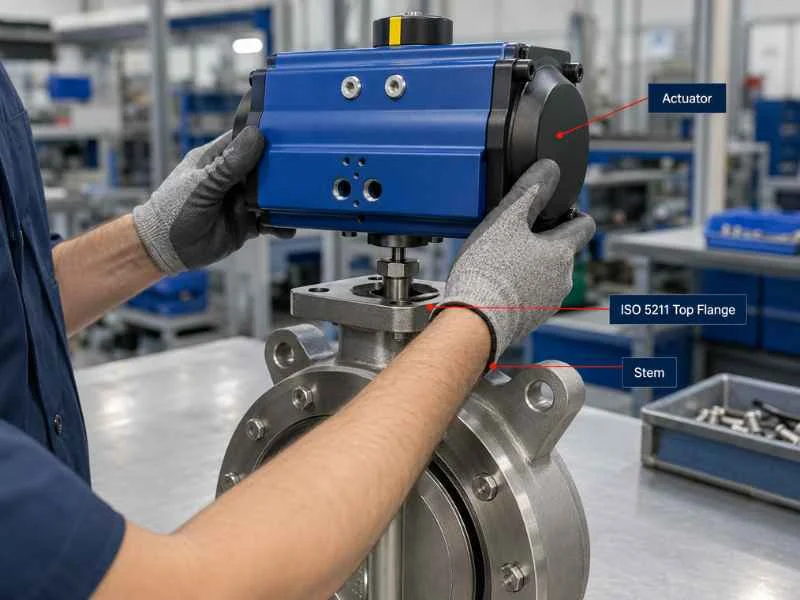
The actuator is the device that provides the force to rotate the stem, while the top flange provides a standardized mounting point. This interface is typically governed by the ISO 5211 standard, ensuring actuator interchangeability.
Automation and Control Interface
The top flange and actuator are essential for integrating the valve into a control system. Understanding them is key for both manual and automated operations.
- Actuators: These devices translate an external power source into the torque needed to turn the valve stem. Manual actuators are simple levers (for small valves) or handwheel-operated gearboxes (for larger valves). Gearboxes reduce the physical effort needed to operate the valve against high pressure. Automated actuators are more common in modern plants. المحركات الهوائية use compressed air and are known for their reliability and fast cycle times. Electric actuators use a motor and provide precise positioning, making them ideal for modulating service. Hydraulic actuators use fluid pressure to generate very high torque for the largest valves.
- ISO 5211 Top Flange: This international standard is crucial for practical engineering. It defines the dimensions of the mounting flange on top of the valve, including the bolt circle diameter and the stem drive details. Because of ISO 5211, you can purchase a valve from one manufacturer and an actuator from another, confident they will fit together. This simplifies sourcing, maintenance, and future upgrades, giving you flexibility in your procurement strategy.
- Actuator Sizing: Sizing the actuator correctly is critical for reliable operation. The required torque depends on several factors: the valve size, the differential pressure across the disc, and the friction from the seat material. An undersized actuator may fail to close the valve completely against line pressure, leading to dangerous leaks. Always use the valve manufacturer’s torque data and apply appropriate safety factors when selecting an actuator.
Q&A: Key Questions on Butterfly Valve Components
What is the most critical butterfly valve component for sealing?
The seat is the most critical butterfly valve component for achieving a tight seal. It is the flexible or metal ring that the disc presses against when closed. The seat’s material and condition directly determine the valve’s ability to prevent leaks, making its selection vital for both safety and process efficiency.
How does the material of a butterfly valve component affect its use?
The material of each butterfly valve component dictates its resistance to temperature, pressure, and chemical corrosion. For example, a stainless steel body and disc are suitable for corrosive media, while a Buna-N (NBR) seat is excellent for oil service but not for steam. Choosing the correct material is essential for valve longevity and plant safety.
Can I replace a single butterfly valve component?
It depends on the valve design and the specific part. On many valves, components like the seat and disc are replaceable, which allows for maintenance and extends the valve’s life. However, parts like a bonded seat or the valve body itself are not typically field-replaceable. Always check the manufacturer’s manual for repair procedures.
What is the function of the stem as a butterfly valve component?
The stem is the shaft that connects the external actuator (like a handle or motor) to the internal disc. Its function is to transfer the rotational force from the actuator to the disc, causing the valve to open or close. The stem’s strength and its connection to the disc are critical for reliable operation.
How does the disc design, as a butterfly valve component, influence flow?
The disc’s design directly impacts flow characteristics. A standard concentric disc offers good general-purpose control. High-performance offset discs (double or triple offset) create a more streamlined flow path when open, reducing pressure drop. The disc’s shape and thickness affect the valve’s flow coefficient (Cv), which defines its maximum flow capacity.
Why is the body an important butterfly valve component?
The body is the primary pressure-containing structure of the valve. It houses all other components and connects the valve to the pipeline. Its material must be strong enough to withstand the maximum system pressure and temperature, and its design (wafer, lug, or flanged) determines how it is installed and maintained.
Final Thought
A thorough understanding of each butterfly valve component empowers you to specify a valve that is not just functional, but also safe, reliable, and cost-effective over its entire service life. Pay close attention to material selection for the disc and seat.
For expert support in selecting the right butterfly valves with the correct components for your project, contact our team at اختبار BCST. We are here to ensure your success.


 English
 Arabic
 Russian
 French
 Spanish