The Ultimate Guide to Sight Flow Indicators: Types, Selection, and Applications
In any complex fluid system—be it in a chemical plant, a pharmaceutical lab, or a food processing facility—uncertainty is the enemy. Is the pump working? Is the line blocked? Is the fluid contaminated? Answering these questions quickly and accurately can be the difference between a smooth operation and costly downtime.
This is where the Sight Flow Indicator comes in. It is a simple, robust, and indispensable device that provides a real-time window into your pipeline, offering immediate visual confirmation of fluid flow, color, and condition.
This comprehensive guide will walk you through everything you need to know about sight flow indicators, from their core functions to the specific types available, helping you choose the perfect model for your application.
What is a Sight Flow Indicator?
A sight flow indicator is an in-line device with one or more viewing windows that is installed directly into a process pipeline. Its fundamental purpose is to allow operators, engineers, and maintenance staff to observe the fluid inside the pipe without interrupting the process. This immediate visual data is critical for monitoring, troubleshooting, and ensuring system integrity.

The Core Benefits of Using a Sight Flow Indicator
- Prevent Costly Damage: Instantly detect blockages, no-flow situations, or reverse flow that could damage pumps, turbines, and other sensitive equipment.
- Guarantee Product Integrity: Visually monitor the color and clarity of your product to spot contamination, aeration, or improper mixing at a glance.
- Simplify Troubleshooting: Quickly determine if a problem is upstream or downstream by confirming flow at critical points in the system.
- Verify Process Automation: Confirm that automated valves, pumps, and cleaning cycles (CIP) are functioning as intended.
Types of Sight Flow Indicators: A Detailed Breakdown
Sight flow indicators can be categorized by their indication method, body style, connection type, or specialized design. Here’s a look at the most common types and their ideal uses.
Indicator Styles: How Flow is Visualized
1. Paddle Wheel Sight Flow Indicator
A paddle wheel indicator features a rotor with visible paddles that spins in proportion to the flow rate. It is one of the most effective designs for providing clear, unambiguous confirmation of flow, especially from a distance.
- مبدأ العمل: Fluid pushes against the paddles, causing the wheel to rotate. The speed of rotation gives a rough estimate of the flow velocity.
- Best For: Opaque or dark liquids where a simple change in clarity is not visible; applications where operators need to see flow status from several feet away.
- Considerations: Not suitable for fluids with high solids content that could jam the rotor.
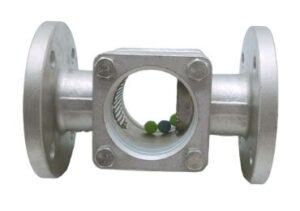
2. Float (Ball) Sight Flow Indicator
This type contains a visible ball (often made of PTFE or another buoyant material) that is pushed up a tube by the force of the flow.
- مبدأ العمل: In a no-flow state, the ball rests at the bottom. As flow begins and increases, the ball rises higher in the viewing tube.
- Best For: Vertical pipelines with upward flow. It’s a simple way to confirm that flow is moving in the correct direction.
- Considerations: Strictly for vertical, upward flow installations.
Body Styles: How the Unit is Constructed
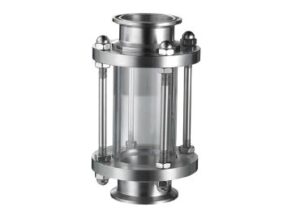
3. Full View / Tubular Sight Flow Indicator
A full view or tubular indicator is constructed from a cylinder of glass (typically borosilicate) held between two flanged end caps. This design offers a complete, 360-degree view of the process fluid.
- مبدأ العمل: Provides an unobstructed window into the pipeline, allowing observation of color, clarity, bubbles, and contaminants from any angle.
- Best For: Applications where maximum visibility is paramount, such as monitoring reactions, crystallization, or inspecting for subtle changes in the fluid.
- Considerations: Generally used in lower-pressure applications compared to armored metal-body indicators.
4. Double Glass Sight Indicator
This is a critical safety design, not just a viewing style. It features a dual-window construction. If the primary inner glass fails due to chemical attack or thermal shock, the secondary outer glass contains the process fluid, preventing a hazardous leak and giving operators time to safely shut down the line.
- مبدأ العمل: Functions as a standard sight glass but with a built-in safety backup.
- Best For: Highly corrosive, toxic, or high-temperature fluids where a breach would be catastrophic. A must-have for personnel safety in critical processes.
- Considerations: The investment is higher, but the safety payoff is invaluable in hazardous service.
Connection & Specialized Types
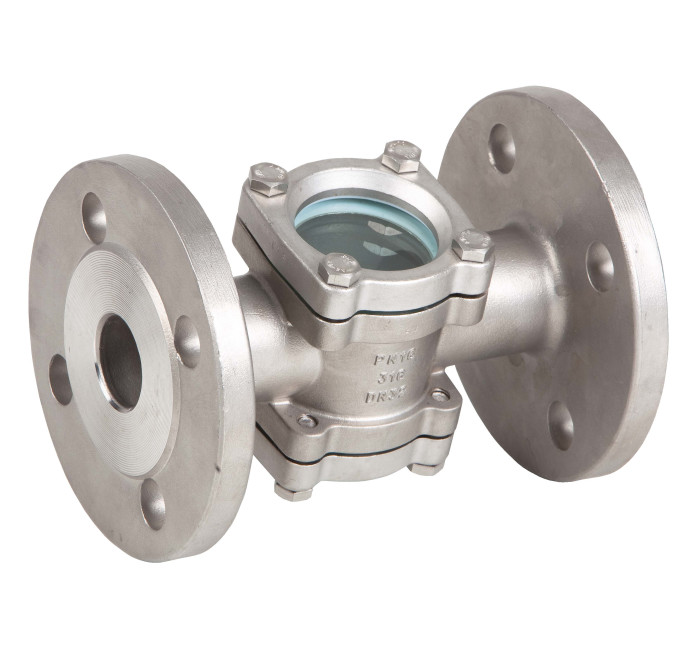
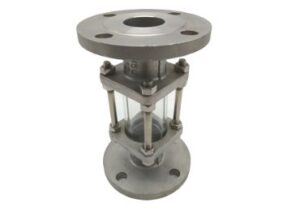
5. Flange Sight Flow Indicator
This refers to any sight flow indicator equipped with flanges for connection. The flanges are bolted to corresponding flanges on the pipeline, creating a secure, leak-proof seal.
- Best For: Most industrial applications, especially in pipes 2″ and larger. Flanged connections are robust and standard across industries like oil & gas, chemical, and water treatment.
6. Thread Sight Flow Indicator
This type uses threaded (typically NPT – National Pipe Taper) connections to screw directly into the pipeline.
- Best For: Smaller-diameter pipelines (typically under 2″), auxiliary lines, and OEM equipment where compact size and ease of installation are important.
7. Sanitary Sight Flow Indicator
Designed specifically for the food, beverage, dairy, and pharmaceutical industries, these indicators feature a crevice-free, polished internal surface to prevent bacterial growth.
- Best For: Any hygienic process. They use sanitary clamp (Tri-Clamp) connections for quick disassembly and cleaning, and are often 3-A certified or FDA-compliant.
8. High Pressure Sight Flow Indicator
These units are engineered for extreme operating conditions. They feature heavy-duty carbon steel or stainless steel bodies, robust retainers, and extra-thick tempered glass fused to a metal ring to withstand immense pressures.
- Best For: Upstream oil and gas, hydraulic systems, and chemical injection skids where pressures can exceed thousands of PSI.
How to Choose the Right Sight Flow Indicator: A Step-by-Step Selection Guide
Selecting the correct model is crucial for safety, reliability, and performance. Follow this step-by-step guide to determine the best sight flow indicator for your needs.
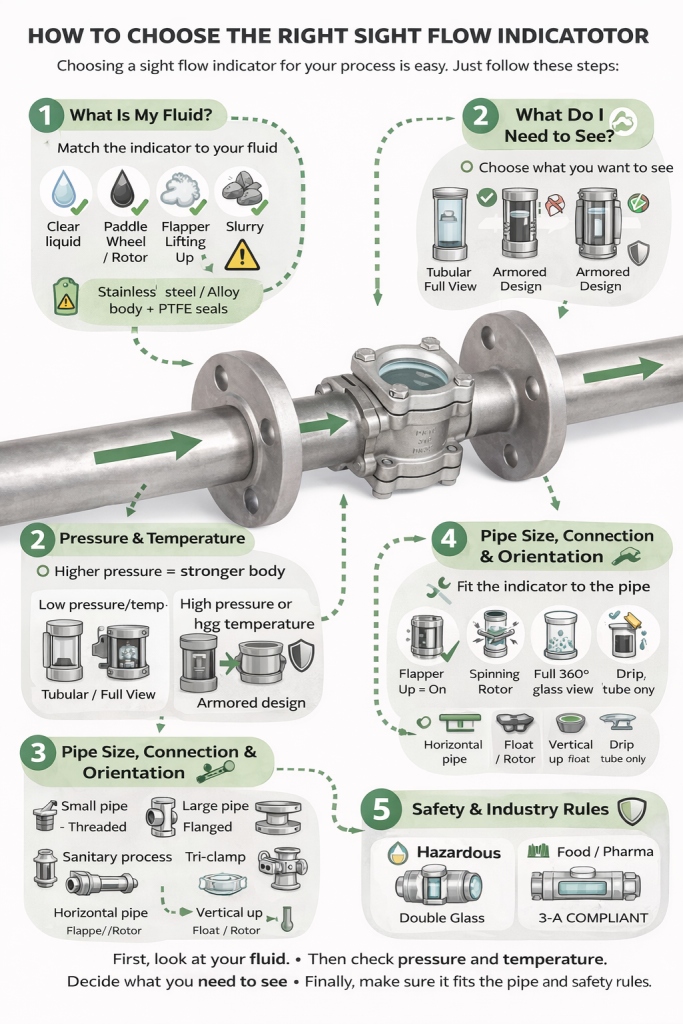
Step 1: What is my fluid?
The nature of your process fluid is the most important factor, influencing both the indicator type and material selection.
- If you have a clear, transparent liquid: A Plain , Flapper , or Paddle Wheel indicator will work well.
- If you have a dark or opaque liquid: A Paddle Wheel / Rotor indicator is the best choice. Its spinning motion is highly visible even when the fluid itself is not, providing unambiguous confirmation of flow.
- If you have a gas: A Flapper indicator is highly effective, as even a small amount of flow will lift the flapper, making it easy to see.
- If you have a slurry or liquid with high solids content: A Plain / Full View indicator is the safest option. It has no moving parts that can become clogged or jammed by solids. Avoid rotor or paddle wheel types.
- If you have a highly corrosive fluid: This dictates material choice. You will likely need a Stainless Steel , Hastelloy , or other alloy body, combined with corrosion-resistant seals like PTFE (Teflon™) .
Step 2: What are my process conditions (Pressure & Temperature)?
These conditions determine the required structural integrity of the sight flow indicator. Always check the manufacturer’s nameplate for its pressure/temperature rating.
- If you have low pressure and temperature: A Tubular / Full View indicator may be a suitable and cost-effective option.
- If you have high pressure (>150 PSI) or high temperature (>400°F / 200°C): You must select an armored High Pressure Sight Flow Indicator . These feature robust metal bodies (Carbon or Stainless Steel) and flanged connections designed to handle stress. For extreme conditions, look for models with glass fused directly to a metal ring.
Step 3: What do I need to see?
Your monitoring goal will determine the ideal indicator style.
- For simple “on/off” flow confirmation: A Flapper indicator is perfect. If the flapper is up, there is flow; if it’s down, there is no flow.
- To see flow status from a distance: A Paddle Wheel / Rotor is superior. The spinning motion catches the eye from across a room.
- To monitor fluid color, clarity, bubbles, or contamination: A Full View / Tubular indicator is the only choice, providing a complete 360° window into the process.
- To observe extremely low or intermittent vertical flow: A Drip Tube indicator is specifically designed for this purpose, allowing you to see drips form and fall.
Step 4: What is my pipe size, connection, and orientation?
The physical installation details will narrow down your selection.
- Connection Type: For pipes under 2 inches, a Thread Sight Flow Indicator is common. For lines 2 inches and larger in industrial settings, a Flange Sight Flow Indicator is the standard for its robustness. For hygienic applications, a Sanitary Sight Flow Indicator with Tri-Clamp connections is mandatory.
- Orientation: Horizontal: Flapper, Rotor, and Plain styles work well. Vertical (upward flow): Rotor, Flapper, and especially Float (Ball) indicators are effective. Vertical (downward flow): A Drip Tube style is typically required. Standard flappers may not function correctly. Always check the manufacturer’s specifications for orientation.
- Horizontal: Flapper, Rotor, and Plain styles work well.
- Vertical (upward flow): Rotor, Flapper, and especially Float (Ball) indicators are effective.
- Vertical (downward flow): A Drip Tube style is typically required. Standard flappers may not function correctly. Always check the manufacturer’s specifications for orientation.
Step 5: Are there critical safety or industry requirements?
Compliance and safety are non-negotiable.
- If the fluid is hazardous, toxic, or lethal: You should specify a Double Glass Sight Indicator . The secondary window provides critical containment and safety if the primary glass fails.
- If the application is in the food, beverage, or pharmaceutical industry: You must use a Sanitary Sight Flow Indicator that is 3-A certified or otherwise compliant with hygienic standards.
How to Install and Maintain Your Sight Flow Indicator
Proper installation and routine maintenance are essential for the long-term safety and reliability of your sight flow indicator. Always consult the manufacturer’s specific manual, but these general best practices apply to most models.
Installation Best Practices
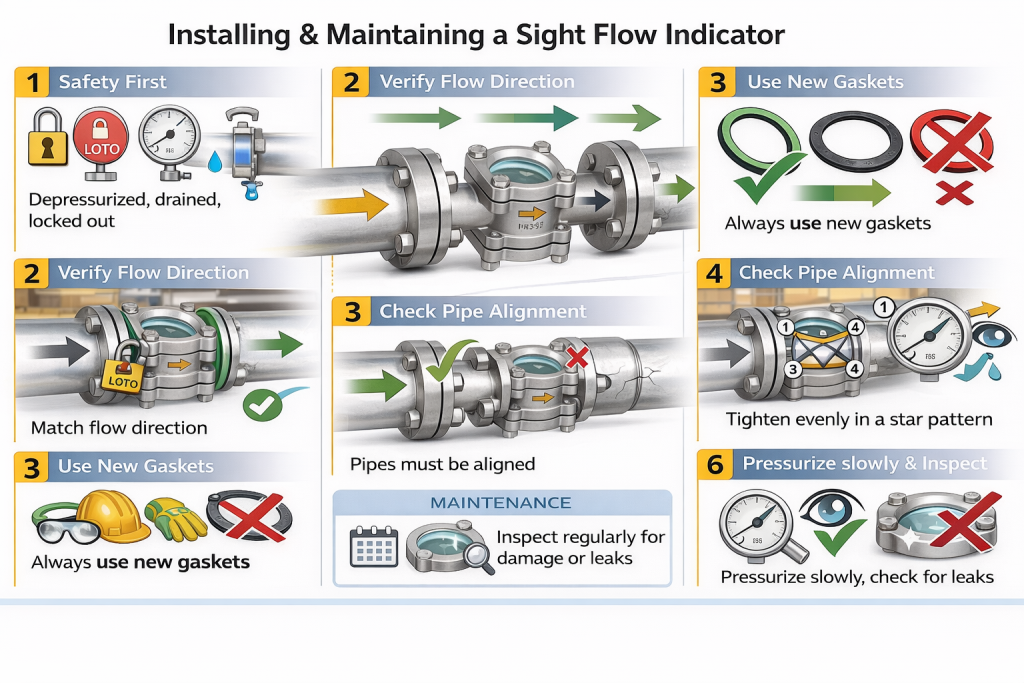
- Safety First: Before beginning, ensure the pipeline is fully depressurized, drained, isolated, and locked out/tagged out (LOTO). Always wear appropriate Personal Protective Equipment (PPE), including safety glasses.
- Verify Flow Direction: Most indicators (especially flapper and rotor types) have a flow direction arrow cast or stamped onto the body. Ensure the unit is installed in the correct orientation.
- Use New Gaskets: Never reuse old gaskets. Use new gaskets that are correctly sized and made from a material compatible with your process fluid and temperature.
- Check Pipe Alignment: The pipe flanges must be parallel. Never use the sight flow indicator to pull misaligned pipes together. This creates dangerous stress on the housing and glass, which can lead to premature failure.
- Follow Proper Bolting Procedure: When tightening bolts on a flanged unit, use a star or criss-cross pattern to apply pressure evenly. Use a torque wrench and tighten to the manufacturer’s recommended torque specifications. Over-tightening can crack the glass, while under-tightening will cause leaks.
- Pressurize Slowly: After installation, re-pressurize the system slowly while carefully inspecting the sight flow indicator’s seals for any signs of leakage.
Maintenance and Proactive Inspection
A sight flow indicator is a pressure-containing component and should be part of your regular maintenance and inspection schedule.
- Daily Visual Checks: During operator rounds, visually inspect the unit for: Leaks: Any sign of weeping from the gaskets or seals. Cracks: Look for any fractures or chips in the glass. Cloudiness or “Etching”: This can indicate a chemical attack on the glass surface, weakening its integrity. Internal Buildup: Note any scaling or deposits that obscure visibility.
- Leaks: Any sign of weeping from the gaskets or seals.
- Cracks: Look for any fractures or chips in the glass.
- Cloudiness or “Etching”: This can indicate a chemical attack on the glass surface, weakening its integrity.
- Internal Buildup: Note any scaling or deposits that obscure visibility.
- Regular Cleaning: To ensure clear visibility, clean the external glass surfaces regularly. If internal surfaces become coated, schedule a shutdown to remove the unit for safe and thorough cleaning according to manufacturer guidelines.
- Scheduled Component Replacement: Gaskets and seals are wear items and have a finite life. Follow a preventive maintenance schedule to replace them before they fail, especially in critical or high-temperature service. If the glass shows any signs of wear, etching, or damage, replace it immediately. Do not remain in service.
- Keep Records: Maintain a log of inspections, cleaning, and any component replacements for each sight flow indicator. This helps track the asset’s health and predict its service life.
خاتمة
A sight flow indicator is more than just a component; it’s an investment in process control, safety, and peace of mind. By providing a clear and immediate view into your operations, it empowers you to act quickly, solve problems efficiently, and keep your systems running at peak performance.
Ready to find the perfect window into your process?
Browse our complete collection of sight flow indicators or contact our technical experts today for a personalized recommendation.












 English
 Arabic
 Russian
 French
 Spanish