
Why you Need Non Return Valve for Your Piping System?
Your pump shuts down, but the fluid in the discharge line rushes backward, spinning the pump in reverse and causing catastrophic damage. This single event leads to costly repairs and extended, unplanned downtime. A study finds that, A non‑return valve opens when upstream pressure exceeds downstream pressure, and closes when flow tries to reverse or pressure equalizes.
أ صمام عدم الرجوع, also known as a check valve, is a crucial device that automatically allows fluid to flow in only one direction. It prevents damaging backflow, protects equipment like pumps, and ensures process safety without any external control.
What are the Most Common Types of Non-Return Valves?
You need to prevent backflow, but selecting the wrong type of check valve can lead to it failing, chattering, or creating a massive pressure drop in your line. This choice impacts the efficiency and reliability of your entire system.
The most common types are swing, lift, and dual plate check valves. Each uses a different mechanism—a swinging disc, a lifting piston or ball, or spring-loaded hinged plates—and is best suited for different applications, orientations, and flow conditions.

Dive Deeper: A Comparison of Core Check Valve Designs
Choosing the right check valve is the first step toward effective backflow prevention. For an engineer like Hassan, understanding the internal mechanism of each type is key to matching the valve to the service conditions. These are not one-size-fits-all devices; the fluid type, flow velocity, and installation orientation all play a critical role.
صمامات الفحص المتأرجحة
This is the simplest and most common design. It consists of a disc (the “clapper”) that hangs from a hinge. Forward flow pushes the disc open, allowing a nearly unobstructed flow path. When the flow stops or reverses, gravity and the reverse flow push the disc closed against its seat. They provide very low resistance to flow but can close very quickly in high-velocity lines, which can cause a damaging pressure surge known as water hammer. They are best for clean, low-velocity fluids and are typically installed in horizontal lines or in vertical lines with upward flow.
Lift Check Valves
These valves use either a piston or a ball as the closing member. In a piston-style lift check, the fluid pressure from below lifts the piston off its seat. When flow stops, gravity forces the piston to drop back onto the seat, creating a seal. A ball check works identically, but with a ball instead of a piston. They require a higher fluid pressure to open compared to a swing check (higher pressure drop) but offer a very tight seal. Their design inherently restricts them to horizontal lines or vertical lines with upward flow, as they rely on gravity for closure.
Dual Plate Check Valves
Also known as wafer check valves, these are compact, lightweight, and versatile. The design features a disc split into two half-circle plates (like a butterfly’s wings) hinged in the center. The plates are held closed by a torsion spring. Forward flow pushes the plates open, and when flow stops, the spring action rapidly closes them قبل significant reverse flow can build up. This rapid, spring-assisted closure makes them a superior choice for preventing water hammer. Their wafer design allows them to be installed between flanges in any orientation, making them extremely popular.
| نوع الصمام | الآلية | مسار التدفق | تثبيت | الأفضل لـ | Key Weakness |
|---|---|---|---|---|---|
| Swing Check | Hinged Disc (Clapper) | Full, Unobstructed | Horizontal, Vertical Upflow | Low-velocity liquids | Slamming / Water Hammer |
| Lift Check | Gravity-based Piston/Ball | Tortuous (S-Shape) | Horizontal, Vertical Upflow | High-pressure, clean fluids | High pressure drop |
| Dual Plate | Spring-loaded Half-Discs | Divided around center pin | Any Orientation | General purpose, preventing slam | Spring can wear or fail |
How Do You Select the Right Non-Return Valve for the Job?
You specify a check valve based on pipe size, but in service, it chatters constantly and wears out in months. This oversight created a maintenance headache and threatened the reliability of your system.
Proper selection requires looking beyond pipe size. You must analyze the fluid (gas, liquid, slurry), flow velocity, acceptable pressure drop, and installation orientation to choose a valve that operates stably and reliably for its intended service life.
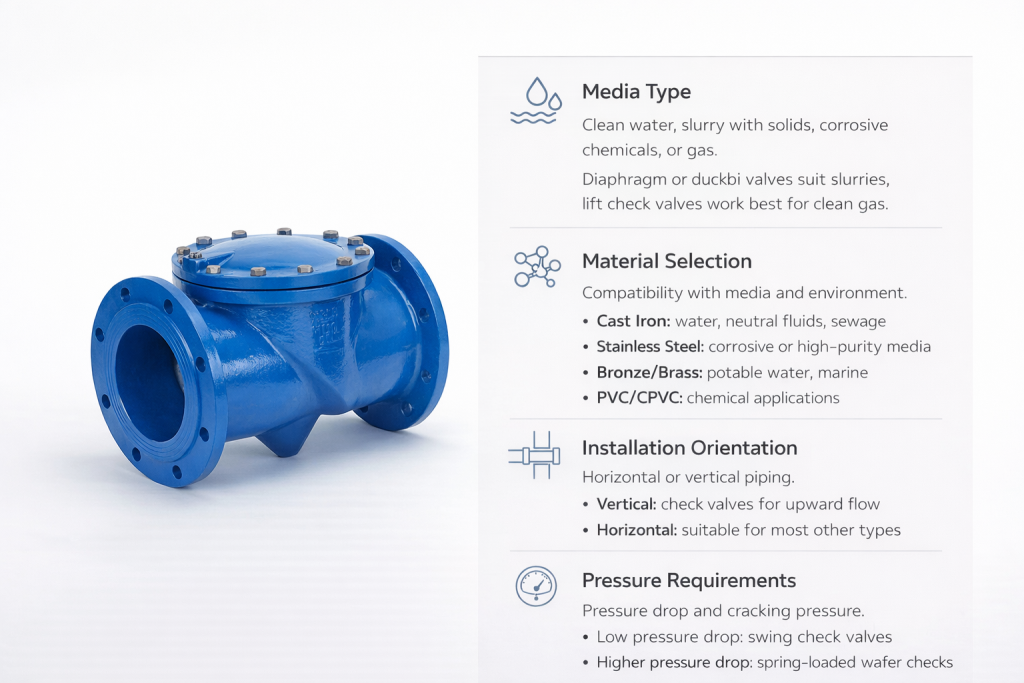
Dive Deeper: A Checklist for Valve Specification
A check valve that is oversized for the flow rate will not open fully, leading it to flutter and chatter, which quickly destroys the valve’s internals. A valve that is undersized will create excessive pressure drop, wasting energy and starving downstream equipment.
معايير الاختيار الرئيسية
- Fluid Characteristics:
- State: Is it a liquid, a gas, or steam? Gas and steam have very low densities and require a valve that can operate with minimal force, like a lightweight swing check or a spring-assisted dual plate.
- النظافة: Does the fluid contain solids or slurries? A standard swing check can handle some solids, but for abrasive slurries, a specialized design like a rubber-flapper check valve might be needed to avoid clogging the hinge mechanism. Lift checks are only suitable for perfectly clean fluids.
- Flow Dynamics & Water Hammer:
- Velocity: High flow velocities create a risk of “slam,” where a valve like a swing check slams shut with incredible force. This creates a pressure wave called water hammer that can rupture pipes and damage equipment.
- الحل: In systems with high flow rates or where pumps stop and start frequently (creating sudden flow reversals), a “non-slam” or “silent” check valve is essential. Dual plate and nozzle-style check valves are specifically designed with springs to close quickly and quietly قبل reverse flow can gain momentum.
- Installation and Maintenance:
- Orientation: Can the valve be installed vertically with downward flow? If so, your options are limited. Only a spring-assisted valve (like a dual plate or nozzle check) will work, as gravity-based swing and lift checks would simply fall open.
- Space & Weight: Are you working in a tight space or on an offshore platform where weight is a premium? A wafer-style dual plate check valve is significantly smaller and lighter than a full-body swing or lift check of the same size.
- Performance Requirements:
- Pressure Drop: How much pressure loss can you tolerate? A swing check offers the lowest pressure drop, making it suitable for low-pressure systems. Lift checks have a high pressure drop and should be avoided unless their tight sealing is absolutely required.
- Sealing Class: Do you need bubble-tight shutoff? A soft-seated valve will provide a Class VI (bubble-tight) seal, while a metal-seated valve will have some allowable leakage (e.g., Class IV).
خاتمة
A non-return valve is your system’s automatic guardian against backflow. By understanding the main types and carefully selecting one based on your specific process conditions, you ensure the safety and reliability of your entire operation.
Protect Your System with the Right Check Valve.
Contact our engineers today to discuss your application and find the perfect backflow prevention solution.


 English
 Arabic
 Russian
 French
 Spanish