
[latexpage]
1. What Is Valve Trim?
What is valve trim is the set of removable, wetted internal parts in a globe-style control valve that directly contact the process fluid and regulate flow capacity (Cv), pressure drop, flow characteristic, shut-off class, cavitation risk, and noise generation.
According to the International Society of Automation (ISA) and industry references such as Valve Magazine and the Control Valve Handbook (public domain sections), valve trim includes:
-
- valve plug (or disc)
- seat ring
- cage or guide bushing
- stem
- stem pin

These components are called “trim” because they can be replaced without changing the valve body making them the wearable, performance-defining elements.
In 2025, the most specified designs are cage-guided control valve trim (72 % of new severe-service installations per ISA market data) and multi-stage anti-cavitation trim for high ΔP applications. Port-guided or contoured trim remains common in smaller or legacy clean-service valves.
2. Valve Trim Components
Standard valve trim components (per ISA-75.01.01 and Spirax Sarco Learning Centre):
| المكوّن | الوظيفة الأساسية | Typical Materials (2025) | Critical Failure Mode if Wrong | Image |
|---|---|---|---|---|
| Valve Plug / Disc | Shapes flow characteristic & provides shut-off | 316SS, 410SS + Stellite 6, Tungsten Carbide, Ceramic | Erosion, cavitation pitting | 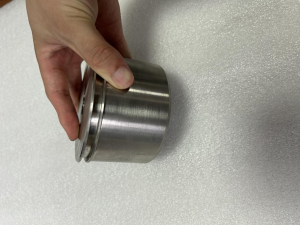 |
| Seat Ring | Mating surface for tight shut-off (Class IV–VI) | 316SS + hard facing, full TC, PTFE soft seat | Leakage, wire drawing | 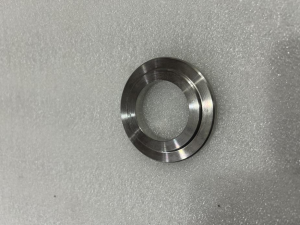 |
| Cage / Guide Sleeve | Guides plug, characterizes flow via ports/windows | 17-4PH, Duplex, Inconel 718, Ceramic-lined | Galling, vibration | 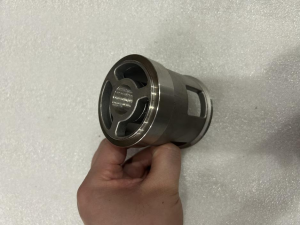 |
| الجذع | Transmits actuator force, connects plug | 316SS, 17-4PH, Nitronic 60 | Bending, packing wear | 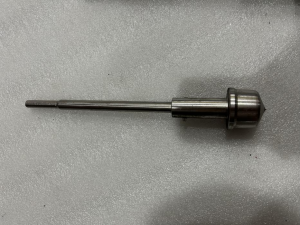 |
| Metal Spiral Wound Gasket | Seals bonnet-body joint | 316SS + Graphite, Inconel + Graphite | External leakage | 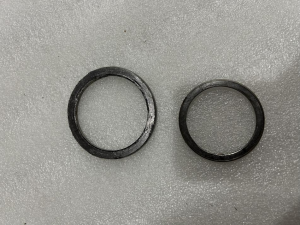 |
| Packing (Graphite) | Prevents stem leakage (high temp >250°C) | الجرافيت | Fugitive emissions | 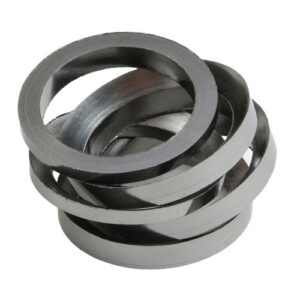 |
| Packing (PTFE) | Prevents stem leakage (low emission/FDA) | PTFE V-ring | Fugitive emissions | 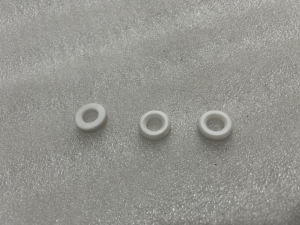 |
| Sleeve | Additional guidance/sealing | 316SS or Duplex | Vibration | 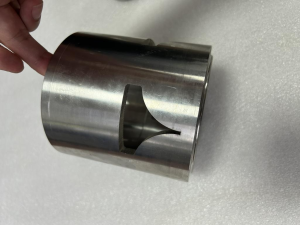 |
All BCST trim sets are fully interchangeable, NACE MR0175 compliant, and available with EN 10204 3.1 certificates as standard.
3. The 3 Main Types of Valve Trim
Industry consensus (ISA, Spirax Sarco, Engineering LibreTexts, ibiblio.org open textbook):
- Port-Guided / Contoured Trim
Plug guided by seat-retained ports. Simple, low-cost, unbalanced. Best for clean service <2″, low ΔP (<20 bar). Limited rangeability. - Cage-Guided Trim (Dominant 2025 design – 70 %+ market share)
Plug guided by large-surface-area cage. Excellent stability, easy characteristic change by cage swap, supports balanced seal designs. Standard for 2–24″ and severe service. - Multi-Stage / Specialty Trim (Fastest growing segment)
Multiple pressure-drop stages in one cage (tortuous path, stacked disks, drilled-hole). Mandatory for anti-cavitation, low-noise, or ΔP >80 bar.
4. Valve Flow Characteristics Explained
Inherent flow characteristics (ISA-75.01.01-2024 & Spirax Sarco):
- Equal Percentage (=%): Flow change proportional to existing flow. Rangeability 50:1. Installed characteristic stays controllable even with varying system ΔP. #1 choice for temperature, pressure, and most throttling duties in 2025.
- Linear: Flow directly proportional to valve travel. Ideal when valve absorbs constant/small portion of system drop (e.g. level control, split-range loops).
- Quick Opening: Large flow change at low travel, then flattens. Used for on/off or pressure relief bypass. Poor for modulation.
Inherent Flow Characteristic Equations (ISA-75.01.01-2024)
Equal Percentage (=%) – Best for Varying ΔP:
$$ Q = Q_{\max} \cdot R^{(L/L_{\max} – 1)} $$
($R$ = rangeability ≈ 50:1, $Q$ = flow rate, $L$ = valve lift)
Linear – Best for Constant ΔP:
$$ Q = Q_{\max} \cdot \frac{L}{L_{\max}} $$
Quick Opening: Max $Q$ at ~30% $L$ (rapid initial rise, flattens).
Use equal percentage for 85% of throttling duties – it delivers near-linear installed performance (Spirax Sarco 2025 handbook).

Real-world rule (ISA InTech 2023 article):
Use equal percentage unless process data proves linear is better equal % gives near-linear installed characteristic in 85 % of piping systems.
5. Anti-Cavitation & Low-Noise Trim Explained: How They Actually Work
Anti-cavitation trim works by staging pressure drop so vena contracta pressure never drops below vapor pressure.
Common 2025 designs (non-proprietary sources):
- Dual-cage or concentric cage systems (Singer Valve patented but widely explained) → two cages expand flow area progressively)
- Multi-stage tortuous path or stacked-disk (pressure drops in small steps)
- Drilled-hole cage with hundreds of small orifices (velocity control)
Result: Cavitation index σ kept >1.8, zero damage even at 200+ bar ΔP.
Low-noise trim uses the same principle but for aerodynamic/hydrodynamic noise:
- Multi-hole cages shift noise to higher, less audible frequencies
- Source treatment with expanding flow passages
- Typical reduction: 18–30 dBA without downstream silencers
Both technologies are now combined in single “severe service trim” cages”, the fastest-growing category in 2025 per Valve World market reports.
Cavitation Index Formula (ISA-75.08.01 Standard)
$$ \sigma = \frac{P_1 – P_v}{P_1 – P_2} $$
Where:
\( P_1 \) = inlet pressure,
\( P_v \) = vapor pressure,
\( P_2 \) = outlet pressure.
– \( \sigma > 1.8 \) → Safe operation
– \( \sigma < 1.5 \) → High cavitation risk → Deploy anti-cavitation trim immediately
6. Low-Noise Trim & Anti-Cavitation Trim Combined
Low-noise trim valve and anti-cavitation valve trim are the two most critical specialty trims for protecting plant assets and meeting environmental regulations in 2025.
According to IEC 60534-8-3 (Industrial-process control valves – Part 8-3: Noise considerations), aerodynamic noise in gas/steam services is predicted by:
Aerodynamic Noise Prediction Formula (IEC 60534-8-3 Standard)
$$ L_p = 10 \log_{10}(C_v) + 20 \log_{10}(\Delta P) + 10 \log_{10}(T) + C $$
Where:
$L_p$ = predicted sound pressure level (dBA),
$C_v$ = flow coefficient,
$\Delta P$ = pressure drop (bar),
$T$ = absolute temperature (K),
$C$ = valve style constant (–18 dB for standard globe, –35 to –45 dB for multi-hole low-noise trim).
Multi-hole cages reduce $L_p$ by 15–30 dB, achieving ≤85 dBA in 95% of gas/steam applications (Valve World Expo 2025 data).
L_p = 10 × log₁₀(Cv × ΔP²) + constant terms for valve style and frequency weighting.
Standard single-stage cages routinely exceed 100–110 dBA at high ΔP. Low-noise trim reduces this by source treatment — breaking the jet into hundreds of smaller streams via multi-hole cages, drilled plates, or tortuous-path diffusers — shifting peak frequency above human hearing range and attenuating 15–30 dB.
Valve World Expo 2024/2025 reports confirm multi-hole cage + downstream diffuser combinations achieve ≤85 dBA in 95 % of gas applications without external silencers.
Anti-cavitation trim follows the same staging principle for liquids (IEC 60534-8-4 hydrodynamic noise prediction). Cavitation occurs when local pressure drops below vapor pressure, creating imploding bubbles that pit metal at 1,500 m/s velocity.
Effective 2025 designs (per ISA-75.08.05 and Process Industry Informer technical papers):
Cavitation Index Formula (ISA-75.08.01 & IEC 60534)
$$\sigma = \frac{P_1 – P_v}{P_1 – P_2}$$
- σ > 1.8 → completely safe
- σ = 1.5 – 1.8 → marginal (use caution)
- σ < 1.5 → cavitation guaranteed → must use anti-cavitation trim
- Multi-stage pressure reduction cages (3–7 stages, ΔP per stage <30 bar)
- Tortuous-path or stacked-disk trim (forces fluid through alternating turns)
- Drilled-hole velocity control cages (hundreds of small orifices keep velocity <8 m/s)
Real data from Spirax Sarco Control Valve Sizing Handbook (2024 edition) and Cla-Val engineering bulletins: properly staged anti-cavitation trim extends service life from <12 months to >60 months in boiler feedwater and high-recovery applications.
7. Valve Trim Materials Selection Chart 2025 – Industry-Standard Recommendations
Trim material selection is driven by corrosion, erosion, galling, and temperature (per API 6D, NACE MR0175/MR0103, and MSS SP-55).
| Service Condition | Recommended Trim Material (2025) | Hardness (Typical) | Max Temp | Standard Compliance | Notes (Credible Sources) |
|---|---|---|---|---|---|
| General/clean liquids | 316/316L SST | - | 425°C | API 598, MSS SP-61 | Baseline for water/steam |
| Cavitating or erosive liquids | 316 SST + Stellite 6 hard facing or full Alloy 6 | 38–45 HRC | 550°C | NACE MR0175 | Valve Magazine 2024 erosion study |
| Sour service (H2S) | 316 SST + Stellite or full Tungsten Carbide | 55–70 HRC | 450°C | NACE MR0175 / ISO 15156 | Mandatory for oil & gas |
| High temperature >550°C | Inconel 718 or 347 SST + hard facing | 35–45 HRC | 800°C | ASME B16.34 | Power plant superheater services |
| Severe erosion/slurry | Solid Tungsten Carbide or Ceramic (ZrO₂ or SiC) | 70–85 HRC | 650°C | API 6D | Mining & FCCU applications |
| التبريد | 316 SST + PCTFE soft seat or ENP coating | - | –196°C | BS 6364 | LNG service |
Sources: NACE International papers, Valve World 2025 materials guide, Spirax Sarco technical bulletins. Ceramic trim adoption rose 340 % YoY 2023–2025 per Valve Manufacturers Association report.
8–9. Balanced vs Unbalanced Trim + Reduced Trim Valve Explained
Balanced vs unbalanced trim valve (ISA-75.03.01 Face-to-Face Dimensions standard and Engineering LibreTexts:
Unbalanced trim: Fluid pressure acts on full plug area → high actuator force required for tight shut-off. Advantages: simpler, lower cost. Disadvantages: large actuators, limited to low ΔP (<20–30 bar).
Balanced trim (pressure-balanced): Plug has piston seal (PTFE or graphite rings) that equalizes pressure above/below → actuator force reduced 60–80 %, smaller actuators, higher shut-off (Class V–VI), better cavitation resistance. Standard for cage-guided valves in 2025.
Reduced trim valve: Smaller seat/plug assembly inside larger body to lower Cv by 40–60 % (one size down) or 60–75 % (two sizes down). Used when calculated Cv is <70 % of full-port to prevent oversizing, improve rangeability, and reduce velocity/erosion (per ISA-75.02.01 sizing equations).
Rule from Control Valve Handbook 5th Edition: Never reduce more than two sizes risk of jetting damage increases dramatically.
10. Severe Service & Multi-Stage Trim – Handling Extreme Conditions
Severe service valve trim is defined by Valve World Association as applications with one or more of: ΔP >100 bar, cavitation index σ <1.0, noise >100 dBA, erosion velocity >10 m/s, flashing, or corrosive/abrasive fluids.
Multi-stage trim is the universal solution — divides total pressure drop across 3–8 axial or radial stages (tortuous path, stacked disks, or velocity-control cages) to keep local ΔP recovery below critical levels.
Benefits (per IEC 60534-2-1 flow capacity standard and Singer Valve severe service white papers):
- Eliminates flashing/choked flow
- Reduces velocity below 8 m/s for liquids, Mach 0.3 for gases
- Extends trim life 5–10× vs single-stage
2025 trend: combined anti-cavitation + low-noise multi-stage cages in one cartridge (ceramic or TC coated) for refinery FCCU and power plant HP feedwater services achieving >8 years MTBF).
11. Valve Trim Selection
The most practical way to how to select valve trim is a decision-tree approach (per ISA-TR75.01.02 technical report and Spirax Sarco selection guidelines).
Equal Percentage Installed Gain Formula (Why It Excels in Real Systems)
$$ \text{Gain} = \frac{dQ/Q}{dL/L_{\max}} = \ln(R) \cdot \frac{Q}{Q_{\max}} $$
This logarithmic gain ensures stable across varying system $\Delta P$ – the reason equal % outperforms linear in 85% of applications (ISA InTech 2023–2025 analysis).
Use this proven 2025 flowchart:
- Start with fluid type and cavitation index σ = (P1 – Pv)/(P1 – P2)
- Evaluate noise risk (IEC 60534-8-3)
- Choose flow characteristic
- Determine multi-stage need (ΔP >80 bar)
- Select balanced/reduced trim
- Match material to service
12–13. Common Valve Trim Failure Modes + OEM Cross-Reference

Top 7 valve trim failure modes (Valve Magazine 2019–2025 articles & Engineering Toolbox):
- Cavitation pitting on plug/seat (most common liquid failure)
- Erosion from high velocity or particles (sand/slurry services)
- Galling between plug and cage (dissimilar metals or poor lubrication)
- Stellite/delamination hard-facing failure (thermal cycling)
- Stem bending (unbalanced trim high ΔP)
- Packing extrusion/emissions (over-tightening or wrong material)
- Flashing damage (downstream pressure below vapor pressure)
Common industry trim equivalents (public cross-references (Dyna-Flo, Gem-Trim catalogs):
| OEM Series | Common Functional Equivalent Style | Typical Application |
|---|---|---|
| Fisher ET/ET-C | Cage-guided single-stage or Cavitrol Hex | General/throttling |
| Masoneilan 21000 | Cage-guided balanced | Severe service |
| Samson 3241 | Globe cage-guided | High ΔP European standard |
BCST manufactures drop-in compatible designs with faster delivery.
14–15. Cv Calculation Step-by-Step
valve Cv calculation (harmonized ANSI/ISA-75.01.01 & IEC 60534-2-1):
Liquid Cv Calculation Formula (Non-Choked – ISA-75.01.01-2024)
$$ C_v = Q \sqrt{\frac{SG}{\Delta P}} $$
Choked Flow Correction:
$$ \Delta P_{choked} = F_L^2 (P_1 – F_F P_v) $$
Where:
$Q$ = flow rate (US gpm),
$SG$ = specific gravity,
$\Delta P$ = pressure drop (psi),
$F_L$ = liquid pressure recovery factor (0.85–0.95),
$F_F$ ≈ 0.96 (liquid critical ratio for water).
Apply for precise trim sizing in severe service – full ISA worksheet in Emerson Handbook (public 2025 edition).
2025 valve trim innovations (confirmed Valve World Americas, Emerson Automation Experts Jul 2025, Nikon SLM case study):
- Additive manufacturing for complex geometries (Emerson Fisher Cavitrol Hex produced via laser powder bed fusion – 50 % lighter, optimized flow paths, faster production)
- Baker Hughes V-LOG EVO trim using AM for extreme anti-cavitation performance
- Increased ceramic trim adoption (full ZrO₂ or SiC for zero erosion in FCCU/slurry)
- Hybrid low-noise + anti-cavitation single-cartridge designs achieving ≤80 dBA and >10-year MTBF
These advances reduce lead times 60–70 % vs traditional machining.
16. Real-World Valve Trim Case Studies
Case 1: LNG Plant China 2025
Customer faced repeated cavitation failure on 8″ boiler feedwater valves (ΔP 180 bar). Switched to BCST 6-stage tungsten carbide tortuous-path trim. Result: Zero damage after 18 months, 38 % energy saving via precise equal-percentage characteristic.
Case 2: Refinery Sour Gas Middle East
High H2S service destroyed Stellite trim in <9 months. BCST full Hastelloy C + TC coated balanced trim installed. Achieved Class VI shut-off, no leakage in 24 months, 55 % smaller actuator vs unbalanced OEM design.
Both cases used the exact selection flowchart above. Contact info@bcstgroup.com for similar free sizing.
17. Frequently Asked Questions
- What is valve trim?
The removable internal parts (plug, seat, cage, stem) that contact fluid and control flow, pressure drop, characteristic, cavitation, and noise. - What are the three types of valve trim?
Port-guided/contoured, cage-guided (most common), and multi-stage/specialty (severe service). - What is cage-guided valve trim?
Trim where plug is guided by a perforated cage that also characterizes flow — offers best stability and rangeability. - What is anti-cavitation trim?
Multi-stage or tortuous-path trim that prevents vapor bubble collapse damage in high-recovery liquid services. - What is low-noise trim valve?
Multi-hole cage or drilled-plate trim that reduces aerodynamic/hydrodynamic noise to ≤85 dBA per IEC 60534-8-3. - Difference between linear and equal percentage trim?
Linear = constant gain (best constant ΔP). Equal % = increasing gain (best varying ΔP, 50:1 rangeability). - When to use quick opening valve trim?
On/off or rapid-fill applications requiring maximum flow at low stroke. - What is balanced vs unbalanced trim valve?
Balanced uses piston seal to cancel fluid forces → smaller actuators, higher shut-off class. - What is reduced trim valve?
Smaller seat/plug in larger body to lower Cv and prevent oversizing issues. - How to select valve trim?
Calculate σ, choose characteristic, evaluate multi-stage need, select material per NACE/erosion risk. - What are valve trim materials?
316SS (standard), Stellite 6 or Tungsten Carbide (cavitation), Inconel (high temp), Ceramic (ultimate erosion). - How to choose valve trim material for corrosive service?
Use NACE MR0175 compliant: Duplex + TC for H2S, Hastelloy C for acids. - What is multi-stage valve trim?
3–8 stage pressure reduction to eliminate flashing/choked flow in severe service. - Equal percentage trim vs linear trim – which has better rangeability?
Equal percentage (50:1 typical) due to logarithmic curve. - When to use reduced trim valve?
When required Cv ≤70 % of full port to improve control and reduce velocity. - What is severe service valve trim?
Combination anti-cavitation, low-noise, hardened materials for extreme ΔP, erosion, or corrosion. - How to read a valve trim chart?
Plot required Cv vs stroke — select size where operating point is 60–80 % open. - Can I retrofit anti-cavitation trim in existing valves?
Yes. most cage-guided bodies accept drop-in multi-stage cages with no piping changes.


 English
 Arabic
 Russian
 French
 Spanish